

- Quick Buy/SellBuy & sell with cards and mobile payments
- P2PTrade with local payments at best prices
- Fiat DepositDeposit in BRL, COP, EUR, and more
- Global Bank TransferBuy and sell via local banks
- MEXC CardSpend your crypto worldwide
- SpotBuy and sell crypto with ease
- RealStocksTrade top US equities directly with crypto
- ConvertSwap hot tokens instantly with 0 fees
- Pre-MarketGet in early before official listings
- MX ZoneUnlock exclusive perks with MX
- Spot DCASteady growth through ups and downs
- Spot GridBuy low and sell high 24/7
- Meme+Discover on-chain gems early
- On-ChainYour unified hub for discovering, trading, and managing on-chain assets
- USDT-MPerpetual Futures settled in USDT
- USDC-MPerpetual Futures settled in USDC
- USD1-MPerpetual Futures settled in USD1
- Coin-MPerpetual Futures settled in other cryptos
- Futures EarnEarn up to 20% APR on your Futures funds
- AI StrategyConvert ideas into strategic action
- Grid TradingCapture volatility with automated trading
- Copy Trade × AIFollow seasoned traders or strategize with AI
- Demo TradingSimulate Futures trading risk-free
- Futures OverviewExplore Futures tools, products, and features
- GOLD Futures24/7 access to top liquidity & leveraged power
- OIL Futures24/7 access to top liquidity & leveraged trading
- SILVER FuturesTrade with 0 fees, top liquidity, and flexible leverage.
- BTC FuturesMarket's lowest fees and high leverage
- ETH FuturesMarket's lowest fees and high leverage
- ZEC Futures SurgeEnjoy 0 fees, up to 150× leverage, and top position capacity at 21×+ leverage
- MEXC EarnEarn high APR on your crypto
- Hold and EarnHold assets and earn interest daily
- Futures EarnEarn on balance and unlock higher APR as you trade
- On-Chain EarnEasy staking. Real on-chain yield
- MEXC LoansBorrow instantly at competitive rates
- Rewards HubGet started with $10,000 in bonuses
- Event CenterHigher rewards, 0 fees
- Invite and EarnInvite friends and earn 140 USDT each
- Anthropic Pre-IPO HeatwaveWin ANTHROPIC(PRE), NVIDIA H200 GPU, and more
- Midterm Market RushTrade TradFi to share $500,000
- LaunchpadAccess top tokens early or at a discount
- $500K TSLA FeverWin TSLAX, TSLAON & more!
- Airdrop+Deposit and trade to claim new airdrops
- KickstarterHold MX to earn new tokens
- RealStocks PNL Rate LeaderboardTrade $100 to win up to $10,000 in stock rewards
- 0 FeesTrade hot futures, enjoy limited 0 fees
- Futures M-DayTrade Futures and claim daily rewards
- Futures Loss Coverage PlanGet triple protection and win $5,000 in XAUT
- Referral ProgramInvite friends and unlock commissions from 40%
- Affiliate ProgramTop-tier affiliate commissions up to 70%
- MEXC VVIPM-Score into Wealth, 10+ Elite Benefits Upgrading
- MEXC × TradingViewConnect MEXC to trade directly on TradingView
- Crypto NewsFollow the latest crypto headlines
- AnnouncementsStay on top of every happening on MEXC
- LearnStrong crypto fundamentals for every beginner
- MEXC InstitutionalTailored solutions for institutional clients
Hyperliquid ShieldTX Launch: How Much Are Copy-Trading Bots Really Costing Traders?
Overview
Avail expanded access to ShieldTX, a privacy-focused trading tool for Hyperliquid, on October 28, 2026, targeting a problem emerging from transparent perpetual futures markets: automated systems can identify successful wallets, monitor their positions, and replicate their trading activity. ShieldTX attempts to reduce this exposure by creating separate wallets for individual positions, making it harder for public observers to connect a trader's broader portfolio with specific transactions. The expanded release remains invitation-based rather than fully open to all users.
The Hyperliquid ShieldTX launch follows research examining 332,317 wallets over a 30-day period. From a smaller sample of seven leading traders and suspected copying accounts, researchers estimated a median additional execution cost of 63 basis points, equivalent to 0.63%. Avail has also suggested that ShieldTX could potentially reduce execution costs by 15–25 basis points, although a controlled comparison demonstrating consistent realized savings has not been publicly established.
These figures describe different measurements and should not be treated as interchangeable. The 63-basis-point estimate is not a standard Hyperliquid trading fee or a platform-wide average, while the suggested savings are not guaranteed.
The more consequential question is whether persistent wallet transparency creates an economic disadvantage for traders whose strategies can be reconstructed by competitors. ShieldTX offers a case study in how transaction privacy may affect execution quality, trading costs, and the competitive structure of decentralized derivatives markets.
Key Takeaways
- ShieldTX expanded invitation-based access on October 28, 2026, using separate wallets to reduce the public linkage of Hyperliquid positions.
- Research involving selected leading traders estimated 63 basis points in median additional execution costs associated with suspected copying activity.
- Avail's proposed 15–25 bps potential saving is not a verified universal improvement.
- ShieldTX reduces public wallet linkage but does not conceal every position or remove all privacy risks.
- Execution privacy may become increasingly relevant to professional traders, market makers, and funds operating on transparent blockchains.
What Hyperliquid ShieldTX Actually Changes
Hyperliquid's public trading infrastructure allows market participants to observe positions and wallet activity through blockchain explorers and specialized analytics platforms. This transparency helps users independently assess market behavior, but it can also expose valuable information about successful traders. Once a wallet becomes recognizable, observers may track its position direction, asset selection, trading frequency, and changes in exposure. Over time, repeated transactions can reveal elements of an investment strategy, allowing automated systems to respond to the trader's activity without obtaining permission or participating in a formal copy-trading program.
ShieldTX attempts to reduce this information exposure by separating a trader's original funding identity from the wallets used to establish individual positions. Developed by Avail using its Nightshade privacy infrastructure, the service allows traders to maintain a shielded balance while funding separate Hyperliquid wallets for individual positions. Orders continue to execute through Hyperliquid's existing markets, preserving access to the underlying order book rather than creating an independent trading venue. After positions are closed, proceeds can return to the shielded balance. The intended effect is to make it more difficult for outside observers to reconstruct a trader's combined positions through publicly visible funding relationships.
According to figures provided by Avail, private testing involved 75 participants, approximately $50 million in trading volume, and more than 3,800 position wallets. These figures describe testing activity rather than post-launch adoption. In particular, the wallet count does not represent 3,800 independent customers, because the product is designed to create multiple wallets for individual users.
Does ShieldTX Make Hyperliquid Trades Completely Private?
No. ShieldTX does not hide the underlying trades or positions from Hyperliquid's public trading environment. Instead, it attempts to obscure the connection between a trader's funding identity and the position-specific wallets used to interact with the exchange.
The distinction is important because transaction unlinkability is narrower than complete anonymity. A publicly visible position can still be observed and analyzed, and transaction timing or trading behavior may provide clues about relationships between accounts. Certain supporting infrastructure operators also retain access to information unavailable to ordinary public observers. ShieldTX should therefore be evaluated as a tool for reducing identifiable wallet relationships rather than a guarantee that every aspect of a trading strategy becomes invisible.
The 63-Basis-Point Cost of Being Copied
The most significant quantitative finding associated with ShieldTX concerns the estimated cost of trading under persistent public observation. Researchers examined 332,317 Hyperliquid wallets over 30 days and selected seven traders from the platform's top 100. They then investigated approximately 25 suspected copying wallets for each selected trader, looking for accounts that repeatedly entered positions involving the same asset and direction within 60 seconds of the leading trader. The methodology required at least 10 repeated matches before classifying an account as a potential copier.
The study estimated a median additional execution cost of 63 basis points among the selected traders affected by copying activity. This estimate suggests that recognizable trading patterns can coincide with less favorable execution, but it does not establish that every copied trade causes a loss or that 0.63% represents the average cost for all Hyperliquid users. Market volatility, order size, asset liquidity, and changes in order-book depth can influence transaction prices independently of copying behavior. The selected sample also concentrates on highly visible traders whose experiences may differ from those of smaller accounts.
ShieldTX Research: Key Data and Definitions
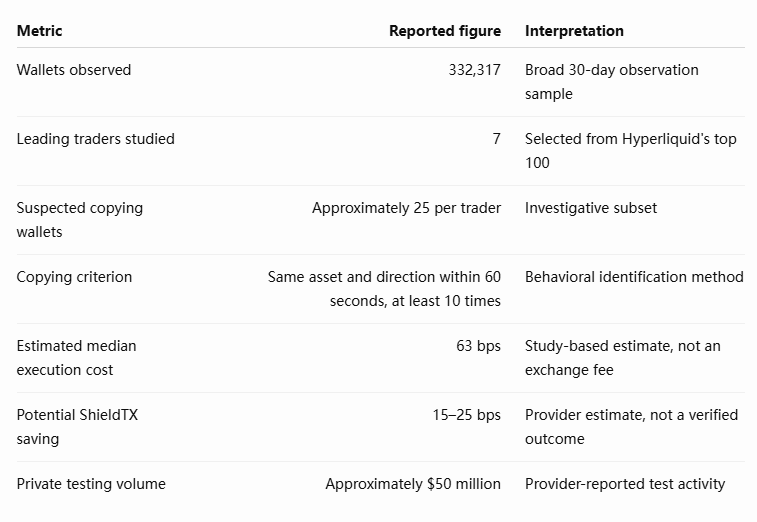
The economic effect becomes clearer when expressed as a hypothetical transaction cost. Applying 63 basis points to $1 million in notional trading volume produces $6,300 of execution-price impact. This is a mathematical illustration rather than a documented loss from an individual trade. Actual execution outcomes depend on order type, position size, timing, and market conditions, while notional exposure should not automatically be treated as realized capital lost.
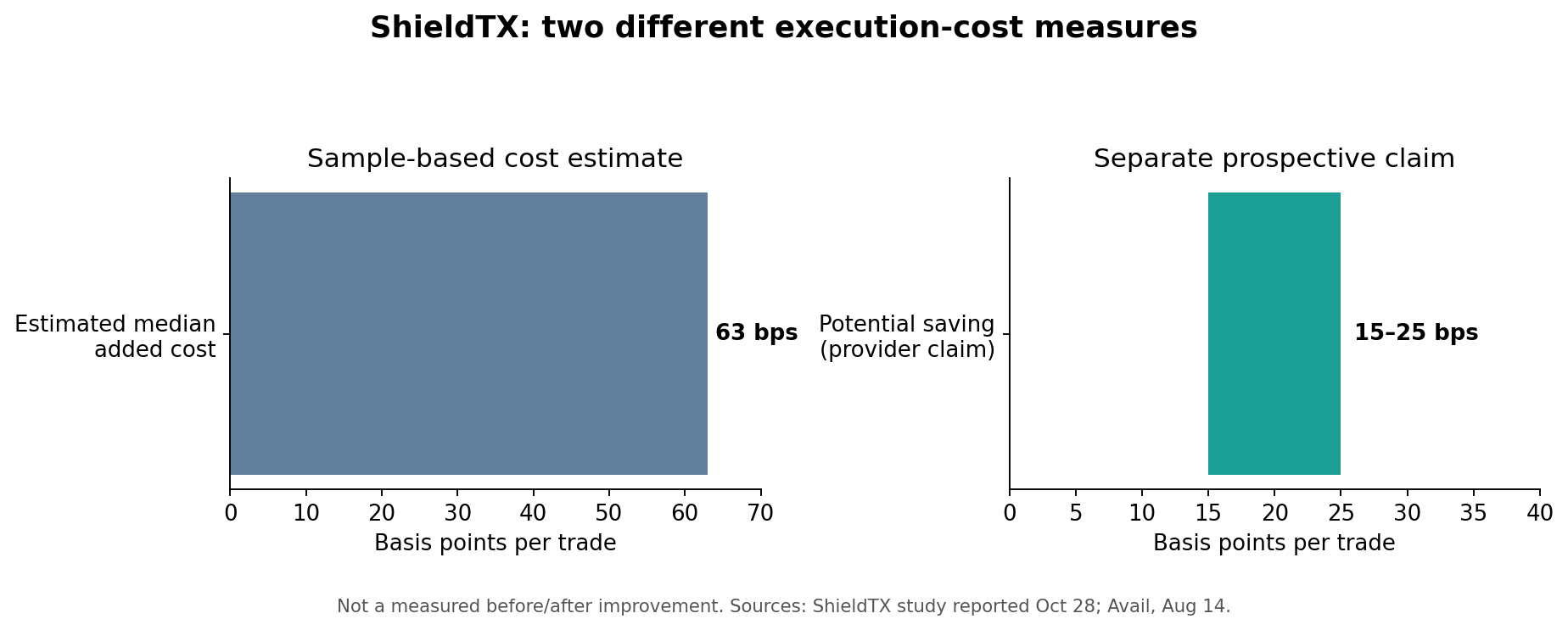
Figure 1. Estimated Execution Cost and Potential ShieldTX Savings
Data note: The 63 bps figure refers to estimated additional execution costs among studied traders. The 15–25 bps range represents Avail's stated potential savings. The two measures are not a verified before-and-after comparison and should not be subtracted to calculate a demonstrated post-ShieldTX cost.
The absence of a controlled before-and-after comparison is particularly important. A credible assessment of the product's economic effectiveness would need to compare similar trades executed under comparable market conditions, controlling for factors such as order size, asset liquidity, volatility, and execution timing. Until that evidence becomes available, ShieldTX's privacy mechanism is more clearly established than the magnitude of any realized cost reduction.
How Copy-Trading Bots Turn Transparency Into Slippage
Copy-trading bots can influence execution conditions when they monitor identifiable accounts and respond quickly to changes in their positions. If a recognizable trader begins building a position, other market participants may place orders in the same direction after observing the activity. Their transactions can consume available liquidity and change the prices at which subsequent orders execute. This is particularly relevant when the original trader uses a sequence of transactions to establish or adjust exposure rather than executing an entire position at once. In such situations, the ability of competitors to anticipate future trading activity may become economically more important than the immediate impact of a single order.
However, following another trader does not always harm the original account. Additional buying after an initial long position, for example, may temporarily move prices in the original trader's favor. The more defensible concern is that public identification can expose strategy information and create unpredictable execution conditions, especially for traders whose order sizes are substantial relative to available market liquidity. The costs may appear through slippage, adverse price movements, or reduced flexibility in managing positions, rather than as an explicit fee imposed by the exchange.
This differs from voluntary copy trading, where a lead trader chooses to make activity available through a platform's own follower system. MEXC's explanation of public and private copy-trading visibility provides an example of how disclosure can be managed within such a service. Hyperliquid's third-party wallet-monitoring activity is structurally different because public transaction information can be analyzed without an invitation from the original trader. ShieldTX targets this involuntary visibility by making persistent wallet identification more difficult.
What Privacy Can—and Cannot—Fix
ShieldTX uses a structure intended to separate deposited capital, wallet funding, and public trading activity. Avail describes Nightshade as privacy-oriented infrastructure supporting shielded balances and position-specific wallet creation. Designated solvers assist with funding the wallets used to trade, while the underlying positions continue to interact with Hyperliquid's execution environment. This arrangement can reduce straightforward wallet-clustering techniques based on shared funding addresses, making it more difficult to associate separate positions with a known trader.
The architecture nevertheless introduces distinct trust and operational considerations. Avail's technical description acknowledges that the current Nightshade sequencer may observe sensitive information, including note preimages and user state. A designated solver also learns the address it is instructed to fund, and the service depends on supporting systems operating reliably. These conditions limit claims that the tool provides complete anonymity or removes every opportunity for transaction analysis.
The relevant trade-off is therefore not simply privacy versus transparency. Traders must evaluate whether reduced public attribution produces enough economic benefit to justify additional technical dependencies, service costs, and operational risks. A privacy tool may improve one aspect of execution while introducing new assumptions about intermediaries and supporting infrastructure. Its value is most convincingly established when both privacy protection and execution outcomes can be measured independently.
MEXC View: Execution Privacy Is Becoming Market Infrastructure
The ShieldTX development illustrates an emerging tension in decentralized derivatives markets. Public transaction records support transparency and independent verification, but the repeated association of identifiable wallets with trading strategies can provide competitors with information that affects execution. For professional traders, the ability to conceal persistent relationships among positions may therefore have measurable financial value rather than serving only a preference for anonymity.
This creates a potential market for infrastructure separating transaction verification from portfolio attribution. Traders could continue benefiting from a public execution environment while reducing the information available to systems attempting to reconstruct their broader positions. The commercial relevance of such tools will depend on their effectiveness against real monitoring techniques, the reliability of their privacy infrastructure, and measurable changes in execution quality.
The longer-term implication is not that decentralized markets should eliminate transparency, but that transparency can be designed at different levels. Financial systems may increasingly distinguish between information needed for market integrity and information that unnecessarily exposes individual trading strategies.
Risks and Limitations
The reported 63-basis-point estimate comes from a limited study of selected leading traders, not a randomized or platform-wide assessment. Suspected copying behavior was identified through transaction patterns, meaning the classification does not independently prove that every identified account was controlled by an automated trading bot.
The principal limitations are:
- Incomplete privacy: Individual positions remain visible, while some supporting infrastructure operators retain access to sensitive information.
- Unverified savings: The potential 15–25 bps benefit has not been established through a published controlled before-and-after study.
- Infrastructure risk: Sequencer operation, solver behavior, smart contracts, and funding arrangements introduce dependencies.
- Restricted access: The October 28 expansion was invitation-based rather than universally available.
These considerations should be evaluated alongside the potential benefits of reducing public wallet attribution.
FAQ
Is ShieldTX an official Hyperliquid privacy feature?
No. ShieldTX is a third-party privacy tool developed by Avail. It uses separate infrastructure to create position-specific wallets and route activity to Hyperliquid's existing markets. It is not a native privacy setting built into Hyperliquid's core trading protocol.
Does ShieldTX guarantee lower trading costs?
No. The provider has suggested potential execution savings, but those estimates are not guaranteed for individual trades. ShieldTX does not eliminate exchange fees, funding payments, or ordinary market impact. Execution quality continues to depend on asset liquidity, order size, volatility, and trading conditions.
Can copy-trading bots still identify ShieldTX users?
Potentially. ShieldTX makes direct public wallet linkage more difficult, but it does not eliminate behavioral analysis or every source of information leakage. Certain infrastructure operators can also access specific transaction details. Its protection is therefore narrower than complete trading anonymity.
Privacy May Protect Trading Strategies, but Cannot Eliminate Slippage
The Hyperliquid ShieldTX launch highlights how persistent wallet identification can become an execution-cost consideration in transparent derivatives markets. Avail's research suggests that successful traders attracting repeated copying activity may experience less favorable execution, with the studied accounts showing an estimated median additional cost of 63 basis points. Although that figure cannot be generalized to every trader, it provides a useful starting point for examining the financial consequences of publicly observable trading strategies.
ShieldTX responds by making the relationship between a trader's funding identity and individual positions less obvious. It preserves access to Hyperliquid's existing execution environment while introducing an additional privacy layer. However, its architecture does not conceal every trade, remove supporting infrastructure risks, or establish a guaranteed reduction in execution costs. The provider's claimed potential savings should remain separate from the research estimate until independent comparative evidence becomes available.
Future evaluation should focus on matched execution comparisons, larger and more representative trading samples, security assessments, and the effectiveness of improved privacy architecture. The most useful measure would be whether traders can achieve better execution under comparable market conditions after reducing identifiable wallet relationships.
The longer-term significance is that transaction unlinkability may become part of professional trading infrastructure. ShieldTX does not demonstrate that greater privacy always produces better execution, but it provides a framework for testing whether protecting strategy information can preserve trading efficiency in transparent markets.
Sources
MEXC internal link used:
https://www.mexc.com/learn/article/copy-trading-guide-for-lead-traders/1
Avail — Why We Built ShieldTX: Private Perp Trading on Hyperliquid:
https://blog.availproject.org/why-we-built-shieldtx-private-perp-trading-on-hyperliquid/
Avail — Inside ShieldTX: The Architecture Enabling Shielded Trading Onchain:
https://blog.availproject.org/inside-shieldtx-the-architecture-enabling-shielded-trading-onchain/
The Block — Avail Launches ShieldTX Privacy Tool, October 28, 2026:
https://www.theblock.co/news/defi/2026-10-28-avail-launches-shieldtx-privacy-tool-targeting-copy-trading-bots-on-hyperliquid-431977
Risk Disclaimer: This article is for reference only and does not constitute investment advice. The cryptocurrency market is highly volatile. Please make decisions cautiously based on your individual circumstances.
More Related News
Stay ahead of the curve with Trending News—your daily pulse on the crypto and traditional finance markets. We cut through the noise to bring you the most critical headlines, macro shifts, and market-moving events as they happen. From breaking regulatory updates to sudden price actions and institutional trends, this is where you'll find real-time insights to keep your trading strategy sharp and informed.
Comments
Only preset comments and emojis can be selected