Cardano activated the Van Rossem hard fork on Saturday, July 18, 2026 at around 21:44 UTC, moving the network to Protocol Version 11 with no downtime beyond a brief block gap.
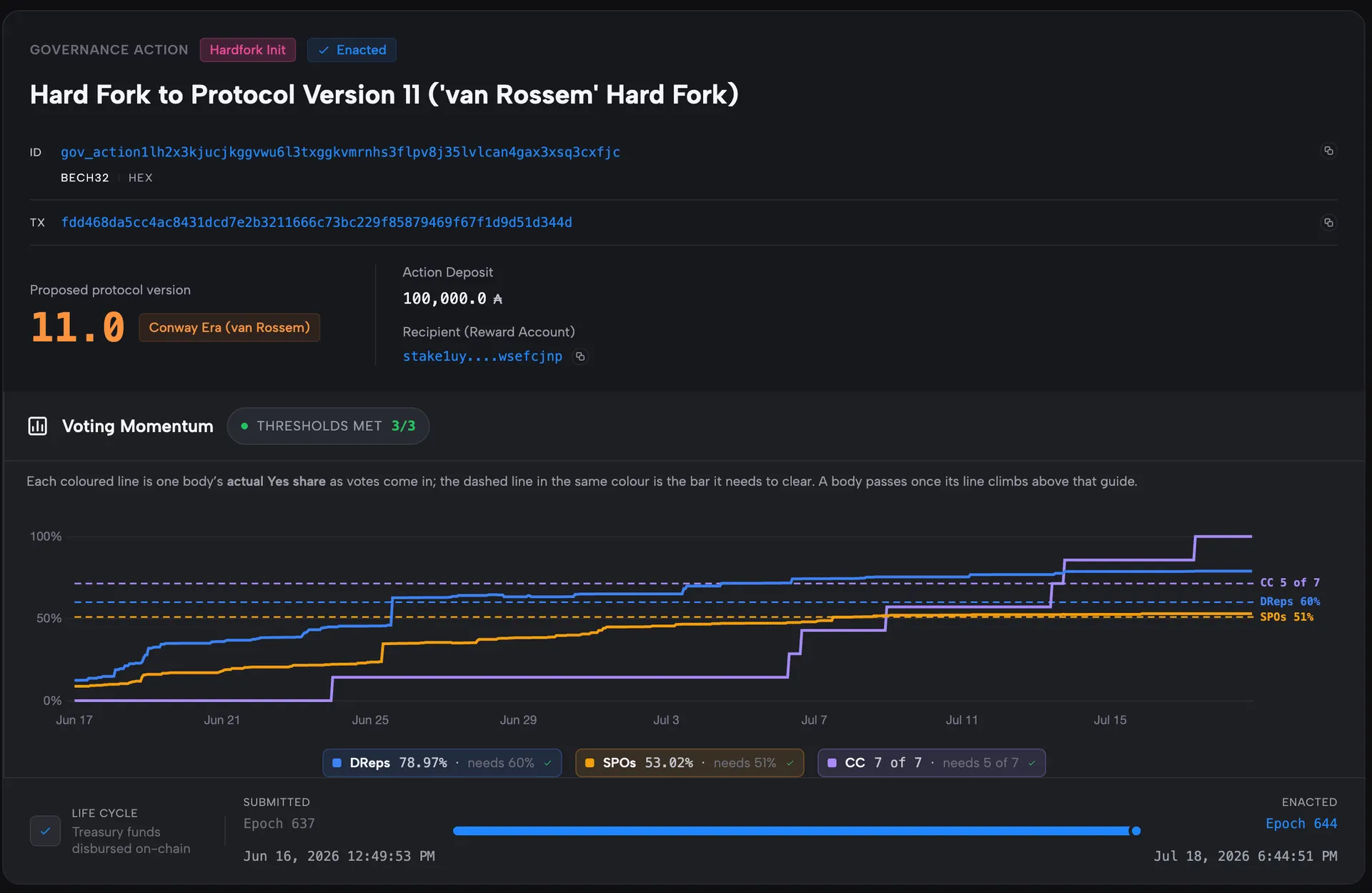
It is the first hard fork in Cardano's history initiated, debated and ratified entirely through onchain governance: delegated representatives voted 77.63% in favor, stake pool operators 52.7%, and the Constitutional Committee approved unanimously.
The upgrade bundles five Cardano Improvement Proposals that make Plutus smart contracts faster and cheaper, add new cryptographic tools, and tighten node security.
Van Rossem lays the groundwork for the upcoming Dijkstra era and the Ouroboros Leios scaling design, which targets more than 1,000 transactions per second with a mainnet rollout planned before the end of 2026.
Cardano (ADA) trades near $0.165 with a muted immediate reaction, but wallets holding between 100,000 and 100 million ADA have grown their balances to the highest level since 2023.
What Happened: Cardano's First Fully Onchain Governed Upgrade
Cardano crossed a milestone years in the making over the weekend. The Van Rossem hard fork was enacted on mainnet on July 18 at approximately 21:44:51 UTC, upgrading the network from Protocol Version 10 to Version 11. The transition was smooth, with only a brief block gap of around ten minutes and no disruption to users, wallets or holdings.
What makes this upgrade historic is not the code but the process. Every previous Cardano hard fork was coordinated top down by the network's founding entities, chiefly Input Output. Van Rossem was instead initiated, debated and ratified entirely through the onchain governance framework introduced in the Voltaire era. Three bodies had to sign off: delegated representatives, who voted 77.63% in favor, stake pool operators at 52.7% support, and the Constitutional Committee, which approved unanimously. Ratification landed on July 13, with enactment following at the epoch boundary five days later.
The upgrade's name carries emotional weight for the community. It honors Max van Rossem, a Cardano governance contributor who passed away on January 11, 2026, the same day his son was born.
What Is Inside Protocol Version 11
Van Rossem is an intra era upgrade, meaning it adds capabilities while keeping the ledger inside the current Conway era, which minimizes disruption for wallets, exchanges, stake pool operators and dApps. It packages five Cardano Improvement Proposals. CIP-133 adds multi scalar multiplication over the BLS12-381 curve, enabling verification of many signatures at once, a building block for advanced cryptography such as zero knowledge applications. CIP-138 introduces a native array type for onchain data, and CIP-153 improves the handling of multi asset values.
The upgrade also lowers the execution costs of Plutus
smart contracts and updates cost models, making dApp development on Cardano cheaper. On the security side, stake pools must now use a unique verifiable random function key tied to each pool identity rather than reusing keys across the network, and ledger consistency checks were tightened to keep nodes synchronized as transaction volume grows. Operators needed updated node software to remain in consensus, and major wallets such as Lace shipped compatible releases before activation.
The Road to Leios and the Dijkstra Era
Van Rossem is explicitly a stepping stone. It lays the procedural and technical groundwork for the Dijkstra era, Cardano's next major development phase, headlined by Ouroboros Leios, a redesign of the consensus pipeline targeting more than 1,000 transactions per second. The Leios rollout is planned for mainnet before the close of 2026, and having now proven that the community can ship a hard fork through pure onchain governance, Cardano has a template for delivering it.
ADA Price: Muted Reaction, Accumulating Whales
So far the market has treated the milestone as procedural rather than thesis changing. ADA traded around $0.1646 after the fork, down slightly on the day, while 24 hour trading volume dropped by more than half to roughly $180 million. That fits a familiar pattern in crypto where upgrade activations become sell the news events unless they immediately unlock visible new activity.
The onchain picture is more interesting. Wallets holding between 100,000 and 100 million ADA, the cohort usually described as whales, have pushed their combined balances to the highest level since 2023, accumulating through the event even as shorter term traders positioned bearishly. That divergence between large holders and leveraged traders is worth watching: if cheaper smart contracts start translating into growing DeFi, NFT and real world asset activity on Cardano, the accumulation case strengthens. If usage stays flat, ADA remains a governance success story in search of a demand catalyst, still trading far below its former highs.
What It Means for Traders on MEXC
The immediate takeaway for holders is simple: no action was required, funds were unaffected, and deposits and withdrawals across the ecosystem continued normally around the upgrade. For traders, the setup is a classic post event coil. ADA is compressing near multi year lows with whales accumulating, a scaling catalyst dated for later this year, and sentiment washed out.
Disclaimer: This content is for educational and reference purposes only and does not constitute any investment advice. Digital asset investments carry high risk. Please evaluate carefully and assume full responsibility for your own decisions.