Once one of the largest restaking protocols in the EigenLayer ecosystem, Ether.fi is now entering the most important transformation since its launch. As the restaking narrative failed to meet expectations, the project began placing a bigger bet on the crypto neobank sector.
This led Arthur Hayes to describe Ether.fi as “The Bank of the Future.” But is Ether.fi actually building the bank of the future, or simply betting on another new narrative?
Key Takeaways:
Ether.fi began pivoting toward the crypto neobank sector while restaking was still at its peak, suggesting this was a long-term strategy rather than a reaction to EigenLayer’s decline.
Cash is growing rapidly but has not yet reached break-even, while staking remains the main source of revenue funding the expansion phase.
Its biggest advantage is its $3.3 billion staking platform, providing financial resources and credibility that many other crypto neobanks do not have.
Ether.fi’s success will depend on whether it can bring Cash to break-even and turn Cash Card, lending, and tokenized stocks into a closed financial ecosystem.
1. A Leading Restaking Protocol Moves Into the Neobank Market
At the beginning of 2024,
Ether.fi was impossible to ignore when discussing EigenLayer. At one point, the protocol held around half of all restaked assets across the entire ecosystem, equivalent to more than $6 billion.
From a peak of approximately $18.3 billion in deposits across the entire Liquid Restaking Token sector at the end of 2024, capital gradually began flowing out as point incentives and airdrop expectations faded. EigenLayer itself, now rebranded as EigenCloud, fell from a peak of $22 billion in TVL to around $5.1 billion, representing a 77% decline. CEO Mike Silagadze later openly admitted that restaking was “a little early” relative to actual market demand.
This decline also exposed the weakness of a narrative that depended too heavily on incentives rather than genuine usage demand. Once rewards decreased, users had fewer reasons to keep their capital locked. At the same time, market liquidity and attention began shifting toward new narratives, particularly the explosive memecoin boom on Solana.
What is interesting is that Ether.fi did not wait until everything collapsed before responding. As early as September 2024, when its TVL was still above $9 billion at its peak, the team quietly announced plans for its first Visa Cash Card. This is the key to understanding the broader strategy: the transition toward becoming a neobank took nearly 12 months and was a deliberate move, not a panic reaction after the restaking narrative began to cool.
2. Roadmap Timeline: Four Stages of a Deliberate Pivot
Stage 1 (Q1-Q3 2024): Restaking superstar. TVL grew from zero to $9.4 billion in less than a year. At the same time, the Cash Card was first teased in September 2024, even while the restaking business was still at its peak.
Stage 2 (Q1-Q3 2025): Neobank version 1.0. On April 24, 2025, the Cash Card officially launched in the United States, and the brand repositioned itself as a “DeFi Neobank.” The ETHFI price increased by 150-180% in the week following the launch. Additional features were then introduced, including an iOS app, hotel booking integration with 5% cashback, business cards, and “Borrow Mode,” which allowed users to spend without selling their crypto. By the end of 2025, the number of daily active cards had increased by 475%.
Stage 3 (First half of 2026): Exiting EigenLayer. As the restaking market continued to shrink, Ether.fi took decisive action. weETH was fully converted into a pure LST with no remaining restaking exposure, while weETHs, its separate restaking product on Symbiotic, remained very small at approximately 9,136 tokens. The share of assets restaked through EigenLayer fell from around 50% to below 1%. The project aims to fully remove all EigenPod withdrawal credentials by Q4 2026.
Stage 4 (August 2026): “ether.fi Summer.” On August 13, 2026, the largest update in Ether.fi’s history was launched, transforming its self-custodial app into a “next-generation crypto neobank” built around four core pillars: Cash Card 2.0 with 3-4% cashback depending on the tier and zero FX fees, xStocks for trading tokenized stocks and metals, a dedicated Aave V4 instance on Optimism that enables margin borrowing against an entire portfolio without requiring users to sell their assets, and fiat rails supporting more than 30 currencies.
3. Is Ether.fi Actually Succeeding With Its Neobank Strategy?
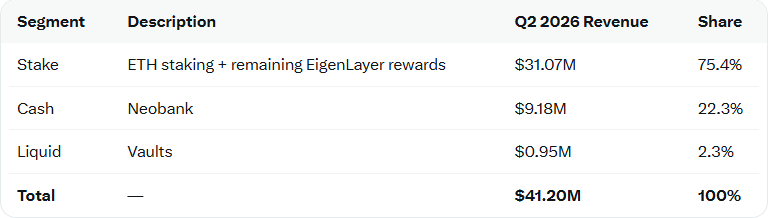
This is the most interesting part, and also the most easily misunderstood. Recently, whenever people talk about Ether.fi, most of the discussion has focused on the project's growing presence in the crypto neobank space. Even Arthur Hayes, former CEO of BitMEX, has publicly shilled Ether.fi as “The Bank of the Future.” However, when looking at Ether.fi’s Q2 2026 report, Stake, which includes ETH staking and the remaining rewards from EigenLayer, still contributed around 75% of the company’s $41.19 million in total revenue. Meanwhile, Cash, the neobank business, accounted for only slightly more than 22%.
However, once cashback is separated out as a cost rather than revenue, the picture changes significantly. Cash Card generated approximately $3.14 million in transaction fees, along with $0.2 million in borrowing interest from Aave, while Ether.fi paid out $5.83 million in cashback to users. In other words, the neobank business is currently operating at a net loss of around $2.5 million per quarter, and it is the more than $30 million in profit from staking that is currently covering this loss.
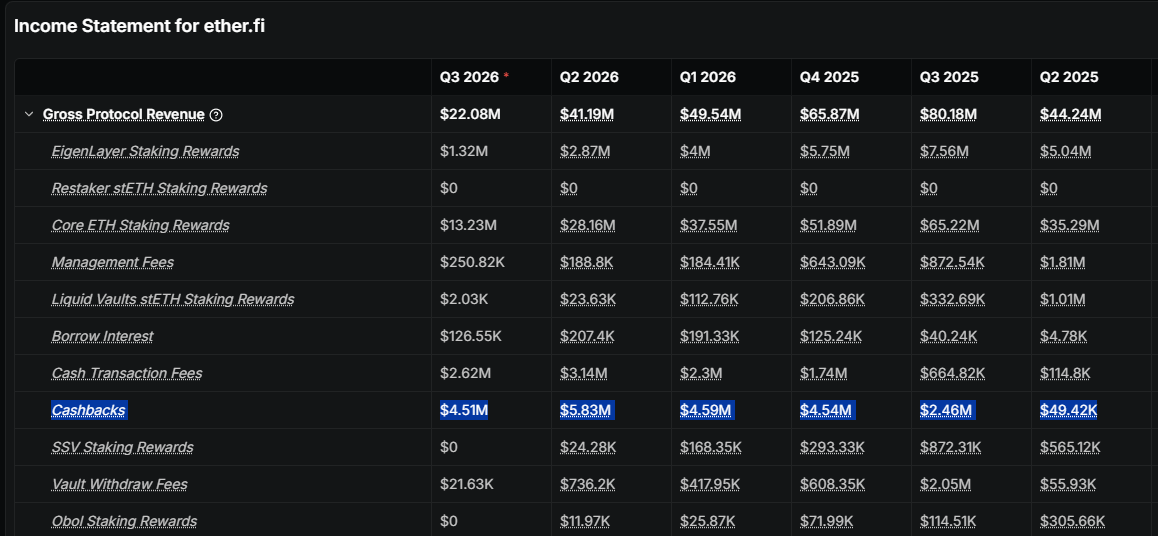
This is not necessarily a sign of failure, but rather a familiar “loss leader” model in fintech: accepting losses during the early stage to acquire users, with the expectation that cashback will gradually decrease as users move to higher tiers and total transaction volume becomes large enough for transaction fees to exceed cashback costs. Based on run-rate data that removes the impact of ETH price volatility, Cash’s share of recurring revenue increased from around 43% at the end of 2025 to 55-57% by mid-2026, surpassing Stake for the first time.
The important difference is that Stake revenue depends directly on the price of ETH. Revenue reached $49.5 million in Q1 but fell to $41.2 million in Q2 largely because ETH declined in price. Cash revenue, on the other hand, is almost unrelated to market volatility, because users will still swipe their cards to buy coffee whether ETH goes up or down.
User growth also shows a clear trend. Monthly on-chain transaction volume increased from around $54 million in January 2026 to more than $100 million in July 2026, while active addresses increased from 21,900 to more than 40,000, representing growth of approximately 85% in just seven months.
4. Why Is Ether.fi Making Such a Big Bet on the Neobank Sector?
The answer can be found in something CEO Mike Silagadze once said: much of the traditional DeFi lending market is like a “meat grinder,” where users enter only to get liquidated and eventually leave. Restaking, by nature, is a commodity product. Anyone can copy it, there are no meaningful switching costs, and users stay primarily for points before disappearing once the incentives end.
A neobank addresses exactly this problem by creating multiple layers of user engagement. A user who uses a Cash Card every day, holds tokenized stocks in their portfolio, borrows on margin through Aave, and locks a portion of ETHFI in a vault to move up membership tiers will find it much harder to leave the ecosystem than someone who simply deposits ETH to earn yield.
At the same time, Ether.fi operates with an extremely lean team of around 30 employees, using blockchain infrastructure to automate much of the settlement process. This helps keep operating costs significantly lower than those of a traditional neobank.
In addition, the rapid
growth of the tokenized stock market, from around $32 million in market capitalization at the beginning of 2025 to more than $3 billion by mid-2026, representing nearly 90x growth in just over a year, has become another important piece of Ether.fi’s strategy. It expands the range of assets that can potentially be used as collateral for margin lending, moving beyond ETH, BTC, and stablecoins toward hundreds of tokenized stocks and ETFs.
Users could hold assets such as NVDAx or SPYx in their wallets, use them as collateral to borrow cash through Aave without selling them, and then spend that cash through the Cash Card. This is the model of a “portfolio as a programmable bank account” that Ether.fi is pursuing.
The biggest drawback is that xStocks are currently unavailable in the United States due to regulatory restrictions, preventing Ether.fi from accessing nearly 40% of its potential market.
5. Why Has No Crypto Neobank Reached a Billion-Dollar Market Cap Yet, and What Makes Ether.fi Different?
Compared with pure DeFi, where Aave, Uniswap, and Lido have all reached market capitalizations ranging from billions to tens of billions of dollars, almost no crypto
neobank has achieved a comparable scale.
The core reason crypto neobanks struggle to reach large valuations is that DeFi is trustless infrastructure. Users only need to trust the code. Neobanks are the opposite. They require something closer to real “bank-level” trust, including institutional credibility, reserve capital, and an operating track record. Few people would want to deposit money into a bank with no capital or reputation.
Ether.fi is a rare exception because it already has a $3.3 billion staking base that can serve as financial support for its neobank ambitions, an advantage that projects such as TRIA or Avici do not yet have. The ETHFI buyback mechanism through smart contracts, with weekly buybacks funded by withdrawal fees and monthly buybacks funded by total protocol revenue, is also relatively uncommon within the crypto neobank sector. Most tokens in this category are primarily governance tokens without a meaningful connection to actual protocol cash flows.
6. Risks and Outlook for the Future
There are three major risk categories worth watching at the moment. First, competition in the crypto card market is becoming increasingly intense, with products such as Coinbase Card, Coca Card, and neobanks like Revolut, while Ether.fi still does not hold a banking license like a fully regulated bank. Second, Stake revenue remains heavily dependent on the price of ETH. If ETH declines sharply while Cash has not yet reached breakeven, profit margins could erode quickly. Third, regulatory risks surrounding xStocks in major markets such as the United States could limit the pace of growth, which is also a broader challenge for the RWA narrative.
Ether.fi is executing one of the more deliberate and long-term pivots in crypto: moving from being one of EigenLayer’s largest restaking participants to building a fintech layer on top of its staking infrastructure. The transition has taken nearly 12 months rather than being a reactive response after the market weakened. The data suggests that the strategy is making progress: Cash has surpassed Stake in terms of run-rate revenue share, users and transaction volume have nearly doubled within half a year, while buybacks continue to operate consistently. The project also sits at the intersection of two major narratives of 2026: RWA and stablecoin payment and neobank infrastructure.
However, this is still a bet that has not been fully proven. The neobank business has yet to reach breakeven and remains dependent on staking revenue, while the pace of user growth and the ability to penetrate major markets will determine its long-term viability.
On the other hand, the rapid development of tokenized stocks could become an important catalyst. If this market continues to expand, Ether.fi could benefit by becoming an interface layer that connects users to a wider range of assets, from ETH to tokenized equities. As crypto and traditional finance increasingly converge, the ability to stake ETH, hold tokenized stocks, borrow, and spend within the same ecosystem could make Ether.fi’s neobank thesis more compelling while expanding the potential for user and revenue growth.
7. Trading ETHFI and the Neobank Sector on MEXC
$ETHFI is listed on MEXC across both spot and futures markets, allowing investors to either accumulate the token for the long term based on the neobank pivot thesis or open derivatives positions to capitalize on short-term volatility around catalysts such as buybacks and product updates.
Beyond ETHFI, MEXC is also one of the exchanges that listed several emerging tokens in the neobank and RWA sector early, including TRIA and AVICI, with relatively liquid trading pairs available.
For those looking to closely track this narrative, the Sector/Trending section on MEXC provides a clear overview of projects within the same category, making it easier to compare their performance in real time.
Conclusion
Ether.fi is no longer simply a restaking project. The protocol is using the resources and user base accumulated during the EigenLayer era to fund a larger ambition: building a crypto neobank that combines staking, payments, lending, and RWA within a single ecosystem. Current data suggests that the new direction is growing, but it has not yet proven that it can stand on its own.
If Cash reaches breakeven and the tokenized stock market continues to expand, ETHFI could become one of the biggest beneficiaries of the convergence between crypto and traditional finance.
Disclaimer: This content does not constitute investment, tax, legal, financial, or accounting advice. MEXC Blog provides this information for educational purposes only. Always do your own research, understand the risks, and invest responsibly.