

Spain vs Argentina Prediction: 2026 World Cup Final Preview, Lineups and Score Forecast

Spain and Argentina meet at New York New Jersey Stadium for the 2026 FIFA World Cup final, bringing together the reigning European champions and the defending world champions.
Spain reached their first World Cup final since lifting the trophy in 2010 by defeating France 2-0 in the semifinal. Argentina secured a second consecutive final after Lionel Messi supplied two late assists in a dramatic 2-1 comeback victory over England.
The final will be played on July 19, 2026, at 15:00 local time in New York and New Jersey. Kickoff is scheduled for 21:00 in Madrid and 16:00 in Buenos Aires. Official match information is available through the FIFA World Cup final preview.
Spain enter with the more controlled recent performance, a midfield capable of dominating possession and several dangerous one-on-one attackers. Argentina offer greater experience in close knockout matches, Messi’s creativity and a proven ability to recover after falling behind.
Our prediction gives Spain a narrow advantage, but Argentina’s resilience and experience make this a low-to-moderate-confidence selection.
Fans can review the available outcomes through the Spain vs Argentina prediction market on MEXC.
Summary
Spain vs Argentina is the 2026 FIFA World Cup final.
Spain are attempting to win their second World Cup after their 2010 triumph. Argentina are trying to retain the title they won in 2022 and become the first country since Brazil in 1962 to win consecutive men’s World Cups.
Spain reached the final through disciplined possession, coordinated pressing and midfield control. Argentina’s route was more dramatic, with several comeback victories and decisive contributions from Messi.
| Match information | Details |
|---|---|
| Match | Spain vs Argentina |
| Competition | FIFA World Cup 2026 |
| Stage | Final |
| Date | July 19, 2026 |
| New York kickoff | 3:00 p.m. ET |
| Madrid kickoff | 9:00 p.m. |
| Buenos Aires kickoff | 4:00 p.m. |
| Venue | New York New Jersey Stadium |
| Spain semifinal | Defeated France 2-0 |
| Argentina semifinal | Defeated England 2-1 |
| Predicted champion | Spain |
| 90-minute score prediction | Spain 1-1 Argentina |
| Final score scenario | Spain 2-1 after extra time |
| Confidence | Low to moderate |
How Spain Reached the 2026 World Cup Final
Spain’s knockout-stage route combined defensive discipline with increasingly convincing performances:
- Round of 32: Spain 3-0 Austria
- Round of 16: Spain 1-0 Portugal
- Quarterfinal: Spain 2-1 Belgium
- Semifinal: Spain 2-0 France
Spain controlled the semifinal against France through aggressive pressing and intelligent positioning. Mikel Oyarzabal opened the scoring from the penalty spot before Pedro Porro added the second goal.
France entered that match with one of the tournament’s strongest attacks, but Spain restricted them to two shots on target. Rodri and Fabián Ruiz controlled central areas, while Spain’s defensive structure limited Kylian Mbappé’s opportunities in transition.
The victory returned Spain to the World Cup final for the first time since 2010.
Spain Team Preview
Spain’s greatest strength is their ability to control where the match is played.
Rodri provides positional discipline in front of the defense, while Fabián Ruiz and Dani Olmo can receive between the lines and move possession into attacking areas.
FIFA has highlighted Rodri, Fabián and Olmo as a major reason Spain reached the final. Their positioning allows Spain to maintain possession without losing protection against counterattacks.
On the right, Lamine Yamal can isolate defenders and create chances through dribbling, crossing or shots from the edge of the area. Pedro Porro’s overlapping runs give Argentina another movement to track.
Mikel Oyarzabal offers intelligent movement through the centre, while Álex Baena and other attacking midfielders can move into the spaces created by Yamal.
Spain’s Main Strengths
Spain’s midfield structure is their clearest advantage.
Rodri can control the tempo and prevent Argentina from attacking immediately after turnovers. Fabián Ruiz provides ball progression, while Olmo can move into advanced positions around Argentina’s midfielders.
Spain also press as a coordinated unit. Against France, their forwards and midfielders reduced the time available to Mbappé and France’s central creators.
Their width is another important weapon. Yamal can stretch Argentina’s left side, while Marc Cucurella and Pedro Porro can support attacks from the full-back positions.
Spain’s Main Concerns
Spain must avoid giving Messi space between midfield and defense.
Their full-backs are encouraged to advance, but that movement can leave open channels if possession is lost. Argentina will look for Messi, Julián Álvarez or Lautaro Martínez before Spain can recover their defensive shape.
Player fitness is another factor. Yamal and Porro trained separately from the main squad during preparations in New Jersey. Spain described the sessions as precautionary and expected both players to be available, but Porro has been managing a minor hamstring issue while Yamal has had bruising and soreness.
How Argentina Reached the 2026 World Cup Final
Argentina’s knockout route required more recovery and late-game resilience:
- Round of 32: Argentina 3-2 Cape Verde
- Round of 16: Argentina 3-2 Egypt
- Quarterfinal: Argentina 3-1 Switzerland after extra time
- Semifinal: Argentina 2-1 England
Argentina trailed England after Anthony Gordon scored in the semifinal. Messi then created the equalizer for Enzo Fernández before supplying the cross for Lautaro Martínez’s stoppage-time winner.
The performance reflected a broader pattern. Argentina also recovered from difficult positions against Cape Verde, Egypt and Switzerland.
Messi described the team’s resilience as the result of unity and confidence developed over several tournaments.
Argentina Team Preview
Argentina continue to build around Lionel Messi, even though his role has changed with age.
At 39, Messi no longer presses or covers distance like a traditional winger. Instead, he conserves energy, moves into areas where he can receive facing goal and waits for the correct moment to accelerate the attack.
He enters the final with eight goals at the tournament and 21 career World Cup goals. His two semifinal assists also extended his record as one of the competition’s most productive creators.
Enzo Fernández, Alexis Mac Allister, Rodrigo De Paul and Leandro Paredes provide the midfield work around him. Julián Álvarez offers movement behind defenders, while Lautaro Martínez remains a major option from the bench or starting lineup.
At the other end, Emiliano Martínez gives Argentina an experienced goalkeeper with a strong record in high-pressure knockout situations.
Argentina’s Main Strengths
Argentina’s greatest strength is their ability to remain competitive when a match is moving against them.
They do not need complete territorial control to create decisive moments. Messi can produce a pass that changes the game, while Enzo Fernández and Mac Allister can arrive late around the penalty area.
Argentina are also comfortable changing their attacking structure. Messi can play centrally or drift toward the right, Álvarez can attack the space behind defenders, and Lautaro can provide a more direct penalty-area presence.
Their experience is significant. Several players were part of the 2022 title-winning squad and understand the pressure of a World Cup final.
Argentina’s Main Concerns
Argentina have conceded in every knockout match.
Spain’s pressing may create problems if Argentina attempt to play slowly through their defensive line. Enzo, Paredes and Mac Allister must receive under pressure without allowing Spain to recover possession near the penalty area.
Argentina must also manage Yamal’s one-on-one threat. Nicolás Tagliafico may require support from a midfielder or winger, which could leave additional space for Porro or Olmo.
Messi’s workload is another consideration. He remains highly influential, but Spain may attempt to make him defend and repeatedly change direction in midfield.
Possible Spain vs Argentina Lineups
These are predicted lineups rather than confirmed starting elevens.
| Position | Spain | Argentina |
|---|---|---|
| Goalkeeper | Unai Simón | Emiliano Martínez |
| Right-back | Pedro Porro | Nahuel Molina |
| Centre-back | Pau Cubarsí | Cristian Romero |
| Centre-back | Aymeric Laporte | Lisandro Martínez |
| Left-back | Marc Cucurella | Nicolás Tagliafico |
| Defensive midfield | Rodri | Leandro Paredes |
| Central midfield | Fabián Ruiz | Enzo Fernández |
| Central midfield | Dani Olmo | Alexis Mac Allister |
| Right attack | Lamine Yamal | Giuliano Simeone |
| Left/central attack | Álex Baena | Lionel Messi |
| Striker | Mikel Oyarzabal | Julián Álvarez |
Spain used an unchanged lineup against France after also starting the same core group in the quarterfinal. Argentina made only one change for the semifinal against England, indicating that both coaches may prefer continuity.
Argentina could use Rodrigo De Paul as an additional midfielder, while Lautaro Martínez’s winning goal against England strengthens his case for a larger role.
Final lineups should be confirmed through the FIFA Match Centre before kickoff.
Latest Injury and Fitness News
Lamine Yamal
Yamal trained separately as part of a precautionary workload-management plan.
Reports indicate that he has minor bruising and soreness rather than a serious new injury. Spain expect him to be fit for the final.
Pedro Porro
Porro has been managing a minor hamstring issue but is also expected to be available.
His participation is important because of the balance he creates with Yamal on Spain’s right side. Porro also scored and was named the leading performer in Spain’s semifinal victory.
Lionel Messi
Messi recovered from a muscle strain earlier in the tournament and has completed all four knockout matches.
Argentina coach Lionel Scaloni has praised his physical preparation and described his form at 39 as unsurprising. There is currently no indication that he will miss the final.
Messi vs Lamine Yamal
The final presents one of international football’s most compelling generational comparisons.
Messi is playing in his sixth World Cup and attempting to win a second consecutive title. Yamal, now 19, is appearing in his first World Cup final after growing up admiring the former Barcelona star.
Their roles are different.
Messi creates from central and right-sided positions, often waiting between midfield and defense before accelerating play. Yamal stays wider, attacks defenders directly and helps Spain stretch the field.
Argentina may ask Tagliafico and Mac Allister to work together against Yamal. Spain could use Laporte and Rodri to block Messi’s passing lanes.
FIFA has identified three major final matchups:
- Aymeric Laporte vs Lionel Messi
- Rodri vs Enzo Fernández
- Lamine Yamal vs Nicolás Tagliafico
Key Tactical Battles
Rodri vs Argentina’s Midfield
Rodri must control the centre without allowing Messi to receive behind him.
Argentina may use Enzo and Mac Allister to draw Rodri away from his preferred position before finding Messi in the resulting space.
Yamal vs Tagliafico
Yamal will try to isolate Tagliafico and attack with his left foot.
Argentina must decide whether to offer immediate support or trust the full-back in one-on-one situations. Additional defensive support may leave Porro free to overlap.
Messi vs Laporte and Cubarsí
Spain’s centre-backs should avoid following Messi too far into midfield.
Rodri may need to close him first, allowing Laporte and Cubarsí to protect the space behind them.
Spain’s Press vs Argentina’s Experience
Spain will attempt to recover the ball high up the field.
Argentina must remain calm and avoid forcing passes through crowded central areas. Emiliano Martínez may use longer distribution when Spain’s press becomes too aggressive.
Set Pieces
Argentina have strong aerial targets through Romero, Lisandro Martínez, Álvarez and Lautaro.
Spain can respond with Laporte, Cubarsí, Rodri and Oyarzabal. One corner or free kick may be enough to decide a final expected to contain long cautious periods.
Spain vs Argentina Head-to-Head Context
Spain and Argentina have a long international history, but they have rarely met in matches with consequences as significant as a World Cup final.
Their previous meetings include friendlies, World Cup fixtures and the broader rivalry between European and South American champions.
FIFA’s official Spain vs Argentina head-to-head guide provides the full historical record.
Historical results offer context, but the current teams differ considerably from earlier versions. Spain’s present identity is built around Rodri and Yamal, while Argentina’s remains connected to Messi and the experienced core that won in 2022.
Spain vs Argentina Prediction
Our predicted champion is Spain.
Spain produced the stronger semifinal performance and appear better equipped to control the midfield. Their pressing could force Argentina into turnovers, while Yamal and Porro may create an advantage on the right side.
Argentina’s experience prevents this from being a high-confidence selection. Messi can change the game with one pass, and the defending champions have repeatedly recovered from losing positions.
The most likely scenario is a cautious opening followed by a more open second half.
| Prediction category | Selection |
|---|---|
| Predicted champion | Spain |
| 90-minute result | Draw |
| 90-minute score | Spain 1-1 Argentina |
| Final score scenario | Spain 2-1 after extra time |
| Both teams to score | Possible |
| Extra-time probability | Medium |
| Penalty-shootout probability | Low to medium |
| Confidence | Low to moderate |
| Spain’s main advantage | Midfield control and pressing |
| Argentina’s main advantage | Messi, experience and resilience |
Final prediction: Spain to defeat Argentina after extra time and win the 2026 World Cup.
Can the Final Go to Extra Time and Penalties?
Yes.
If Spain and Argentina are level after 90 minutes, the final proceeds to two 15-minute periods of extra time.
If the score remains level, the champion is decided by a penalty shootout.
Users should carefully review the MEXC market rules to confirm whether a specific outcome is settled according to:
- the score after 90 minutes;
- the result after extra time;
- or the team that officially lifts the trophy.
How to Participate in Spain vs Argentina on MEXC
- Open the Spain vs Argentina prediction market on MEXC.
- Review the available outcomes and current market prices.
- Check the market closing time.
- Read the settlement conditions carefully.
- Confirm whether extra time and penalties are included.
- Review the official starting lineups.
- Select the outcome matching your analysis.
- Enter the amount and review the order before confirming.
Market prices may change as participants react to injuries, lineup announcements and other team news.
A market price represents current participant expectations and does not guarantee a particular result.
Recommended Reading
- Spain vs Argentina Prediction Market on MEXC
- FIFA Spain vs Argentina Final Preview
- FIFA’s Three Key Spain vs Argentina Duels
- France vs England Third-Place Playoff Prediction
Frequently Asked Questions
When Is Spain vs Argentina?
The World Cup final takes place on July 19, 2026. Kickoff is at 3:00 p.m. ET, 9:00 p.m. in Madrid and 4:00 p.m. in Buenos Aires.
Where Is the World Cup Final Being Played?
The match will be played at New York New Jersey Stadium in East Rutherford, New Jersey.
Who Is Expected to Win?
Spain are our narrow favorite because of their midfield control, pressing and strong semifinal performance.
What Is the Predicted Score?
Our 90-minute prediction is 1-1. We predict Spain to win 2-1 after extra time.
Will Lionel Messi Play?
Messi is expected to start. There is currently no indication that he is unavailable for the final.
Will Lamine Yamal Play?
Spain expect Yamal to be fit despite his separate precautionary training session.
Can Argentina Win Consecutive World Cups?
Yes. Argentina are the defending champions and would become the first country since Brazil in 1962 to retain the men’s World Cup.
Has Spain Won the World Cup Before?
Yes. Spain won their first and only previous World Cup in 2010.
Can the Match Go to Penalties?
Yes. A penalty shootout will decide the champion if the teams remain level after extra time.
Where Can I Participate in the Prediction?
The match is available through the Spain vs Argentina prediction market on MEXC.
Risk Notice
This article is provided for informational and entertainment purposes only. Sports predictions are uncertain and do not guarantee any result or financial return.
Starting lineups, injuries, weather conditions, tactics and player availability may change before kickoff. Users should independently review official match information, MEXC settlement rules, eligibility requirements and regional restrictions before participating.
Description:Crypto Pulse is powered by AI and public sources to bring you the hottest token trends instantly. For expert insights and in-depth analysis, visit MEXC Learn.
The articles shared on this page are sourced from public platforms and are provided for reference only. They do not represent the position or views of MEXC. All rights belong to James Mitchell. If you believe any content infringes upon the rights of a third party, please contact [email protected] for prompt removal. MEXC does not guarantee the accuracy, completeness, or timeliness of any content and is not responsible for any actions taken based on the information provided. The content does not constitute financial, legal, or other professional advice, nor should it be interpreted as a recommendation or endorsement by MEXC. For expert insights and in-depth analysis, visit MEXC Learn.
Latest Updates on Cash Cat
View More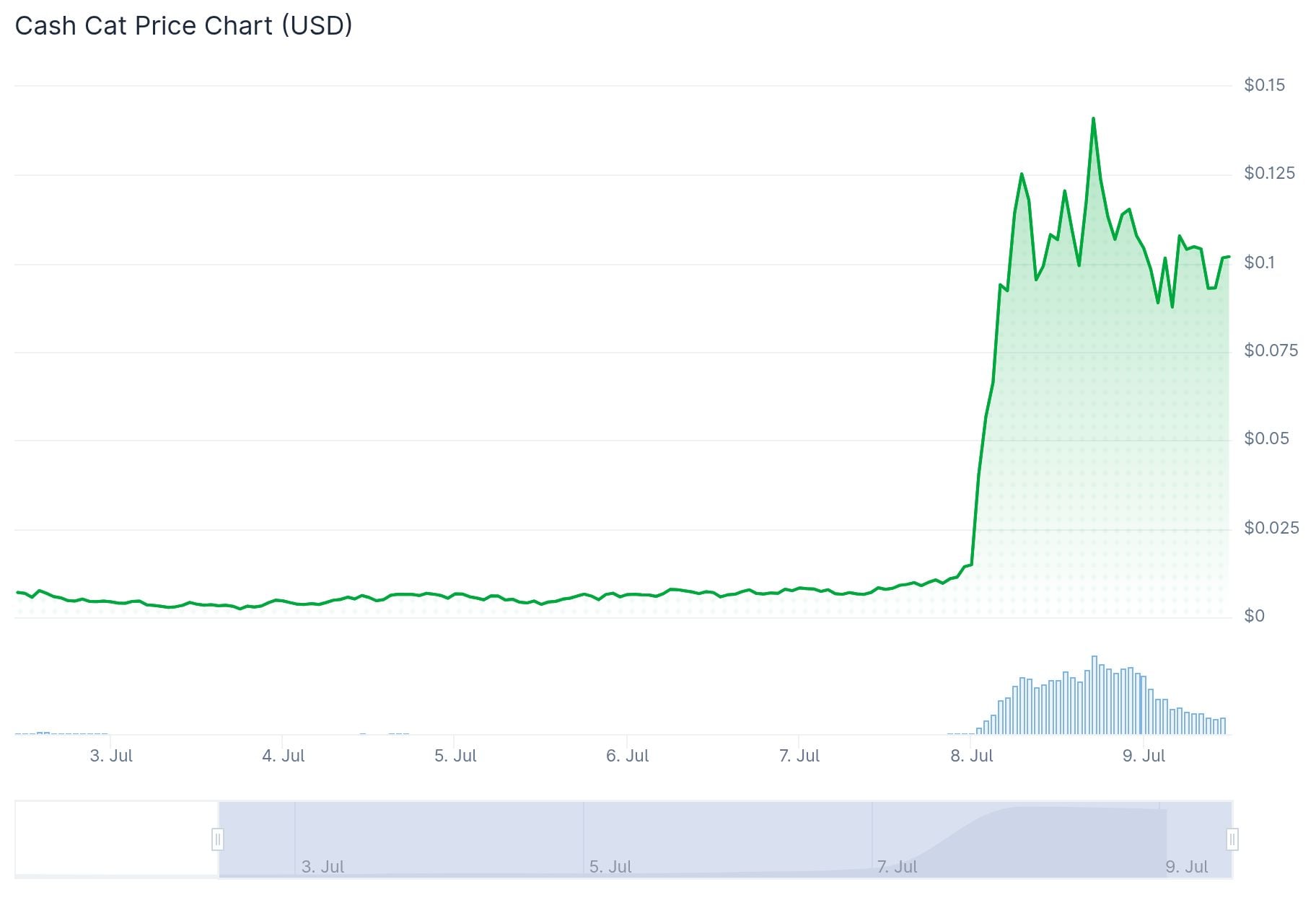
Cash Cat (CASHCAT) Price: Why the Robinhood Chain Meme Coin Jumped Over 1,400% in 24 Hours
Cash Cat (CASHCAT) Explodes Over 1,400% as Robinhood Chain Meme Token Goes Viral
$560 Million Record: CashCat Coin Takes Over Robinhood; Hyperliquid Joins XRP in Bitwise 10 Crypto Index; 105,742,020% in Bitcoin: Satoshi-Era Whale Awakens - Morning Crypto Report
HOT
Currently trending cryptocurrencies that are gaining significant market attention
Crypto Prices
The cryptocurrencies with the highest trading volume
Newly Added
Recently listed cryptocurrencies that are available for trading