


What is Bitcoin Mining? (Explained for Beginners)
BTC mining is the computational process that powers the proof-of-work Bitcoin network, securing transactions and generating new bitcoins. Unlike traditional currencies issued by central banks, Bitcoin relies on a decentralized network of miners who contribute their computing power to validate BTC transactions and maintain the blockchain's integrity.
This process began in 2009, when Satoshi Nakamoto launched the Bitcoin network with a vision to create a decentralized financial system free from centralized control. The Bitcoin mining process fundamentally involves solving complex mathematical puzzles using the SHA-256 hashing algorithm to achieve consensus across the network.
For newcomers to the crypto space, understanding BTC mining is essential as it explains how this digital asset maintains its scarcity, security, and decentralization and continues to function without centralized oversight.
How Bitcoin Consensus Works to Keep Your Funds Safe
At its core, BTC operates on a Proof of Work (PoW) consensus mechanism, which serves as the foundational protocol governing how the Bitcoin network reaches agreement on the state of the blockchain. This mechanism ensures that all participants in the Bitcoin network can trust the validity of transactions without requiring a central authority.
Bitcoin's implementation of Proof of Work is distinctive because it provides enhanced security through mathematical proofs and economic incentives. The network achieves this through a process where Bitcoin miners compete to solve cryptographic puzzles by finding a valid hash below a target value, using a variable called a nonce.
This approach effectively prevents double-spending and 51% attacks by requiring attackers to control an economically unfeasible amount of computing power. Compared to other cryptocurrencies that use alternative mechanisms, Bitcoin's consensus model offers robust security and true decentralization.
Mining Economics: Is Bitcoin Mining Profitable?
The economic foundation of BTC mining revolves around a carefully designed incentive structure that rewards participants for securing the network while maintaining token scarcity. Miners currently receive 3.125 BTC per block (as of the latest halving), with additional rewards coming from transaction fees included in each block.
This Bitcoin reward undergoes halving events every four years to control inflation, with the next significant change expected in 2028. Profitability in Bitcoin mining depends on several critical factors, including electricity costs, hardware efficiency, network difficulty, and Bitcoin market price.
For those considering entering Bitcoin mining, the choice between solo mining and joining mining pools presents a significant decision point. Mining pools provide consistent BTC rewards and reduced variance at the cost of pool fees and reduced maximum potential earnings, while solo mining offers maximum rewards and no shared fees but requires substantial initial investment and technical expertise.
Current ROI calculations suggest that Bitcoin miners can expect to break even within 12-24 months under current market conditions, though this varies significantly based on individual operational efficiency.
Hardware & Software: What You Need to Mine Bitcoin
Successfully mining BTC requires specific hardware and software setups tailored to the network's SHA-256 hashing algorithm. For hardware, Bitcoin miners typically need ASIC miners (Application-Specific Integrated Circuits) with high processing power and efficient cooling to remain competitive. Popular Bitcoin mining equipment includes the Antminer S19 Pro and WhatsMiner M30S, with initial investments ranging from $2,000 to $10,000 depending on scale and efficiency goals.
On the software side, BTC miners require mining software such as CGMiner or BFGMiner, which provide essential features like performance monitoring and payout management. Setting up a Bitcoin mining operation involves several critical steps, including hardware assembly, software configuration, wallet setup, and pool connection or solo mining preparation.
Energy consumption represents a significant ongoing cost, with an average Bitcoin mining setup consuming approximately 3,000–4,000 kWh per month, resulting in monthly electricity costs of $300–$600 at average utility rates. Bitcoin miners should also consider cooling requirements, noise levels, and space constraints when planning their operations.
Can't Mine? Trade Bitcoin on MEXC Instead
Mining BTC offers a unique way to participate in this secure and decentralized network through its Proof of Work mechanism. Want to get involved with Bitcoin without mining equipment? Our 'Bitcoin Trading Complete Guide' covers everything you need to know to start trading BTC immediately. Begin your Bitcoin learning journey today on MEXC with industry-leading security and competitive fees.
Description:Crypto Pulse is powered by AI and public sources to bring you the hottest token trends instantly. For expert insights and in-depth analysis, visit MEXC Learn.
The articles shared on this page are sourced from public platforms and are provided for reference only. They do not represent the position or views of MEXC. All rights belong to MEXC. If you believe any content infringes upon the rights of a third party, please contact [email protected] for prompt removal. MEXC does not guarantee the accuracy, completeness, or timeliness of any content and is not responsible for any actions taken based on the information provided. The content does not constitute financial, legal, or other professional advice, nor should it be interpreted as a recommendation or endorsement by MEXC. For expert insights and in-depth analysis, visit MEXC Learn.
Learn More About Bitcoin
View More
Bitcoin Future: What It Is, How It Works, and Where BTC Is Headed

The Stefan Thomas IronKey: 7,002 Bitcoin, a Lost Password, and Two Attempts Left

What Is the Bitcoin Formula? Mining Profitability, Difficulty, and Supply Explained
Latest Updates on Bitcoin
View More
Crypto Market Update - 5 June 2026: ETF Outflow Streak Breaks as BTC Tests $62K
Grayscale flags Strategy BTC sale as pressure point, calls for new buyer cohorts
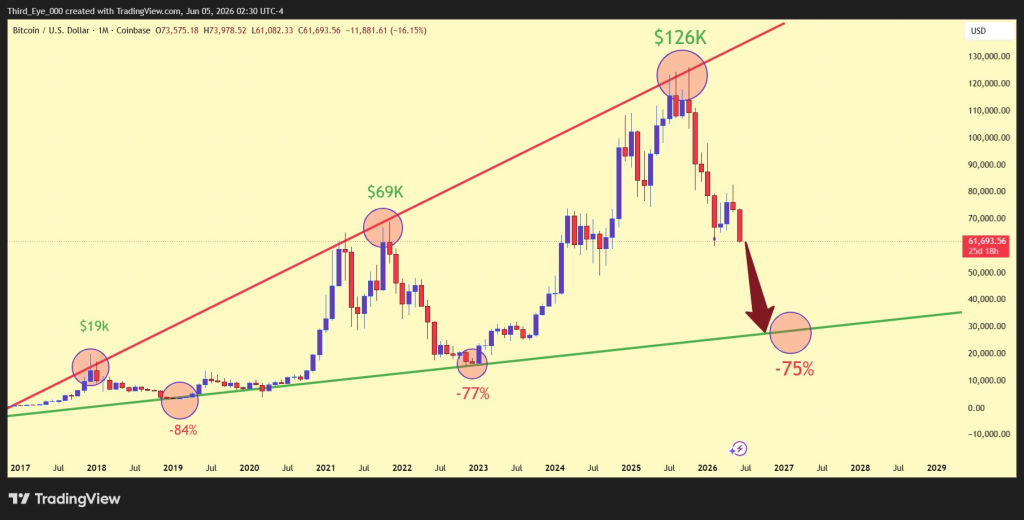
Bitcoin (BTC) Price Crash Isn’t Over: Why a Dip to $30K Is Becoming Increasingly Likely


HOT
Currently trending cryptocurrencies that are gaining significant market attention
Crypto Prices
The cryptocurrencies with the highest trading volume
Newly Added
Recently listed cryptocurrencies that are available for trading