Overview
Global computing infrastructure and enterprise technology hardware provider
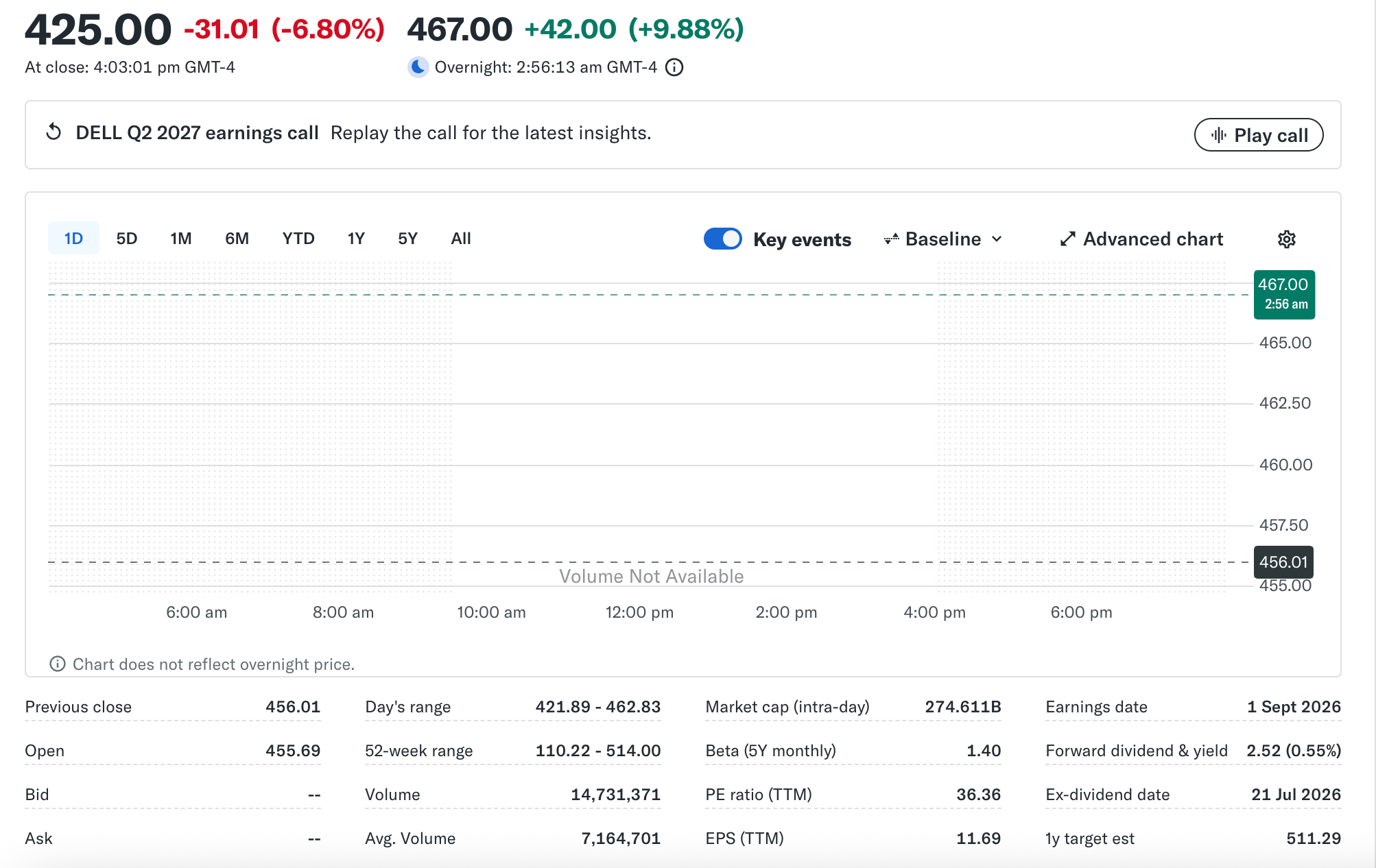
Dell Technologies experienced severe secondary market selling pressure following the release of its quarterly financial disclosures, with its share price sliding sharply lower in post-earnings trading to significantly underperform broad market benchmarks. Despite confirming that trailing twelve-month artificial intelligence server bookings exceeded $130 billion and reporting an unprecedented backlog approaching the hundred-billion-dollar milestone, the market executed an aggressive institutional de-risking maneuver. According to reporting from
Reuters, the structural breakdown fueling the equity decline was not top-line revenue velocity, but a sharp contraction in underlying gross margins driven by high-cost server components, stagnant demand across enterprise client personal computers, and aggressive sell-the-news profit-taking following an extended pre-earnings run-up. Because high-density AI servers function primarily as pass-through component integration with rigid manufacturing cost profiles, surging multi-billion-dollar booking numbers amplified concerns regarding profitless prosperity, prompting institutional allocators to discount Dell's forward cash conversion potential.
Key Takeaways
Massive hardware bookings failed to offset persistent margin erosion as cumulative trailing twelve-month AI server orders topped $130 billion, yet rapid dilution across gross margin percentages triggered aggressive equity selling.
Operating margins within the Infrastructure Solutions Group faced structural dilution due to aggressive competitive bidding for sovereign compute and tier-one hyperscaler clusters, preventing segment operating profits from expanding in line with top-line growth.
Client Solutions Group revenue stagnation weighed on enterprise cash generation as corporate enterprise PC refresh cycles remained delayed, leaving historical high-margin commercial desktop and laptop segments in defensive posture.
Buy-the-rumor sell-the-news dynamics penalized elevated equity valuations after substantial year-to-date appreciation pushed buy-side whisper expectations to extreme levels, making minor margin compressions an immediate catalyst for momentum liquidation.
Working capital requirements expanded significantly as carrying high-cost processor inventory and advanced memory components to service the unfilled backlog tied up operational cash flows, dampening near-term capital distribution expectations.
The Profitless Prosperity Dilemma: Why 130 Billion in Orders Triggered an Institutional Selloff
In public equity markets, rapid expansion in booked contract volume does not automatically produce equivalent shareholder returns, a reality demonstrated in Dell's granular financial statements.
Low-Margin Pass-Through Reality Behind Massive Bookings
According to operational disclosures registered via the
Dell Technologies Investor Relations portal, while unfulfilled AI server backlogs reached an unprecedented $95 billion, these compute-heavy rack solutions represent capital-intensive hardware assembly. In a modern high-density compute rack, upstream processor accelerators, dense memory modules, and specialized networking fabrics account for the overwhelming majority of total manufacturing costs. Analytical research published by
Bloomberg indicates that hardware system integrators possess limited pricing leverage when negotiating against sophisticated cloud hyperscalers or tier-one research labs, ensuring that surging rack shipments dilute overall corporate gross margins.
Operating Margin Misses Prompt Systematic Portfolio Rebalancing
Ahead of the earnings disclosure, institutional desks positioned portfolios around expectations of expanding operating leverage, anticipating that manufacturing scale within the Infrastructure Solutions Group (ISG) would generate substantial margin expansion. Instead, operating profit margins expanded at an exceptionally shallow rate, with certain hardware categories yielding margins inferior to legacy software-defined storage. For long-term institutional asset allocators relying on discounted cash flow modeling, structural margin compression impaired multi-year free cash flow projections, causing systematic strategies and fundamental funds to initiate immediate de-grossing procedures.
Sluggish Core Segments: Delayed Enterprise PC Cycles Anchor Cash Flow Generation
Compounding hardware margin dilution within AI servers, Dell's legacy operational foundation continues to navigate cyclical stagnation.
Client Solutions Group Encounters Persistent Top-Line Resistance
Within Dell's overarching enterprise architecture, the Client Solutions Group (CSG), which encompasses commercial laptops, corporate desktop workstations, and peripherals, historically functioned as the primary cash flow generator for the corporation. Detailed industry analysis from
The Wall Street Journal underscores that elevated corporate borrowing costs and tight non-AI enterprise IT budgets prompted multinational corporations to extend standard hardware replacement cycles. Despite extensive semiconductor marketing regarding next-generation AI PC platforms, business software ecosystems have yet to deliver clear productivity use cases, encouraging corporate procurement officers to defer fleet modernization and leaving CSG segment turnover flat.
Internal Financial Imbalance Constrains Operating Leverage
When low-margin, capital-intensive AI server shipments expand to represent a dominant percentage of gross revenue while legacy high-margin commercial PC cash flows plateau, corporate financial structures experience severe distortion. The gross margins generated by traditional commercial hardware are insufficient to absorb the expanding operating expenses and component financing required to maintain rapid AI infrastructure scaling, producing a widening divergence between headline contract bookings and net operating income.
Exhaustion of Pre-Earnings Momentum: The Mechanics of the Post-Earnings Decline
Examining market microstructure confirms that Dell's post-earnings decline reflected a predictable unwind of crowded speculative positioning.
High Valuation Multiples Faced Zero Margin for Error
Filings accessible through the
U.S. Securities and Exchange Commission database show that Dell equity experienced aggressive appreciation leading into the earnings report, with forward price-to-earnings multiples expanding beyond historical ranges toward software-like valuations. This expanded multiple was predicated on management delivering not merely record bookings, but immediate gross margin expansion and upgraded free cash flow conversion rates. When reported numbers failed to validate these aggressive assumptions, the multiple collapsed back toward traditional hardware manufacturing ranges.
Derivatives Gamma Unwinds and Systematic Selling Escalation
Across equity options markets, heavy retail and institutional accumulation of out-of-the-money call options heading into the print forced market makers to maintain substantial long equity delta hedges. Following the initial negative price reaction, implied volatility collapsed, causing call open interest to rapidly liquidate. Market makers unwound long underlying equity hedges into secondary markets, amplifying initial post-market losses into an aggressive regular-session decline.
Navigating hardware valuation resets and trading cross-asset technology cycles requires access to flexible, high-liquidity execution platforms.
Furthermore, trading volume data on
MEXC indicates sustained liquidity and cross-market participation across equities-linked digital assets during major technology earnings corrections.
Supply Chain Realities: Memory Inflation and Working Capital Lockup
Evaluating Dell's future order fulfillment highlights structural headwinds originating from upstream component supply chains.
Because frontier artificial intelligence models require massive data throughput, advanced servers require dense configurations of High Bandwidth Memory (HBM) and enterprise solid-state storage. Industry research from the
Financial Times illustrates that upstream memory manufacturers, including
Micron Technology and
SK Hynix, have pre-sold their advanced production lines and increased wholesale component pricing. As a downstream system assembler navigating between memory suppliers and compute silicon designer
Nvidia, Dell faces rigid procurement costs that limit its ability to capture residual hardware profits.
Balance Sheet Inventory Expansion Damps Cash Conversion
An unfulfilled order backlog of $95 billion requires extensive working capital deployment. To ensure timely cluster assembly, Dell must commit substantial liquidity to procure components months before customer delivery and final commercial acceptance. This working capital intensity extends inventory holding periods, immobilizing balance sheet liquidity that would otherwise support share repurchases or dividend distributions, prompting concern among defensive institutional allocators.
Competitive Pricing Friction Against Supermicro and Hardware Peers
Intensifying competition across the enterprise hardware landscape continues to cap potential gross margin recovery.
Across North American and global enterprise procurement channels, agile original equipment manufacturers like Super Micro Computer continue deploying aggressive pricing strategies to defend market share. To maintain customer relationships across Fortune 500 accounts and sovereign infrastructure programs, Dell is frequently forced to provide aggressive volume discounting on complete rack solutions. This competitive dynamic transforms the broader compute hardware boom into a margin-dilutive volume race for downstream system assemblers.
Market participants analyzing Dell's path toward valuation stabilization should monitor several forward operational variables:
Infrastructure Solutions Group gross and operating margins over the subsequent two reporting periods, confirming whether component pass-through pricing effectively offsets memory cost inflation.
Year-over-year revenue trajectory within the Client Solutions Group, tracking whether commercial enterprise desktop and laptop purchasing achieves positive inflection.
Backlog conversion velocity and inventory turnover, verifying that utility interconnect bottlenecks and physical data center construction delays do not force deferred revenue recognition.
Exclusive View from James Mitchell
From a quantitative market structure and liquidity perspective, Dell's post-earnings decline despite $130 billion in AI server bookings represents a necessary correction of an unsustainable multiple expansion.
Market participants frequently make the mistake of conflating hardware contract backlogs with durable economic moats, assigning software-like valuation multiples to low-margin system integration businesses. In foundational corporate finance, enterprise value is determined by the duration and magnitude of discounted free cash flows rather than unadjusted top-line gross revenue. When a company acts primarily as an assembly intermediary between upstream silicon monopolists and downstream cloud hyperscalers while financing expensive component inventories, its business model remains fundamentally cyclical. Analyzing options volatility skews and institutional dealer positioning reveals that sophisticated funds utilized the pre-earnings momentum to execute distribution, exploiting headline booking numbers as exit liquidity. For professional derivative traders and cross-asset allocators, this selloff eliminates ungrounded speculative premiums. The critical forward indicator to monitor is not the nominal dollar volume of new booking press releases, but the precise moment Infrastructure Solutions Group operating margins demonstrate sustainable sequential expansion above the ten percent threshold.
FAQ
Why did Dell stock fall sharply despite reporting 130 billion in AI server orders?
The stock fell because surging AI server revenue diluted corporate gross margins. While gross orders reached historical highs, these servers carry high component costs that limit profit retention. Concurrently, high-margin commercial PC demand remained sluggish, prompting institutional investors to take profits after a substantial pre-earnings advance.
What caused the compression in Dell corporate gross margins?
Gross margin compression was driven by the changing product mix. Advanced AI servers require expensive graphic processing units, high-bandwidth memory, and specialized liquid cooling components that account for the bulk of the selling price, leaving thin assembly margins compared to proprietary software-defined storage or commercial PCs.
What challenges is Dell facing in its commercial PC division?
The Client Solutions Group is navigating restrained corporate IT budgets and delayed hardware replacement cycles. While industry marketing emphasizes AI PC platforms, enterprises have not identified clear operational productivity gains, leading corporate IT departments to postpone fleet modernization.
How does a 95 billion dollar order backlog affect corporate working capital?
Servicing a massive backlog requires deploying significant capital to procure expensive processing chips and memory inventory well before customer delivery and final invoice settlement. This operational dynamic locks up substantial cash flow in inventory, reducing near-term free cash flow available for share repurchases.
How does competition with Supermicro impact Dell hardware pricing?
Specialized competitors like Supermicro frequently utilize aggressive pricing models to secure footprint within major data center deployments. To maintain market share across tier-one enterprise accounts, Dell must offer competitive pricing, capping industry-wide margins on server integration.
What key financial metrics should investors track to identify a valuation bottom?
Investors should monitor operating margins within the Infrastructure Solutions Group, revenue growth inflection across commercial enterprise PCs, working capital efficiency reflected in inventory turnover days, and the durability of free cash flow conversion rates across future fiscal quarters.
Disclaimer
The information, analysis, and views contained in this article are provided for general educational and informational purposes only and do not constitute financial advice, investment advice, legal advice, tax advice, or a recommendation to buy or sell any security, digital asset, or financial derivative. Equity securities and financial instruments are subject to high market volatility and capital risk. Past operational performance, financial results, and quantitative indicators do not guarantee future market returns. Investors must conduct independent due diligence and evaluate their personal financial situation, risk tolerance, and investment goals before executing any trade. The MEXC Crypto Pulse team assumes no liability for any direct or indirect financial losses resulting from the use of or reliance upon the information published herein.
About the Author
James Mitchell specializes in technical analysis, market trends, and trading strategies for both Bitcoin and altcoins. Based in London, he has over 10 years of experience in financial markets. Before joining MEXC Learn, James worked as a senior analyst at a leading European investment firm, where he developed expertise in risk management and quantitative trading. His transition to cryptocurrency markets began in 2017, and he has since become recognized for his data-driven approach. He holds a Master's degree in Financial Economics from the London School of Economics. His analytical approach combines traditional technical analysis with on-chain metrics to provide readers with actionable insights. Areas of expertise include technical analysis, market trends and cycles, trading strategies, Bitcoin and altcoin analysis, and risk management.
Research References