Overview
Global electric vehicle and artificial intelligence pioneer
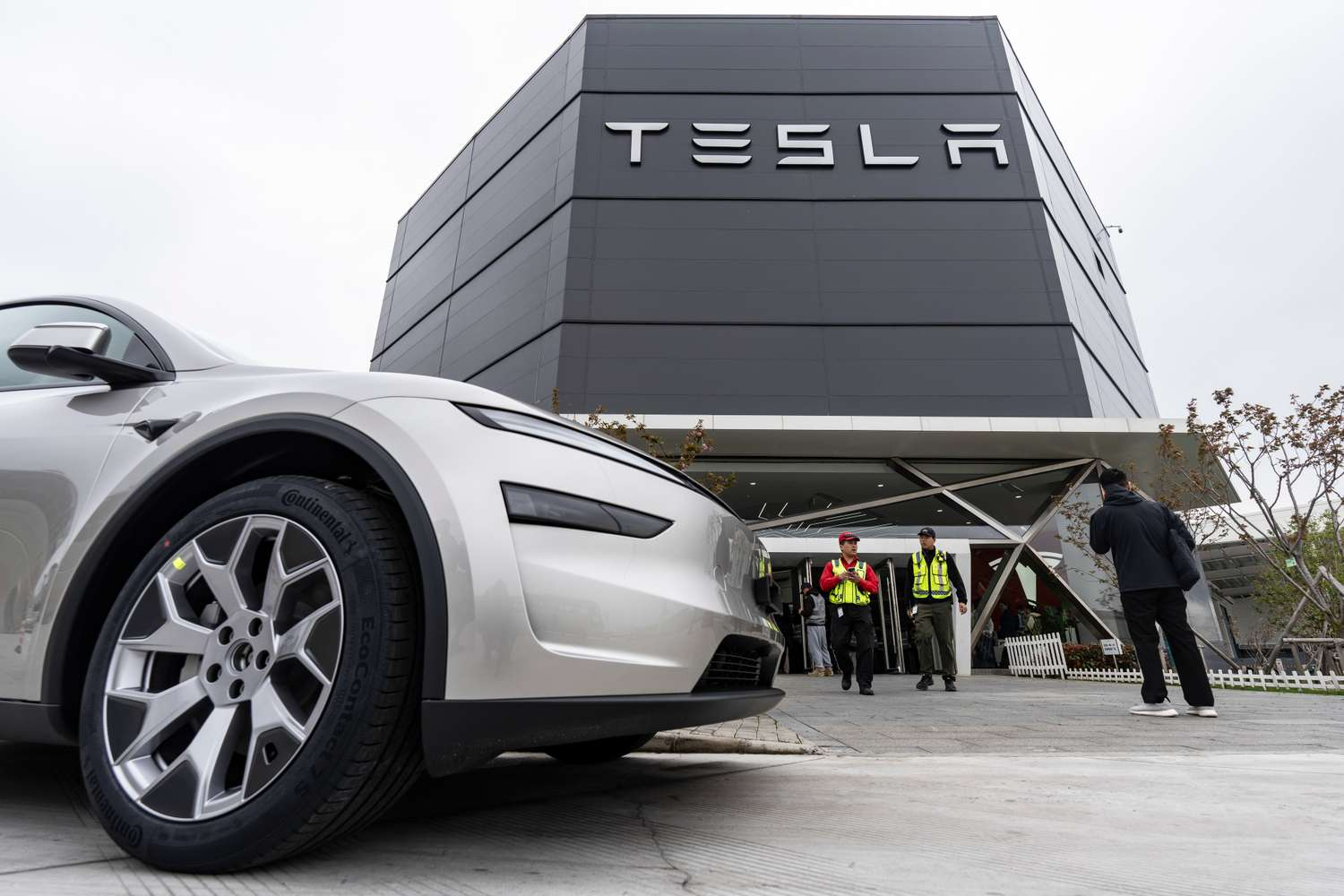
Tesla (NASDAQ: TSLA) staged a sharp upward breakout across secondary equity markets, surging more than 5% intraday to touch $367.95 and marking its strongest closing valuation in several weeks while leading gains across the benchmark S&P 500 index. The primary catalyst driving the aggressive capital allocation is heightened market anticipation surrounding the commercial rollout event for the purpose-built Cybercab at Gigafactory Texas, coupled with significant real-world capability demonstrations across the latest end-to-end neural network iterations of Full Self-Driving (FSD). With Giga Texas actively ramping engineering validation and pilot manufacturing for the steering-wheel-free autonomous vehicle, Tesla's transition from a pure-play automotive manufacturer into an autonomous mobility and software platform is moving toward tangible commercialization. According to financial analysis from
Bloomberg, this progress has reinforced institutional conviction regarding long-term autonomous ride-hailing cash flows, encouraging a broad wave of short covering and strategic portfolio accumulation among multi-asset fund managers.
Key Takeaways
Tesla equity decoupled from broader equity market weakness, surging over 5% on trading volume more than forty percent above its three-month moving average to clear major technical resistance.
The commercial deployment of the Cybercab is advancing into operational phases, with purpose-built test fleets at Gigafactory Texas completing public road validation ahead of formal integration into commercial ride-hailing networks.
End-to-end neural network architecture delivers structural performance gains for Full Self-Driving, utilizing massive real-world fleet training data to compress intervention rates across complex urban navigation environments.
Extreme manufacturing and operational cost optimization allows the Cybercab to achieve an estimated operating cost between $0.21 and $0.25 per mile, driven by a two-seat configuration, a 35 kWh battery pack, and Cell-to-Chassis structural engineering.
Wall Street valuation frameworks are systematically transitioning from automotive manufacturing metrics toward high-margin recurring software and autonomous mobility fleet cash flow streams.
Amid broader macroeconomic crosscurrents, fluctuating Treasury yields, and volatile crude oil markets that pressured major benchmark indices, Tesla shares mounted a distinct upward advance across the
Nasdaq.
According to equity trading metrics compiled by
Reuters, aggregate trading volume in Tesla common stock surpassed 60 million shares, exceeding the 90-day average by roughly forty-six percent. Aggressive institutional bids cleared resting supply near the $366 technical pivot point, propelling the stock to settle at $367.95 and expanding its monthly valuation recovery to more than 18%.
The velocity of the advance illustrates institutional positioning ahead of tangible commercial execution. Unlike speculative momentum cycles driven purely by forward-looking commentary, the current market strength is anchored by concrete operational milestones. Financial commentary from the
Financial Times highlights that visual evidence of expanding Cybercab manufacturing lots in Austin alongside completed municipal first-responder emergency protocols has prompted institutional desks to price in the near-term operational reality of Tesla's dedicated autonomous fleet.
The Cybercab Business Model: Aggressive Cost Reduction and Fleet Economics
The foundation of Tesla's long-term autonomous mobility valuation resides in structural unit economics engineered to undercut traditional human-driven ride-hailing networks.
Two-Seat Layout and Cell-to-Chassis Battery Integration
Global urban mobility datasets indicate that over ninety percent of passenger vehicle trips carry two or fewer occupants across distances under one hundred kilometers. Tesla designed the Cybercab specifically around this operational distribution, eliminating steering wheels, pedal assemblies, and manual transmission linkages in favor of a specialized two-seat cabin. The vehicle integrates a compact 35 kWh battery pack utilizing third-generation 4680 dry-electrode cells within a structural Cell-to-Chassis architecture. Disclosures filed with the
U.S. Securities and Exchange Commission confirm that this platform reduces battery pack production costs by forty to sixty percent compared to the baseline Model Y, establishing an exceptionally low capital expenditure baseline per deployed vehicle.
Eliminating Labor Overhead to Lower Operating Costs Per Mile
In conventional ride-share networks, human driver compensation represents more than half of gross booking value. By deploying a verified autonomous platform, the Cybercab eliminates driver labor costs entirely. Combined with high thermodynamic efficiency and minimal mechanical wear, total lifecycle operating costs are projected to range between $0.21 and $0.25 per mile. This structural cost advantage establishes the economic foundation for Tesla to scale an autonomous network capable of capturing significant market share from legacy transportation operators.
FSD Neural Network Evolution: Transitioning Toward Unsupervised Commercial Autonomy
Hardware cost reductions achieve commercial viability only when paired with deterministic, low-latency autonomous software systems capable of navigating real-world driving environments.
End-to-End Deep Learning Replaces Heuristic Code
Tesla's Full Self-Driving stack has transitioned from legacy rule-based planning algorithms to monolithic end-to-end neural networks. Raw sensor inputs from onboard optical cameras are processed directly through deep neural networks to generate steering, acceleration, and braking control outputs. By utilizing a global fleet of millions of customer vehicles as an asynchronous data engine, Tesla continuously trains its proprietary supercomputing clusters on billions of miles of edge-case scenarios, constructing an expansive real-world training dataset.
Regulatory Approvals and Municipal Operating Frameworks
Technological capability must converge with municipal regulatory authorization to permit driverless fleet operations. The state of Texas offers an established regulatory environment for autonomous commercial trials, while jurisdictions including Nevada have issued operational permits for commercial autonomous taxi networks. Reporting from
The Wall Street Journal indicates that Tesla is actively engaging with state-level transportation authorities to establish statutory compliance and liability frameworks, smoothing the pathway for multi-state fleet scaling.
Active market participants navigating single-stock equity breakouts and autonomous technology volatility utilize professional trading infrastructure to manage risk.
Furthermore, order book metrics on
MEXC demonstrate sustained liquidity depth and cross-market turnover across technology-focused asset pairs during major industrial product cycles.
Wall Street Valuation Rerating: Shifting from Automotive Hardware to Software Multiples
The recent equity rally reflects a fundamental reassessment of Tesla's long-term corporate earnings power among institutional asset managers.
Automotive Hardware Saturation Meets High-Margin Software Cash Flows
As global battery electric vehicle adoption reaches mature expansion rates, pure automotive manufacturing multiples encounter gross margin compression. In updated discounted cash flow projections, institutional analysts are assigning premium software multiples to Tesla's autonomous ecosystem. Projections indicate that annualized recurring revenues derived from FSD software subscriptions, Robotaxi dispatch take rates, and integrated commercial fleet insurance could generate tens of billions of dollars by 2030, commanding gross margins exceeding seventy-five percent.
Derivatives Positioning and Dealer Gamma Hedging
From a market microstructure perspective, clearing the $366 technical resistance level triggered systematic options delta hedging among institutional market makers. Dense clusters of short positions accumulated during earlier consolidation phases were forced into programmatic buy-to-cover execution, amplifying the upward velocity of the breakout.
Operational Execution Risks and Critical Forward Monitoring Variables
While the Cybercab deployment presents compelling operational upside, disciplined market participants must evaluate several structural risk factors:
Autonomous edge cases and liability attribution, where driverless operations without manual override mechanisms require near-perfect reliability to mitigate regulatory intervention and public scrutiny.
Manufacturing yield ramps at Gigafactory Texas, monitoring the scaling timeline of 4680 dry-electrode battery production and large-scale structural castings under volume conditions.
State-level Department of Transportation regulatory approvals, tracking the pace at which high-density metropolitan markets outside Texas grant commercial permits for unsupervised autonomous ride-hailing fleets.
Exclusive View from James Mitchell
From a quantitative market structure and liquidity perspective, Tesla's single-day surge past $367 marks the decisive structural transition from an automotive manufacturing valuation regime to an artificial intelligence and mobility platform framework.
Market participants frequently evaluate Tesla through the narrow lens of quarterly vehicle delivery statistics, underestimating the capital efficiency of autonomous mobility networks. When physical manufacturing costs for a dedicated commercial vehicle drop below twenty thousand dollars and driver labor costs are eliminated, the asset transforms into a continuous cash-generating unit. Analyzing options volatility skews and institutional block liquidity indicates that current accumulation is led by systematic long-term allocators rather than short-term retail momentum. For professional derivatives traders and multi-asset investors, the primary operational metrics to track moving forward are average fleet utilization rates, electrical energy consumption per passenger mile, and paid FSD subscription conversion velocity. As long as operational data confirms the unit economics of the autonomous network, the valuation floor for the asset remains supported.
FAQ
Why did Tesla stock rise more than 5 percent today?
Tesla stock surged due to strong investor positioning ahead of the upcoming Cybercab launch event at Gigafactory Texas, combined with performance validation across the latest end-to-end neural network iterations of Full Self-Driving software, driving expectations for commercial autonomous fleet scaling.
What is the Cybercab and how does it differ from existing Tesla models?
The Cybercab is a purpose-built two-seat vehicle designed specifically for fully autonomous transportation, featuring no steering wheel or pedals. It incorporates a 35 kWh battery pack and structural Cell-to-Chassis engineering to minimize manufacturing and per-mile operating expenses.
How does the Cybercab achieve an operating cost of 0.21 to 0.25 dollars per mile?
The cost reduction is achieved by eliminating driver compensation, utilizing lightweight two-passenger body architectures, deploying efficient 4680 battery cells, and optimizing powertrain efficiency to reduce energy, maintenance, and insurance overhead compared to traditional vehicles.
What advantages does end-to-end neural network architecture provide for FSD?
End-to-end neural networks replace human-coded heuristic logic by mapping raw optical sensor data directly to vehicle control actions. This approach improves system generalization across complex urban environments and accelerates learning through fleet training data.
How are Wall Street analysts valuing Tesla autonomous ride-hailing business?
Analysts are increasingly valuing Tesla as an autonomous technology platform rather than a traditional automotive manufacturer, applying higher software valuation multiples to high-margin recurring revenues from FSD subscriptions, platform take rates, and autonomous fleet management.
What key risks should investors monitor regarding Cybercab deployment?
Investors should monitor manufacturing ramp speeds for 4680 battery cells, state-by-state regulatory approvals for steering-wheel-free vehicles, and system reliability metrics across severe weather and complex urban edge cases.
Disclaimer
The information, analysis, and views contained in this article are provided for general educational and informational purposes only and do not constitute financial advice, investment advice, legal advice, tax advice, or a recommendation to buy or sell any security, digital asset, or financial derivative. Equity securities and financial instruments are subject to high market volatility and capital risk. Past operational performance, financial results, and quantitative indicators do not guarantee future market returns. Investors must conduct independent due diligence and evaluate their personal financial situation, risk tolerance, and investment goals before executing any trade. The MEXC Crypto Pulse team assumes no liability for any direct or indirect financial losses resulting from the use of or reliance upon the information published herein.
About the Author
James Mitchell specializes in technical analysis, market trends, and trading strategies for both Bitcoin and altcoins. Based in London, he has over 10 years of experience in financial markets. Before joining MEXC Learn, James worked as a senior analyst at a leading European investment firm, where he developed expertise in risk management and quantitative trading. His transition to cryptocurrency markets began in 2017, and he has since become recognized for his data-driven approach. He holds a Master's degree in Financial Economics from the London School of Economics. His analytical approach combines traditional technical analysis with on-chain metrics to provide readers with actionable insights.
Areas of Expertise include Technical Analysis, Market Trends and Cycles, Trading Strategies, Bitcoin and Altcoin Analysis, and Risk Management.
Research References