Overview
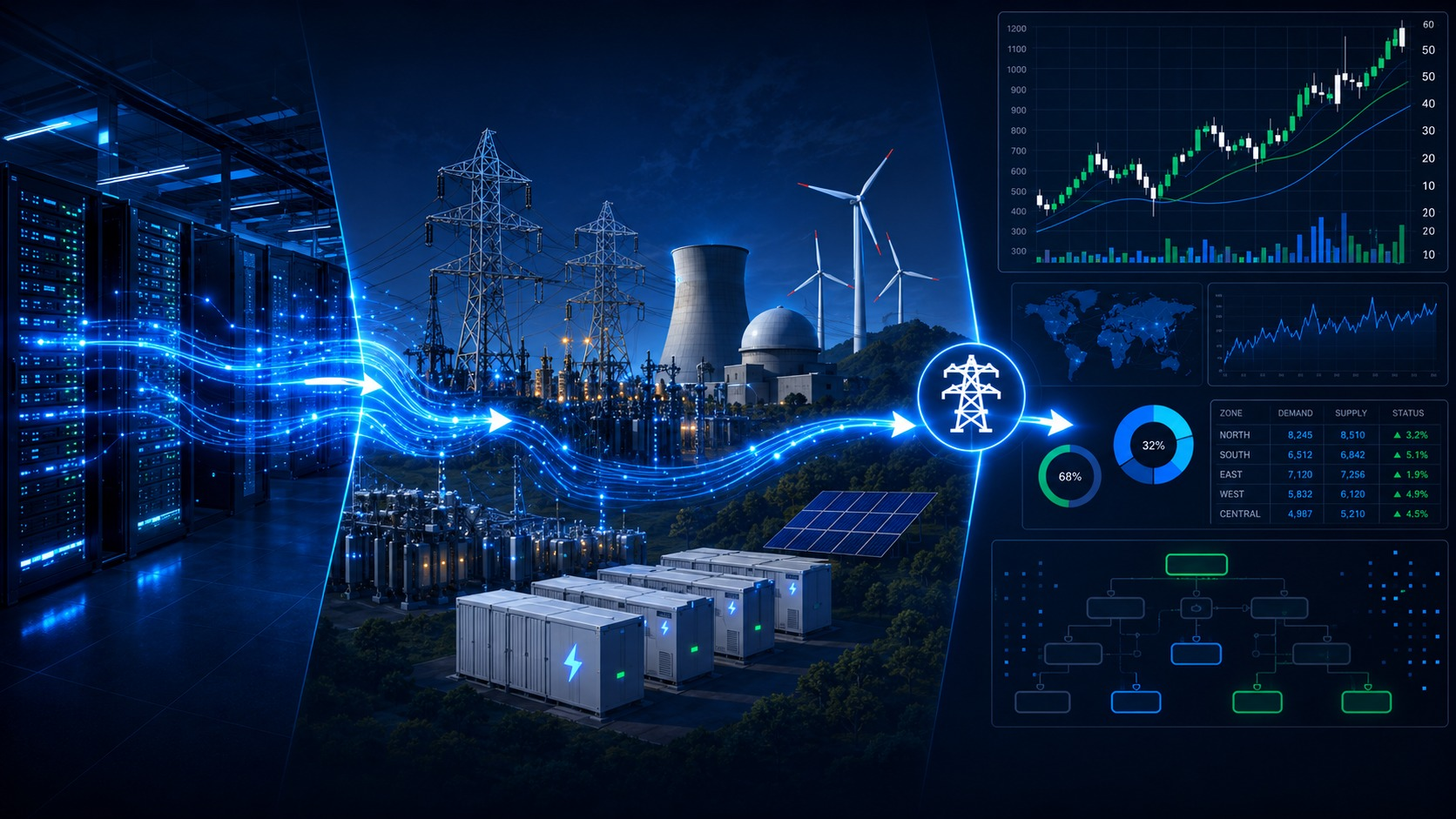
As the global artificial intelligence race expands beyond semiconductor procurement into a battle for physical energy access, power grid equipment has emerged as the definitive bottleneck governing future compute deployment. Under a newly signed Executive Order by the
White House declaring a national emergency to secure the United States Bulk-Power System, federal authorities have imposed stringent restrictions on the acquisition, importation, and installation of electric equipment manufactured by or subject to the jurisdiction of foreign adversaries, tasking the
U.S. Department of Energy with issuing comprehensive regulatory standards within 120 days. The presidential directive explicitly emphasizes that the rapid growth of artificial intelligence, hyperscale data centers, and advanced domestic manufacturing has dramatically intensified the nation's reliance on abundant and reliable electricity. In response to this supply chain realignment, power equipment equities listed on the
Korea Exchange experienced an immediate rally, with HD Hyundai Electric surging 9.28%, Hyosung Heavy Industries gaining 6.04%, LS ELECTRIC climbing 4.71%, and specialty producer Sanil Electric jumping 11.76%. Confronted by an aging domestic grid where over 70% of large power transformers exceed their design lifespans alongside multi-year procurement wait times, institutional investors are aggressively positioning in certified non-adversary manufacturers operating established North American manufacturing footprints.
Key Takeaways
Executive Order establishes strict security guardrails across bulk power transmission networks of 69 kilovolts and above, restricting components from foreign adversaries and creating a structural premium for certified alternative grid equipment suppliers.
South Korean power equipment equities experience substantial capital inflows as HD Hyundai Electric jumps 9.28%, Sanil Electric surges 11.76%, Hyosung Heavy Industries advances 6.04%, and LS ELECTRIC gains 4.71% amid strong institutional demand.
Transformer shortages establish a fundamental physical constraint on artificial intelligence scaling, with average lead times for large power units extending to three to four years amid converging replacement cycles and gigawatt-scale data center interconnect queues.
Record multi-year order backlogs provide exceptional revenue visibility, with combined unfilled orders across leading South Korean manufacturers surpassing 32 trillion won to lock in production capacity through 2028 and beyond.
Operating margins expand above 20% across high-voltage product lines, transforming the valuation framework of heavy electrical equipment providers from cyclical manufacturers into high-visibility secular infrastructure leaders.
Executive Order on Bulk Power Systems: Power Infrastructure as a National Security Priority
While the first phase of the artificial intelligence boom concentrated on graphical processing units, the physical reality of grid interconnection has elevated transmission hardware into a matter of national economic defense.
Restricting Foreign Adversary Equipment and the 120-Day Rulemaking Window
According to reporting from
Reuters, the presidential order targets electrical equipment operating within high-voltage transmission networks at 69 kilovolts and above. The Department of Energy is granted expansive oversight to identify, isolate, monitor, and mandate the replacement of equipment originating from designated foreign adversaries deemed to present cybersecurity or operational risks. This directive accelerates Buy American procurement preferences across federally regulated utilities while eliminating lower-cost foreign hardware from major transmission expansion corridors.
AI Data Centers and Advanced Manufacturing Drive Baseload Surge
The administrative directive explicitly notes that concurrent expansions in advanced semiconductor fabrication, artificial intelligence training clusters, and defense manufacturing have elevated baseload reliability into an indispensable economic asset. Macroeconomic energy data compiled by
Bloomberg indicates that a single gigawatt-scale computing campus demands continuous electrical capacity equivalent to hundreds of thousands of residential households. Without robust high-voltage transformers to step down transmission voltages for computing distribution, digital clusters face severe operational vulnerabilities and potential outage risks.
South Korean Power Equipment Rally: Capturing US Grid Supply Chain Realignment
Positioned with advanced ultra-high-voltage engineering certifications and proactive investments in North American facilities, South Korean manufacturers have become primary beneficiaries of global grid modernization budgets.
HD Hyundai Electric and Hyosung Heavy Industries Lead Ultra-High Voltage Markets
Across Seoul trading venues,
HD Hyundai Electric and
Hyosung Heavy Industries command significant market share in 765-kilovolt ultra-high-voltage transformers. Financial disclosures covered by
The Korea Economic Daily confirm that Hyosung Heavy Industries operates an active transformer production plant in Memphis, Tennessee, with more than half of its heavy industrial backlog tied directly to North American grid operators. Similarly, HD Hyundai Electric has executed multi-million-dollar expansions at its transformer facility in Alabama to capture dedicated data center power solution contracts.
Downstream from primary transmission substations, intermediate distribution and facility switchgear hardware face parallel demand surges.
LS ELECTRIC has leveraged its competitive edge in intelligent distribution panels, vacuum circuit breakers, and busway systems to secure supply agreements with global cloud operators including
Amazon Web Services. Concurrently,
Sanil Electric has recorded double-digit equity gains on the back of its specialized oil-immersed and dry-type distribution transformers engineered specifically for commercial battery storage facilities and localized compute installations.
Investors navigating the expanding intersection of technology hardware, semiconductor cycles, and utility-scale energy infrastructure can monitor market developments on specialized trading platforms.
Furthermore, market metrics on
MEXC demonstrate expanding cross-asset participation as capital allocators rotate funds toward the physical hardware supply chain underpinning artificial intelligence.
The valuation expansion observed across grid equipment equities reflects severe structural supply shortages governed by immutable mechanical manufacturing cycles.
Lead Times Stretching to Four Years Amid Aging Grid Replacement Cycles
According to research published by the
Federal Energy Regulatory Commission, more than 70% of large power transformers operating across the United States have surpassed their initial 25-year design lifespans. This baseline utility replacement cycle collides directly with tens of gigawatts in speculative data center interconnection queues, extending procurement lead times from historical averages of 50 to 80 weeks into unprecedented ranges of 150 to 200 weeks. With transformer availability determining when a data center can energize, equipment providers possess formidable pricing power.
Manufacturing Complexities and Grain-Oriented Electrical Steel Scarcity
Unlike software applications or semiconductor fabrication nodes capable of scaling through rapid lithographic reproduction, large power transformers require heavy precision electrical engineering. Core fabrication depends upon highly constrained global supplies of high-grade Grain-Oriented Electrical Steel (GOES), while precision winding, insulation drying, vacuum oil saturation, and high-voltage dielectric testing demand skilled technical labor. Constructing a greenfield transformer facility and securing formal utility qualification takes upwards of three years, preventing rapid supply adjustments.
Financial Inflection and Margin Expansion: A Multi-Year Upcycle for Grid Manufacturers
Persistent supply deficits have translated into historic operating margins and multi-year revenue visibility across company financial statements.
Financial compilation data indicates that combined order backlogs across HD Hyundai Electric, Hyosung Heavy Industries, and LS ELECTRIC have eclipsed 32.35 trillion won (approximately $24 billion), representing four to five years of committed factory production. By establishing manufacturing bases within the United States well ahead of the current regulatory shifts, South Korean producers are positioned as domestic suppliers capable of fulfilling federal infrastructure requirements without incurring trade penalties.
Operating Margin Expansion and Structural Pricing Leverage
Historically regarded as capital-intensive industrial cyclicals with single-digit operating margins, leading power equipment manufacturers are generating profitability metrics comparable to specialized technology firms. HD Hyundai Electric has posted standalone operating margins exceeding 24%, driven by favorable product mix and price escalation clauses embedded in long-term supply contracts. Analysis from the
Financial Times illustrates that expanding return on equity and consistent free cash flow generation are prompting institutional investors to re-rate the sector as secular compounders rather than traditional commodity cyclicals.
Cross-Asset Implications: Decentralized Energy and Computing Infrastructure
The structural power bottleneck constraining traditional data center corridors provides essential context for the broader digital asset economy and decentralized computational systems.
As public utility interconnect queues lengthen into multi-year delays, technology leaders including
Microsoft and
Nvidia are actively exploring behind-the-meter microgrids, small modular nuclear reactors, and private on-site generation. Within the decentralized physical infrastructure network (DePIN) domain, cryptographic protocols designed to coordinate distributed energy resources, optimize commercial battery storage, and facilitate peer-to-peer power settlement offer scalable mechanisms to supplement centralized electrical grids.
Market participants evaluating the durability of this infrastructure cycle should monitor several primary forward checkpoints:
The finalized Department of Energy rulemaking due within 120 days, assessing whether foreign adversary restrictions extend deeper into Tier-2 subcomponents and raw material refining.
Quarterly transformer lead time indices across North American public utilities, verifying whether manufacturing additions begin to stabilize delivery timelines.
Capital expenditure revisions and Power Purchase Agreement pricing announced by hyperscale computing developers, evaluating whether rising power infrastructure expenses influence forward compute deployment schedules.
Exclusive View from James Mitchell
From a quantitative market structure and capital cycle perspective, the synchronized breakout across South Korean power equipment equities marks the decisive transition of the artificial intelligence trade from digital processors to physical energy infrastructure.
Investors have spent years focusing entirely on transistor scaling and floating-point computation speeds, neglecting the physical reality that digital intelligence is bounded by thermodynamics and electromagnetic distribution. Advanced chips cannot function without specialized transformers to step down high-voltage utility feeds into stable, clean power. The White House Executive Order on the Bulk-Power System creates an institutional moat around certified non-adversary manufacturers, effectively converting multi-year order backlogs into highly defensive, cash-generative infrastructure assets. For systematic macro allocators, the transformer sector offers a rare combination of secular top-line growth and a multi-year supply vacuum that insulates pricing power. The primary forward indicator to track is not short-term share price consolidation, but the ongoing supply-demand balance in electrical steel and the rate at which major utilities expand transmission capital expenditure budgets.
FAQ
Why did the US Bulk-Power System Executive Order trigger a rally in South Korean power stocks?
The order restricts the purchase and installation of critical grid equipment sourced from foreign adversaries, creating an immediate supply gap in an already tight market. South Korean manufacturers such as HD Hyundai Electric, Hyosung Heavy Industries, and LS ELECTRIC possess established ultra-high-voltage technology and US-based manufacturing facilities, making them the primary alternative suppliers for American utilities.
AI data centers consume massive amounts of baseload power that must be converted from high-voltage transmission lines through specialized transformers. Because of material shortages in electrical steel and complex manufacturing processes, lead times for large transformers have stretched to three to four years, directly delaying the energization dates of new computing clusters.
What are the distinct strengths of the leading South Korean power equipment companies?
HD Hyundai Electric and Hyosung Heavy Industries lead in 765-kilovolt ultra-high-voltage transmission transformers with significant North American production presence; LS ELECTRIC specializes in intelligent data center switchgear, distribution panels, and busways; while Sanil Electric excels in specialized, fast-turnaround distribution transformers for commercial storage and edge computing.
How long is the current power equipment supercycle expected to last?
The current upcycle is projected to extend through 2028 to 2030. Unfilled manufacturer order backlogs already cover four to five years of forward production, and the multi-year lead time required to build and certify new transformer manufacturing facilities ensures supply will remain tight over the medium term.
How does this infrastructure cycle differ from historical heavy industrial cycles?
Historical cycles were primarily driven by general macroeconomic expansion with low margins, whereas the current boom is propelled by structural forces including AI data center power demand, mandatory replacement of 25-year-old aging grids, domestic manufacturing reshoring, and geopolitical supply chain exclusions, enabling manufacturers to sustain operating margins above 20%.
What key risks should investors evaluate in the power infrastructure sector?
Key risks include potential shifts in international trade policy, raw material cost inflation in grain-oriented electrical steel, execution delays in constructing new factory capacity, and higher interest rates leading commercial developers to postpone private data center projects.
Disclaimer
The information, analysis, and views contained in this article are provided for general educational and informational purposes only and do not constitute financial advice, investment advice, legal advice, tax advice, or a recommendation to buy or sell any security, digital asset, or financial derivative. Equity securities and financial instruments are subject to high market volatility and capital risk. Past operational performance, financial results, and quantitative indicators do not guarantee future market returns. Investors must conduct independent due diligence and evaluate their personal financial situation, risk tolerance, and investment goals before executing any trade. The MEXC Crypto Pulse team assumes no liability for any direct or indirect financial losses resulting from the use of or reliance upon the information published herein.
About the Author
James Mitchell specializes in technical analysis, market trends, and trading strategies for both Bitcoin and altcoins. Based in London, he has over 10 years of experience in financial markets. Before joining MEXC Learn, James worked as a senior analyst at a leading European investment firm, where he developed expertise in risk management and quantitative trading. His transition to cryptocurrency markets began in 2017, and he has since become recognized for his data-driven approach. He holds a Master's degree in Financial Economics from the London School of Economics. His analytical approach combines traditional technical analysis with on-chain metrics to provide readers with actionable insights. Areas of expertise include technical analysis, market trends and cycles, trading strategies, Bitcoin and altcoin analysis, and risk management.
Research References