

Why Rocket Lab stock tumbled on Nasdaq-100 news
After nearly 20 years in business and less than five years as a public company, Rocket Lab Corporation reached a major milestone on Friday when it joined the Nasdaq-100 Index. The entrance placed the space company among the 100 largest non-financial businesses on the Nasdaq Stock Market.
Most companies would celebrate that kind of recognition. Rocket Lab celebrated it by falling more than 10%.
The Nasdaq-100's June 2026 quarterly rebalance added five companies to the index: Astera Labs, CoreWeave, Nebius Group, Rocket Lab, and Teradyne, with the changes taking effect before market open on Monday, June 22.
What Nasdaq-100 Membership Actually Delivers
Rocket Lab designs, builds, and launches rockets and satellites for government and commercial customers. It trades on the Nasdaq under the ticker RKLB. For investors who have never owned the stock, Friday's index inclusion means they may soon hold it anyway.
The Nasdaq-100 (QQQ) is tracked by more than 200 investment products with over $800 billion in assets under management globally, according to Nasdaq.
Beyond that, the index sits at the center of an investment ecosystem representing over $1.4 trillion in total notional value across ETFs, mutual funds, derivatives, insurance products, and structured notes, according to a separate Nasdaq analysis. ETFs alone account for roughly $587 billion of that total, according to the same analysis.
Every fund mirroring the index must buy RKLB before June 22. That is an automatic demand trigger that does not require an earnings beat to activate.
More SpaceX:
- Veteran hedge fund manager makes a brazen SpaceX bet
- Franklin Templeton CEO sends strong message on SpaceX
- ‘The Big Short’ investor describes SpaceX in three words
For retail investors, the effect is immediate. If you hold a Nasdaq-100 ETF or index fund inside a 401(k) or brokerage account, Rocket Lab (RKLB) will appear in your portfolio after June 22, whether you selected it or not. That scale of forced buying is what separates index inclusion from a press release milestone.
The business has earned the placement. Rocket Lab posted record quarterly revenue of $200.3 million in Q1 2026, a 63.5% increase year-over-year, and its total launch manifest now exceeds 70 contracted missions, according to the official report.
Its contract backlog surged to $2.2 billion, a 108% increase from the previous year, according to the same report. That backlog is locked-in-future revenue.
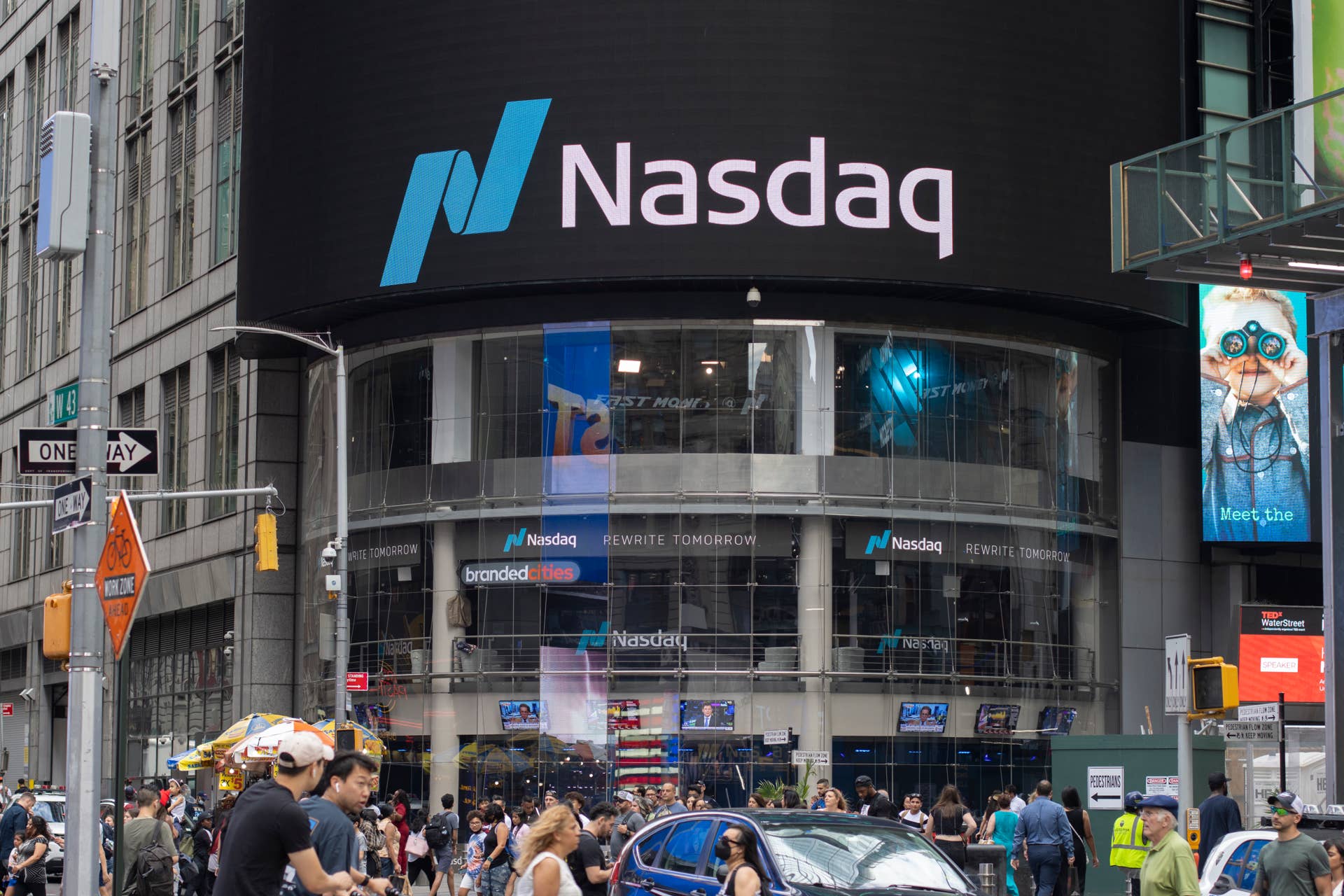 Rocket Lab joins the Nasdaq-100 on June 22, 2026, as SpaceX debuts on the same exchange.
hapabapa &sol Getty Images
Why Rocket Lab stumbled on a day it should have risen
RKLB opened Friday at $118.02 and traded in a range between $99.61 and $118.38, according to Investing.com. The stock closed at $102.39, down 10.79% from the previous session.
The pre-market had surged on the index news. Once regular trading began, investors who had positioned ahead of the announcement sold into the strength. That is the classic "buy the rumor, sell the news" pattern, and it executed precisely on Friday.
Related: Bank of America warns stock market may face a 1994-style shock
But profit taking alone does not explain a 10.79% decline on a milestone day. SpaceX debuted on public markets the same morning and redirected capital away from every other space name in the process.
SpaceX shares opened at $150 and closed at $160.95, a 19.22% gain from the $135 IPO offer price. The largest IPO ever raised $75 billion for the company, according to NBC News. When that much money concentrates in a single stock in one session, adjacent names absorb the outflow. Rocket Lab absorbed it directly.
SpaceX will shape Rocket Lab's valuation
Friday was not a one-time event. SpaceX’s presence as a public company will shape how investors price Rocket Lab on an ongoing basis, and that influence runs in both directions.
The constructive case starts with capital flows. SpaceX’s debut is likely to attract a new wave of institutional money into commercial space broadly.
Wedbush analyst Dan Ives wrote in a note to investors on Friday that SpaceX's going public is an important moment for the broader tech sector as the AI revolution takes its next step forward.
Rocket Lab, as the only scaled Western launch platform outside SpaceX now trading on a public exchange, stands to capture a share of any new institutional inflow into the sector.
The risk case is equally specific. The backdrop of declining space stocks on Friday was primarily driven by the $75 billion SpaceX IPO, which shifted investor focus within the sector.
With a market value near $69 billion built on annual revenue still under $1 billion, Rocket Lab requires consistent execution to justify its valuation. Some analysts downgraded the stock on exactly those grounds ahead of the IPO.
The clearest path to resolving that debate is Rocket Lab’s Neutron rocket, a medium-lift reusable vehicle. Rocket Lab signed five new dedicated Neutron launch contracts in Q1 2026 alone.
A successful Neutron debut would put Rocket Lab in direct competition with SpaceX’s Falcon 9 for larger government and commercial missions, materially expanding its addressable revenue in a way no index rebalance can deliver.
What this moment reveals about space investing going forward
Rocket Lab’s Friday captures something larger than one stock’s bad day. A company can earn a seat in a $1.4 trillion index ecosystem, post record revenue, double its backlog, and still close down more than 10% because the sector’s dominant player went public on the same morning. That is not a verdict on Rocket Lab’s weaknesses. It is the new competitive reality of public space investing.
SpaceX became one of the world’s biggest listed companies on its first day of trading, valued at over $2 trillion.
It now trades every day on the same exchange as Rocket Lab, setting the benchmark every other space company will be measured against.
Investors who own RKLB through choice, or through an index fund they already hold, should understand that Rocket Lab’s valuation and growth story will increasingly be read in direct comparison to SpaceX.
The index inclusion is real, and the forced buying is coming. But the more consequential development for long-term investors is that the benchmark just changed permanently, and Rocket Lab will be measured against it every single trading day from here.
Related: Rocket Lab's latest bold move rattles investors


You May Also Like

Bitcoin could crash to $48,000, if this historical pattern is triggered
Standard Chartered Identifies 3 BTC Bottom Signals After Monday News

Germany hammer World Cup debutants Curacao after early scare



