

Pi Network Opens SLICE Test Token Launch; Pioneers Have Until Pi2Day, June 28 to Participate
Pi Network is giving its community another chance to test a major ecosystem feature before Mainnet rollout, and this time the process looks much simpler than before.
The Pi Core Team has officially opened participation for the SLICE test token launch on Pi Launchpad. The event will remain active until Pi2Day on June 28, giving Pioneers several days to explore the updated system and provide feedback.
This latest launch follows lessons learned from the first Pi Launchpad test token, IRRA. That earlier experiment attracted hundreds of thousands of participants and generated valuable data. Some parts of the process worked well, but several areas created confusion for users. Pi Network has now redesigned the participation model in an effort to make the experience easier to understand.
The SLICE launch offers another opportunity to test how ecosystem tokens could function inside the Pi Network ecosystem before Mainnet token launches eventually arrive.
Pi Network Simplifies Participation After Lessons From The IRRA Test Launch
Data from the IRRA test token launch revealed strong community participation.
More than 478,000 Pioneers took part in the event. Participants staked 36.05 million Test Pi, while more than 198,000 users committed 14.72 million Test Pi. Around 11.71 million committed Test Pi was ultimately used to acquire 10 million IRRA tokens.
Those numbers gave Pi Network valuable insights into user behavior.
Several participants struggled to understand the connection between staking and committing. Some completed the staking step but never finished the commitment process. Others committed amounts that were too small relative to their stake, which reduced their effectiveness during participation.
Complexity became one of the biggest challenges. Pi Core Team explained that the updated Launchpad model now focuses on commitment amounts first. A Pioneer selects how much Test Pi they want to commit, and the system automatically calculates the related fair access hold.
Users can immediately see the commitment amount, hold amount, and total requirement before confirming participation. Everything happens from a single interface, which removes several steps from the previous model.
SLICE Test Token Gives Pi Network Access To Real Application Data
Unlike IRRA, SLICE is connected to an actual Pi ecosystem application called Slice of Pi.
That distinction matters because Pi Network can now evaluate real engagement patterns instead of relying only on test environments.
Slice of Pi is a gaming application integrated into the Pi ecosystem. The application showcases Pi payments and the Pi Ad Network. User activity inside the application may help developers evaluate product usefulness and gather additional feedback.
Pi Network emphasized that SLICE remains strictly a Testnet token.
The token will never migrate to Mainnet, and it has no future Mainnet launch planned. Its primary purpose is education, testing, and ecosystem development.
Another important change involves the fair access hold system. The hold replaces what was previously known as staking or PiPower. Larger commitments require larger holds, which helps prevent a small group of participants from dominating allocations. Smaller participants can still compete under the same framework.
Read Also: SUI Price Prediction: Analyst Says a 10X Rally Is Still Possible
Held Pi remains owned by the Pioneer and is returned after the hold period ends. The updated model also introduces a fixed deterministic hold to commit ratio. This makes calculations easier to understand and reduces uncertainty during participation.
Pi Price Continues Consolidation As Pi2Day Approaches
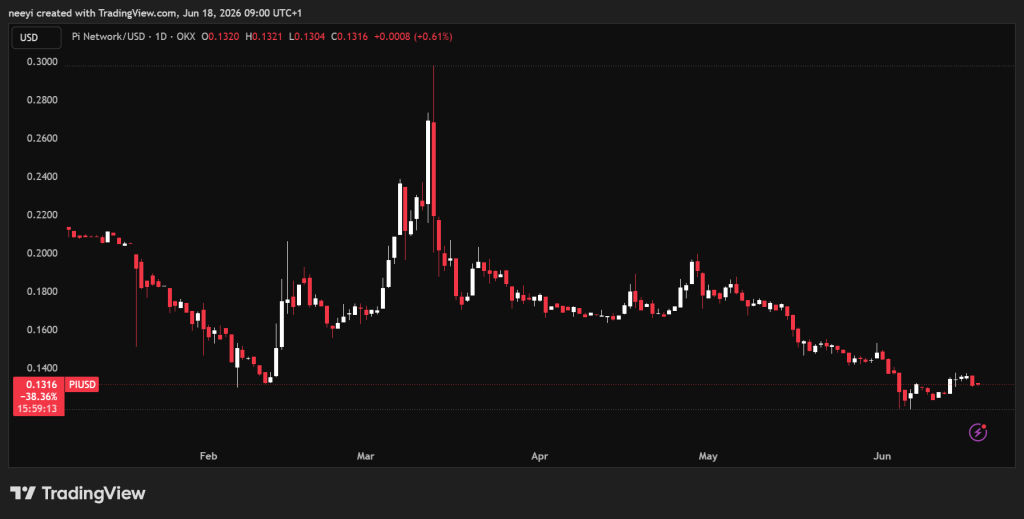
Beyond the Launchpad update, PI price remains under close watch. Pi Network currently trades around $0.131. PI price has pulled back roughly 3.4% during the past 24 hours after reaching an intraday high near $0.135.
Despite that decline, Pi coin continues to hold above a key support region between $0.128 and $0.130. A look at the PI chart shows buyers repeatedly defending that zone over recent sessions. Trading volume increased about 5% during the same period, which indicates continued activity despite broader weakness across altcoins.
Immediate resistance remains near $0.135. A successful move above that level could place the next target between $0.144 and $0.150. That area has previously acted as a strong barrier for PI price advances.
 PIUSD Chart / TradingView.com
Support remains concentrated around $0.128 to $0.130. A break below that region could expose the important psychological support level near $0.120.
Pi Network Price Prediction Depends On Pi2Day And Token Unlock Pressure
Several events could influence PI price over the next week. June 18 marks the deadline for Mainnet node operators to complete the mandatory Protocol v25 upgrade. Smooth synchronization across the network may help PI defend current support levels and challenge resistance near $0.135.
Technical disruptions could create temporary pressure and push Pi coin back toward $0.128. The period between June 19 and June 24 may become even more important.
Read Also: Crypto Price Prediction for Today, June 18: Ethereum (ETH), XRP, Dogecoin (DOGE)
Pi Network faces a scheduled unlock of approximately 14.8 million tokens on Friday. Supply increases often create additional selling pressure, especially when market sentiment remains uncertain.
Pi2Day on June 28 introduces another major variable. Bullish expectations surrounding ecosystem announcements could support accumulation ahead of the event. Under that scenario, PI price may climb toward the $0.140 to $0.145 range.
A weaker outcome could emerge if token unlock pressure overwhelms demand. That scenario may push Pi Network back toward the $0.120 support area.
Subscribe to our YouTube channel for daily crypto updates, market insights, and expert analysis.
The post Pi Network Opens SLICE Test Token Launch; Pioneers Have Until Pi2Day, June 28 to Participate appeared first on CaptainAltcoin.


You May Also Like

Ripple Just Made Its Biggest Move of 2026 While Everyone Watches the XRP Price Chart

FLEX Payment Solutions Expands Digital Payment Capabilities with Pay By Bank

Greece Shuts the Door, France Holds Binance’s EU Future



