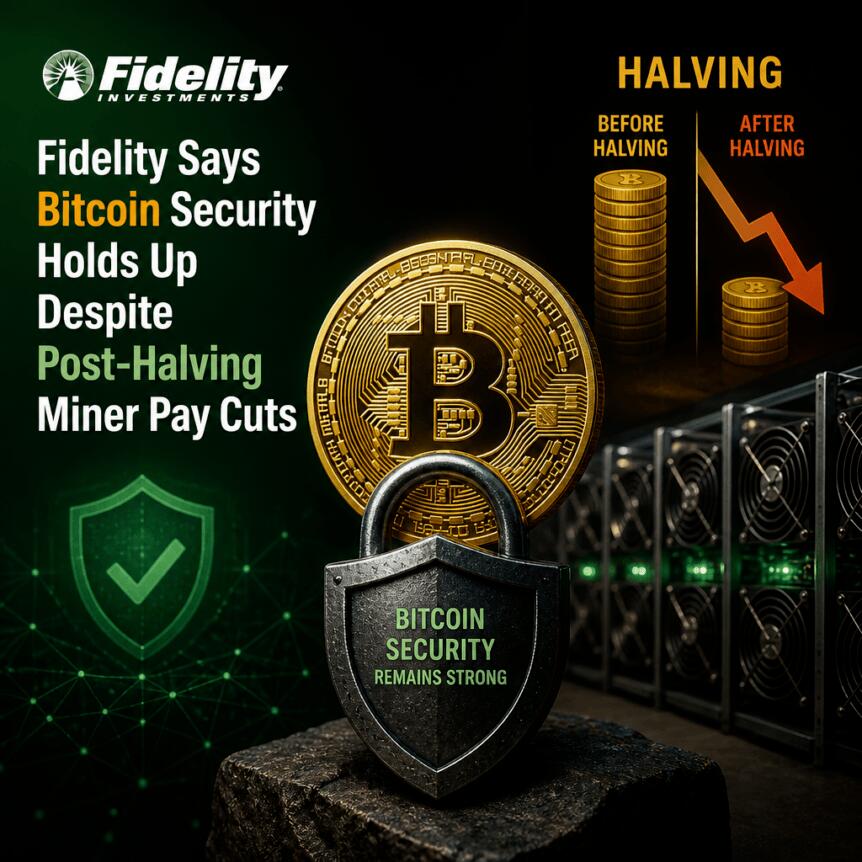
Fidelity Digital Assets is pushing back on a central criticism of Bitcoin’s long-term security: that falling block rewards from repeated halvings will eventuallyFidelity Digital Assets is pushing back on a central criticism of Bitcoin’s long-term security: that falling block rewards from repeated halvings will eventually

Fidelity Says Bitcoin Security Holds Up Despite Post-Halving Miner Pay Cuts
For feedback or concerns regarding this content, please contact us at [email protected]
Fidelity Says Bitcoin Security Holds Up Despite Post-Halving Miner Pay Cuts

Fidelity Digital Assets is pushing back on a central criticism of Bitcoin’s long-term security: that falling block rewards from repeated halvings will eventually weaken incentives for miners and make sustained attacks more feasible. In a new research report, Fidelity argues that Bitcoin’s economic model is broader than issuance alone and that the network’s security can remain robust even as subsidies decline.

The report, authored by Fidelity research analyst Daniel Gray, reiterates that transaction fees and other market incentives help miners maintain profitability and continue contributing hash power. The debate matters to investors and builders because Bitcoin’s fixed issuance schedule steadily reduces new coin supply until the block subsidy disappears—leaving the question of whether fees and incentives will fully replace that funding over time.

Key takeaways

  • Fidelity argues Bitcoin’s security relies on multiple economic forces, not just block rewards.
  • Gray cites historical miner incentives strengthening alongside Bitcoin’s price, despite declining issuance across halving cycles.
  • Miners still face intense near-term financial pressure, even as the long-term security narrative remains contested.
  • Publicly traded miners’ shift toward AI and high-performance computing highlights costs and operational demands that differ from typical mining setups.

Why Fidelity says halving won’t automatically erode security

One of the most persistent concerns around Bitcoin’s programmed supply is that each quadrennial halving reduces the block subsidy that miners earn. Critics contend that, over the long run, declining issuance could lower miner revenue and weaken incentives—unless transaction fees rise enough to compensate for the reduction.

Fidelity’s new analysis challenges that framing by arguing that block rewards are only one part of the security equation. According to the report, miners are also supported by transaction fees and by broader market incentives that keep attacks economically unattractive. Put simply, the network does not depend solely on how many new coins are created per block; it depends on whether miners can still justify securing the chain in the face of costs and risk.

Fidelity’s report also engages with the larger timeline investors watch: Bitcoin’s issuance schedule reduces new supply gradually, and eventually the block subsidy will reach zero. That future transition is why the fee-versus-subsidy question remains central for developers, economists, and market participants.

Miner revenue and incentives across halving cycles

Fidelity points to data showing that miner revenue has risen substantially over time, rather than weakening in line with reduced subsidies. Gray notes that since April 20, 2024, miners have been receiving a subsidy of 3.125 BTC per block—down from 6.25 BTC during the prior halving cycle.

In the report, Gray argues that lower issuance hasn’t translated into weaker incentives because Bitcoin’s rising price has more than offset the decline in block rewards. He also highlights the growth in average daily miner revenue, which he says increased from roughly $26,300 during Bitcoin’s first halving cycle to more than $40.2 million at present.

“Despite declining issuance, miner incentives — and by extension, network security — historically strengthened alongside Bitcoin’s price,” Gray writes. The underlying implication is that if miners continue to capture enough value from the combination of price, fees, and other economic dynamics, the network’s security budget can remain sufficient even as subsidy-based income shrinks.

Fidelity’s argument is particularly relevant for readers who view halvings as deterministic security “stress tests.” Instead of treating reduced issuance as an automatic negative, the report frames miner incentives as a responsive system that has historically adapted when the asset price and fee environment improve.

The security debate versus miners’ real-world financial strain

While Fidelity emphasizes long-term economic resilience, the same period has also exposed serious near-term pressures for many mining firms—especially those operating as public companies. Industry commentary cited in connection with the report describes the current environment as among the most difficult on record, pointing to a combination of lower mining rewards, rising costs, and increasing competition.

That gap between long-term theory and short-term operating reality is where the industry’s behavior becomes important to watch. The source material notes that some miners have diversified into artificial intelligence and high-performance computing, using existing power infrastructure and data center assets to pursue demand from AI workloads instead of relying solely on Bitcoin mining.

In this context, an earlier Cointelegraph report referenced a VanEck estimate suggesting publicly traded miners could require up to $50 billion in additional capital to fully transition to AI infrastructure. The scale of that estimate underscores why many mining companies are making strategic pivots now: even if long-term Bitcoin security remains intact, the companies themselves may need liquidity and capital to remain competitive and operationally flexible.

Why “AI pivot” operations are harder than mining

One reason the pivot to AI and HPC is costly—and not simply a rebranding of mining—is that uptime, reliability, and facility requirements differ from typical mining setups. A quote attributed to Blocksbridge Consulting in the source material contrasts the two environments: a Bitcoin mine, the publication notes, can run with relatively simpler infrastructure and ASIC fleets that can tolerate faster curtailment. AI and HPC facilities, by contrast, require higher standards for continuous operation.

According to the same source, AI and HPC deployments demand greater electrical redundancy, improved cooling, tighter network requirements, and more responsive customer support—factors that add both engineering complexity and capital intensity.

This operational reality can matter for investors and analysts trying to interpret miner behavior. If mining economics remain uncertain on a quarter-to-quarter basis, firms may pursue non-Bitcoin revenue streams not because Bitcoin’s security thesis is wrong, but because maintaining balance sheets and meeting facility requirements in adjacent markets can be just as challenging as competing on hash rate.

Looking ahead: the fee question remains the test

Fidelity’s report argues that Bitcoin can stay secure even as issuance falls, but the broader market will still be watching the transition from subsidy-led revenue to fee-led revenue. The most important near-term signals are how transaction fee levels evolve relative to miner costs, and whether miners’ financial restructuring efforts can be sustained without undermining their ability to keep contributing to network security.

This article was originally published as Fidelity Says Bitcoin Security Holds Up Despite Post-Halving Miner Pay Cuts on Crypto Breaking News – your trusted source for crypto news, Bitcoin news, and blockchain updates.

Disclaimer: The articles reposted on this site are sourced from public platforms and are provided for informational purposes only. They do not necessarily reflect the views of MEXC. All rights remain with the original authors. If you believe any content infringes on third-party rights, please contact [email protected] for removal. MEXC makes no guarantees regarding the accuracy, completeness, or timeliness of the content and is not responsible for any actions taken based on the information provided. The content does not constitute financial, legal, or other professional advice, nor should it be considered a recommendation or endorsement by MEXC.

You May Also Like

Ethereum koers toont zeldzaam dubbel koopsignaal en richt zich op $4.550

Ethereum koers toont zeldzaam dubbel koopsignaal en richt zich op $4.550

Connect met Like-minded Crypto Enthusiasts! Connect op Discord! Check onze Discord   Ethereum laat op de uurgrafiek twee opeenvolgende TD Sequential koopsignalen zien. Deze indicator meet uitputting in een trend en geeft vaak een signaal dat de verkoopdruk kan afnemen. Dit dubbele signaal verschijnt rond het niveau van $4.516, waar de ETH prijs kortstondig steun vindt. Dit type formatie komt zelden voor en wordt daarom extra nauwlettend gevolgd. Wat gaat de Ethereum koers hiermee doen? Ethereum koers test steun rond $4.516 De scherpe daling van de Ethereum koers vanaf de prijszone rond $4.800 bracht de ETH prijs in korte tijd naar ongeveer $4.516. Op dit niveau trad duidelijke koopactiviteit op, waardoor de neerwaartse beweging tijdelijk werd gestopt. Het dubbele signaal dat door de TD Sequential indicator is gegenereerd, viel precies samen met dit prijspunt. De TD Sequential is opgebouwd uit negen candles die een trend meetellen. Wanneer de negende candle verschijnt, kan dit duiden op een trendomslag. In dit geval verschenen zelfs twee signalen kort na elkaar, wat aangeeft dat de verkoopdruk mogelijk uitgeput is. Het feit dat dit gebeurde in een zone waar ETH kopers actief bleven, maakt het patroon extra opvallend. TD Sequential just flashed two buy signals for Ethereum $ETH! pic.twitter.com/JPO8EhiEPi — Ali (@ali_charts) September 16, 2025 Welke crypto nu kopen?Lees onze uitgebreide gids en leer welke crypto nu kopen verstandig kan zijn! Welke crypto nu kopen? Fed-voorzitter Jerome Powell heeft aangekondigd dat de rentes binnenkort zomaar eens omlaag zouden kunnen gaan, en tegelijkertijd blijft BlackRock volop crypto kopen, en dus lijkt de markt klaar om te gaan stijgen. Eén vraag komt telkens terug: welke crypto moet je nu kopen? In dit artikel bespreken we de munten die… Continue reading Ethereum koers toont zeldzaam dubbel koopsignaal en richt zich op $4.550 document.addEventListener('DOMContentLoaded', function() { var screenWidth = window.innerWidth; var excerpts = document.querySelectorAll('.lees-ook-description'); excerpts.forEach(function(description) { var excerpt = description.getAttribute('data-description'); var wordLimit = screenWidth wordLimit) { var trimmedDescription = excerpt.split(' ').slice(0, wordLimit).join(' ') + '...'; description.textContent = trimmedDescription; } }); }); Technische indicatoren schetsen herstelkans voor ETH Naast de dubbele koopsignalen verstrekken ook andere indicatoren belangrijke aanwijzingen. Tijdens de daling van de ETH koers waren grote rode candles zichtbaar, maar na de test van $4.516 stabiliseerde de Ethereum koers. Dit wijst op een mogelijke verschuiving in het evenwicht tussen de bears en bulls. Als deze opwaartse beweging doorzet, liggen de eerste weerstanden rond $4.550. Daarboven wacht een sterkere zone rond $4.650. Deze niveaus zijn in eerdere Ethereum sessies al meerdere keren getest. Een doorbraak zou ruimte openen richting de all-time high van ETH rond $4.953. Wanneer de prijs toch opnieuw onder $4.516 zakt, liggen er zones rond $4.500 en $4.450 waar grotere kooporders worden verwacht. Deze niveaus kunnen als een vangnet fungeren, mocht de druk opnieuw toenemen. Marktdynamiek bevestigt technische indicatoren De huidige situatie volgt op een bredere correctie in de cryptomarkt. Verschillende vooraanstaande crypto tokens zagen scherpe koersdalingen, waarna traders op zoek gingen naar signalen voor een mogelijke ommekeer. Dat juist Ethereum nu een dubbel TD Sequential signaal toont, versterkt de interesse in dit scenario. Fundamenteel blijft Ethereum sterk. Het aantal ETH tokens dat via staking is vastgezet, blijft groeien. Dat verkleint de vrije circulatie en vermindert verkoopdruk. Tegelijk blijft het netwerk intensief gebruikt voor DeFi, NFT’s en stablecoins. Deze activiteiten zorgen voor een stabiele vraag naar ETH, ook wanneer de prijs tijdelijk onder druk staat. Fundamentele drijfveren achter de Ethereum koers De Ethereum koers wordt echter niet alleen bepaald door candles en patronen, maar ook door bredere factoren. Een stijgend percentage van de totale ETH supply staat vast in staking contracten. Hierdoor neemt de liquiditeit op exchanges af. Dit kan prijsschommelingen versterken wanneer er plotseling meer koopdruk ontstaat. Daarnaast is Ethereum nog steeds het grootste smart contract platform. Nieuwe standaarden zoals ERC-8004 en ontwikkelingen rond layer-2 oplossingen houden de activiteit hoog. Deze technologische vooruitgang kan de waardepropositie ondersteunen en zo indirect bijdragen aan een ETH prijsherstel. Het belang van de korte termijn dynamiek De komende handelsdagen zullen duidelijk maken of de bulls genoeg kracht hebben om door de weerstandszone rond $4.550 te breken. Voor de bears ligt de focus juist op het verdedigen van de prijsregio rond $4.516. De whales, die met grote handelsorders opereren, kunnen hierin een beslissende rol spelen. Het dubbele TD Sequential signaal blijft hoe dan ook een zeldzame gebeurtenis. Voor cryptoanalisten vormt het een objectief aanknopingspunt om de kracht van de huidige Ethereum trend te toetsen. Vooruitblik op de ETH koers Ethereum liet twee opeenvolgende TD Sequential signalen zien op de uurgrafiek, iets wat zelden voorkomt. Deze formatie viel samen met steun rond $4.516, waar de bulls actief werden. Als de Ethereum koers boven dit niveau blijft, kan er ruimte ontstaan richting $4.550 en mogelijk $4.650. Zakt de prijs toch opnieuw onder $4.516, dan komen $4.500 en $4.450 in beeld als nieuwe steunzones. De combinatie van zeldzame indicatoren en een sterke fundamentele basis maakt Ethereum interessant voor zowel technische als fundamentele analyses. Of de bulls het momentum echt kunnen overnemen, zal blijken zodra de Ethereum koers de eerstvolgende weerstanden opnieuw test. Koop je crypto via Best Wallet Best wallet is een topklasse crypto wallet waarmee je anoniem crypto kan kopen. Met meer dan 60 chains gesupport kan je al je main crypto coins aanschaffen via Best Wallet. Best wallet - betrouwbare en anonieme wallet Best wallet - betrouwbare en anonieme wallet Meer dan 60 chains beschikbaar voor alle crypto Vroege toegang tot nieuwe projecten Hoge staking belongingen Lage transactiekosten Best wallet review Koop nu via Best Wallet Let op: cryptocurrency is een zeer volatiele en ongereguleerde investering. Doe je eigen onderzoek. Het bericht Ethereum koers toont zeldzaam dubbel koopsignaal en richt zich op $4.550 is geschreven door Dirk van Haaster en verscheen als eerst op Bitcoinmagazine.nl.
Share
Coinstats2025/09/17 23:31
Fed Day Dry Powder: Cryptoquant Analyst Tracks $7.6B Stablecoin Pile on Exchanges

Fed Day Dry Powder: Cryptoquant Analyst Tracks $7.6B Stablecoin Pile on Exchanges

The post Fed Day Dry Powder: Cryptoquant Analyst Tracks $7.6B Stablecoin Pile on Exchanges appeared on BitcoinEthereumNews.com. With the Federal Reserve meeting today, onchain flows are telegraphing that crypto traders are topping off exchanges and leaning long ahead of a widely expected 25-basis-point cut. Pre-Fed Positioning Stablecoins are doing the heavy lifting. Cryptoquant data shows $7.6 billion in fresh USDT and USDC (ERC-20) deposits heading to trading venues ahead of the decision. […] Source: https://news.bitcoin.com/fed-day-dry-powder-cryptoquant-analyst-tracks-7-6b-stablecoin-pile-on-exchanges/
Share
BitcoinEthereumNews2025/09/18 01:36
Michael Saylor’s Bitcoin Treasury Strategy Has Finally Hit Its Breaking Point

Michael Saylor’s Bitcoin Treasury Strategy Has Finally Hit Its Breaking Point

Bitcoin (CRYPTO:BTC) transformed from a niche digital asset into a mainstream investment over the past decade, and few people did more to accelerate that shift
Share
247 Wall St.2026/06/28 20:17

Newbies:Deposit $100, Get $1,000

Newbies:Deposit $100, Get $1,000Newbies:Deposit $100, Get $1,000

Plus Up to a $50 Referral Bonus