

Dow’s Dividend Fell to $0.35 a Share After Five Quarters Stuck at $0.70
Key Takeaways for Dow Stock as of July 2026
- CFO Jeff Tate told investors at Dow’s June 2026 conference appearance that incremental cash goes toward deleveraging first, even as second-quarter guidance climbed to $2.2 billion.
- The dividend now pays $0.35 per share, down from $0.70.
- The payout ratio swung to -47.28% last quarter while Dow stock’s NTM yield holds at 5%, below its 6% average.
- TIKR’s mid-case model prices Dow stock at a $21 target realized by 12/31/30, a potential total return of -22% and an annualized rate of -5% a year.
Dow’s dividend cut is old news. What management just told investors about where the next dollar of cash goes is not. Track Dow stock’s full capital allocation picture on TIKR for free →
Dow Tells Investors New Cash Goes to Debt Before Dividends Return
Dow (DOW) raised its own second-quarter guidance to $2.2 billion of EBITDA, roughly 10% above the original $2 billion guide, and CFO Jeff Tate used the June 9 investor conference to draw a clear line on where that extra cash goes. It goes to debt first.
“Our top priority beyond safe and reliable operations will be supporting deleveraging,” Tate told analysts, describing how Dow would direct any incremental cash generated by the earnings uplift.
That marks a shift in emphasis from Dow’s Q1 2026 earnings call, when Tate described returning cash to shareholders through dividends and share repurchases as remaining “a clear priority across the cycle” inside the company’s broader capital allocation framework. Set against that framing, the near-term dollars are not following it yet.
Dow ended the first quarter with more than $4 billion of cash on hand and roughly $14 billion of total liquidity, and Tate pointed out the company carries no substantive debt maturities before 2029. Even with that cushion, deleveraging still ranks above dividend growth in Dow’s near-term plans.
On the same call, Tate laid out the mechanics behind the cash. Dow’s 2025 cost program will deliver its remaining $500 million and reach materially complete status by the end of the second quarter, while Transform to Outperform adds another $500 million this year on its way to more than $2 billion over the next couple of years. Tate also cited working capital gains of more than $300 million as a separate lever behind improving cash conversion.
None of that plan mentions the dividend directly. But every dollar earmarked for debt is a dollar not going toward restoring the $0.70 rate Dow paid before last year’s cut.
Dow’s cash priorities are laid out in detail on the call. See exactly how that $2.2 billion guidance breaks down on TIKR for free →
Dow Stock’s Payout Ratio Keeps Swinging Negative Even After the Dividend Cut
 DOW Stock Dividends (TIKR)
Dow held its dividend at $0.70 per share for five straight quarters, from June 2024 through June 2025, before cutting it to $0.35 starting in the third quarter of 2025.
The $0.35 rate has held steady for three quarters since, including the quarter ended March 31, 2026.
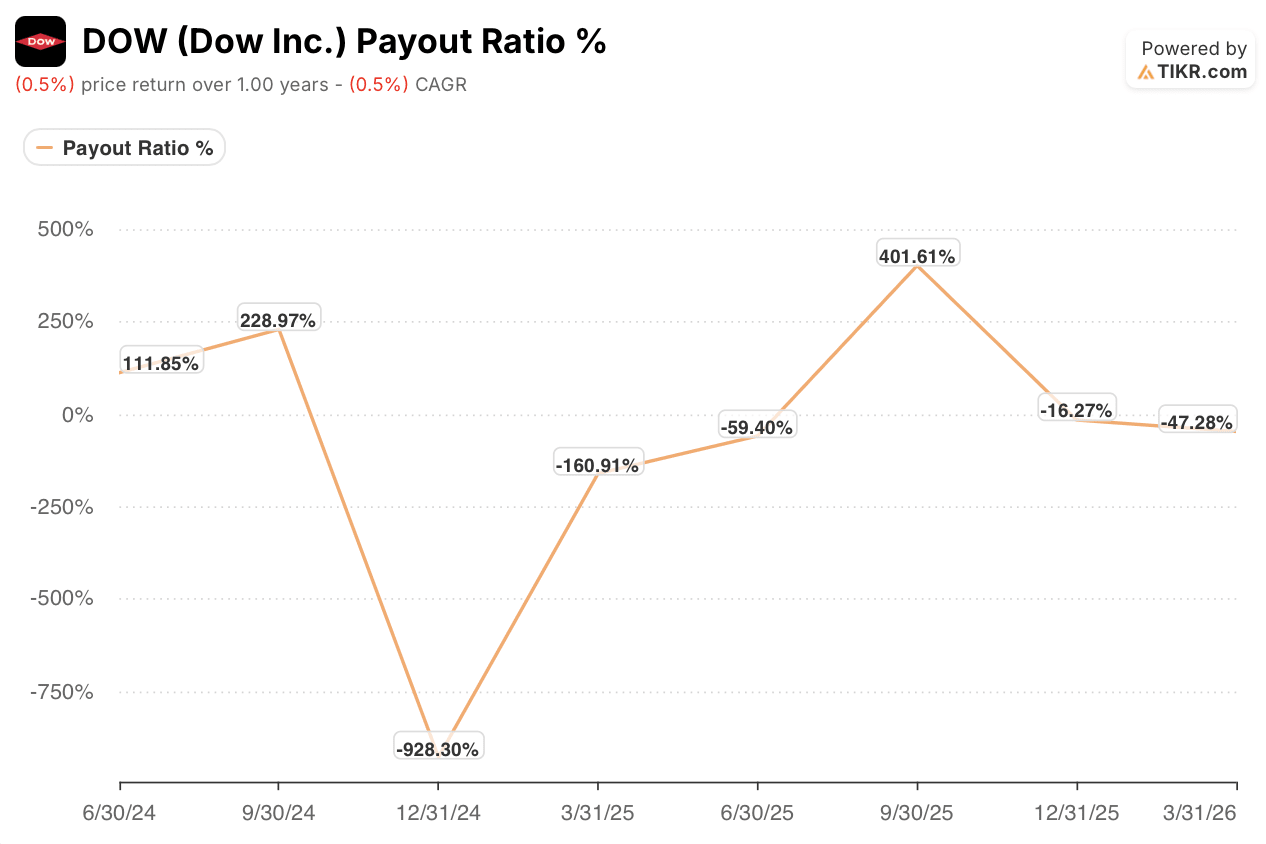 DOW Stock Payout Ratio (TIKR)
The payout ratio doesn’t offer a clean read on its own. It ran as high as 402% in the third quarter of 2025, right after the cut took effect, then swung to -16% in the fourth quarter and -47% in the first quarter of 2026.
A negative payout ratio typically signals a net loss for the period, which makes the $0.35 payment a draw on cash rather than a coverage of earnings.
 DOW Stock Dividend Yield (TIKR)
Dow stock’s NTM dividend yield sits at 5.10%, above its 3.33% low over the past year but well below the 6.14% mean and far off the 10.12% high the yield touched during the depths of the supply disruption. That gap suggests the yield has moved as much with the stock price as with the dividend cut itself.
The open question is whether Dow’s self-help ramp, which Tate expects to accelerate into 2027, generates enough free cash flow to fund both deleveraging and a move back toward the old $0.70 rate, or whether $0.35 becomes the new baseline.
Dow Stock’s TIKR Model Points to a $21 Target Despite the Guidance Raise
TIKR’s mid-case model prices Dow stock at $27 today against a $21 target realized by 12/31/30, for a potential total return of -22% and an annualized rate of -5% a year.
 DOW Stock Valuation Model Results (TIKR)
That return puts Dow stock’s medium-term outlook below where the stock trades now, positioning the shift toward deleveraging as one piece of a broader multiyear reset rather than the reason behind the model’s read.
The target doesn’t need a macro recovery to make sense of Dow’s own numbers. Tate told analysts the 2025 cost program, Transform to Outperform, and the Alberta project alone could add up to $4 billion of EBITDA uplift on top of the $3.3 billion Dow delivered in 2025, without assuming the Middle East conflict resolves.
Yet TIKR’s model still lands below the current price, a gap that puts the burden on execution, not on the dividend, to close.
TIKR’s mid-case model puts Dow stock’s target at $21 with a negative return through 2030. Build your own valuation model on TIKR for free →
Should You Invest in Dow Inc.?
The only way to really know is to look at the numbers yourself. TIKR gives you free access to the same institutional-quality financial data that professional analysts use to answer exactly that question.
Pull up Dow Inc. stock and you’ll see years of historical financials, what Wall Street analysts expect for revenue and earnings in the quarters ahead, how valuation multiples have moved over time, and whether price targets are trending up or down.
You can build a free watchlist to track Dow Inc. alongside every other stock on your radar. No credit card required. Just the data you need to decide for yourself.
Access Professional Tools to Analyze DOW stock on TIKR for Free →


You May Also Like

Bitcoin, Gold, and U.S. Stocks Dive as Trump Pledges to Hit Iran ‘Extremely Hard’

TV anchors cut off mid-sentence and evacuate as nearby building threatens collapse
Funding: African startups raised $1.4 billion in H1 2026 off a $515 million windfall in June



