- Quick Buy/SellBuy & sell with cards and mobile payments
- P2PTrade with local payments at best prices
- Fiat DepositDeposit in BRL, COP, EUR, and more
- Global Bank TransferBuy and sell via local banks
- MEXC CardSpend your crypto worldwide
- USDT-MPerpetual Futures settled in USDT
- USDC-MPerpetual Futures settled in USDC
- USD1-MPerpetual Futures settled in USD1
- Coin-MPerpetual Futures settled in other cryptos
- Futures EarnEarn on balance and unlock higher APR as you trade
- Grid TradingCapture volatility with automated trading
- AI Copy TradeNew & improved AI-Masters with precise style matching
- Demo TradingSimulate Futures trading risk-free
- Futures OverviewExplore Futures tools, products, and features
- OIL Futures24/7 access to top liquidity & leveraged trading
- BTC FuturesMarket's lowest fees and high leverage
- ETH FuturesMarket's lowest fees and high leverage
- MEXC EarnEarn high APR on your crypto
- Hold and EarnHold assets and earn interest daily
- Futures EarnEarn on balance and unlock higher APR as you trade
- On-Chain EarnEasy staking. Real on-chain yield
- MEXC LoansBorrow instantly at competitive rates
- Rewards HubGet started with $10,000 in bonuses
- Event CenterHigher rewards, 0 fees
- Invite and EarnInvite friends and earn 140 USDT each
- $500K BTC CarnivalWin up to 1 BTC & more!
- LaunchpadAccess top tokens early or at a discount
- Airdrop+Deposit and trade to claim new airdrops
- KickstarterHold MX to earn new tokens
- 0 FeesTrade hot futures, enjoy limited 0 fees
- Futures M-DayTrade Futures and claim daily rewards
- Futures Loss Coverage PlanGet triple protection and win $5,000 in XAUT
- Referral ProgrammeInvite friends and unlock commissions from 40%
- Affiliate ProgrammeTop-tier affiliate commissions up to 70%
- MEXC VVIPM-Score into Wealth, 10+ Elite Benefits Upgrading
- MEXC × TradingViewConnect MEXC to trade directly on TradingView
- Crypto NewsFollow the latest crypto headlines
- AnnouncementsStay on top of every happening on MEXC
- LearnStrong crypto fundamentals for every beginner
- MEXC InstitutionalTailored solutions for institutional clients
ARK Venture Fund tokenization: What Do Investors Own?
Overview
ARK Invest has brought the ARK Venture Fund (ARKVX) onchain through Securitize, giving eligible investors blockchain-based access to an existing investment fund with exposure to private and public technology companies. Announced on September 24, 2026, the ARK Venture Fund tokenization initially uses Ethereum, while Securitize provides the regulated infrastructure connecting onchain issuance with investor onboarding and fund administration.
The most important distinction is what has actually been tokenized. ARKVX is an existing actively managed closed-end interval fund; companies in its portfolio such as OpenAI, Anthropic, Stripe and Databricks have not individually been tokenized through this transaction. Investors hold an interest in ARKVX, while the fund itself owns and manages the underlying portfolio.
Tokenization also does not automatically solve private-market liquidity. ARKVX shares are not listed on a securities exchange, ARK does not expect a secondary market to develop, and investors generally obtain liquidity through periodic fund repurchase offers. Onchain transferability therefore does not mean unrestricted 24/7 liquidity.
The importance of the project lies elsewhere. Blockchain is beginning to move beyond tokenized Treasury and money-market products into more complex investment structures where active management, private-company valuations and limited liquidity remain intact. The technology changes the ownership and administrative layer without pretending that the underlying assets have become simpler.
Key Takeaways
- ARKVX has been tokenized through Securitize, initially on Ethereum.
- Investors obtain an interest in the ARK Venture Fund, not direct shares in OpenAI, Anthropic or other portfolio companies.
- ARKVX remains a closed-end interval fund with limited liquidity and periodic repurchase mechanics.
- Tokenization changes the ownership infrastructure, not the economics of the underlying private assets.
- The project shows institutional tokenization expanding beyond cash-like funds into more complex private-market exposure.
What Does ARK Venture Fund tokenization Actually Mean?
The ARK Venture Fund tokenization moves the representation and administration of a fund interest onto blockchain infrastructure while leaving the fund's underlying investment structure largely unchanged. ARKVX remains an actively managed portfolio managed by ARK Invest, and the fund continues to hold its investments in private and public companies according to its strategy. Securitize provides the regulated infrastructure through which eligible investors can access tokenized fund interests, with Ethereum used as the initial blockchain.
The legal and economic structure can be understood simply as: investor → ARKVX fund interest → ARK Venture Fund → underlying portfolio companies. The tokenized security exists at the fund level, not at the level of each company held by the portfolio. This is critical because high-profile private holdings can otherwise create the impression that individual shares in those companies have been issued as blockchain tokens.
For background on ARK's relationship with the tokenization platform, MEXC previously covered ARK Invest's investment in Securitize, a relationship that preceded the decision to bring ARKVX itself onchain.
Do ARKVX Investors Directly Own OpenAI Shares?
No. Tokenized ARKVX ownership is not direct ownership of the fund's portfolio companies.
Owning a fund interest means the investor has economic exposure to the performance of the portfolio according to the fund's legal structure. ARKVX, not the individual fund investor, owns the underlying private and public investments. If the fund holds OpenAI, Anthropic, Stripe or another private company, the legal rights associated with that investment sit at the fund level.
This distinction affects voting rights, liquidity and valuation. An ARKVX holder does not automatically appear on the shareholder register of each underlying company and cannot independently transfer a slice of the fund's OpenAI position simply because the ARKVX interest is represented on Ethereum.
That makes the claim “ARK has tokenized OpenAI shares” inaccurate. What ARK and Securitize have tokenized is access to the fund that may hold those shares. The difference is not semantic; it defines what investors actually own.
Why Tokenize an Existing Interval Fund?
The most useful reason is not unrestricted trading. Interval funds are deliberately structured differently from exchange-traded funds, and ARKVX remains subject to the characteristics of that legal vehicle even after tokenization. The more interesting opportunity lies in improving the infrastructure around ownership, administration and distribution.
Traditional investment funds rely on a network of transfer agents, fund administrators, brokers, custodians and compliance systems. Each participant may maintain its own records, creating a need for repeated reconciliation. Blockchain can provide a common programmable ownership layer around which identity checks, transfer restrictions and investor servicing can be organized.
This matters especially for securities that are not intended to trade freely. Tokenization does not have to turn every financial product into a permissionless crypto asset to create value. It can instead make a regulated, restricted security easier to issue and administer while preserving the restrictions that define the product.
The ARKVX structure is therefore a useful test of whether regulated fund administration can become more programmable without changing the underlying investment vehicle.
Does Ethereum Make ARKVX More Liquid?
Not automatically. ARK describes the Venture Fund as a continuously offered, non-diversified closed-end interval fund with limited liquidity. Its shares are not listed on a securities exchange, and the fund does not expect a conventional secondary market to develop. Liquidity is instead provided through periodic repurchase offers governed by the fund's terms.
Moving the representation of those shares onto Ethereum does not override the legal structure. A blockchain may be capable of processing transfers at any hour, but the security itself remains subject to investor eligibility, transfer restrictions and fund rules. The relevant question is therefore not whether Ethereum can move a token at 2 a.m.; it is whether the holder is permitted to transfer that security and whether an eligible counterparty exists.
The underlying assets add another constraint. Private-company shares are often difficult to value and trade, and their liquidity does not improve simply because the fund that owns them has adopted blockchain infrastructure. Onchain transferability and underlying-asset liquidity are two separate concepts.
That distinction is particularly important for tokenized private markets, where blockchain can reduce administrative friction but cannot manufacture buyers for assets that are economically illiquid.
What Can Tokenization Actually Improve?
The strongest potential benefits sit in processes that happen around the investment rather than in the investment itself. Securitize can combine onchain fund interests with regulated investor verification and transfer controls, potentially creating a more integrated workflow for onboarding, ownership records and fund servicing.
Several improvements are especially relevant:
- Investor onboarding: eligibility and identity checks can connect more directly with the digital ownership environment.
- Ownership records: fund interests can be represented within blockchain-based infrastructure.
- Transfer controls: restrictions can be incorporated into compliant digital workflows.
- Distribution: regulated investment products can reach eligible investors through newer digital channels.
- Administration: a shared ledger can reduce some reconciliation between market participants.
- Future financial utility: where regulation permits, tokenized fund interests could potentially interact with other compliant digital-asset infrastructure.
These are less dramatic claims than “venture capital becomes liquid,” but they are more consistent with how institutional tokenization is actually developing. Much of the cost in securities markets comes from maintaining and reconciling records across separate systems. Making that ownership layer programmable can have value even when the security remains restricted and illiquid.
Traditional ARKVX vs Tokenized ARKVX
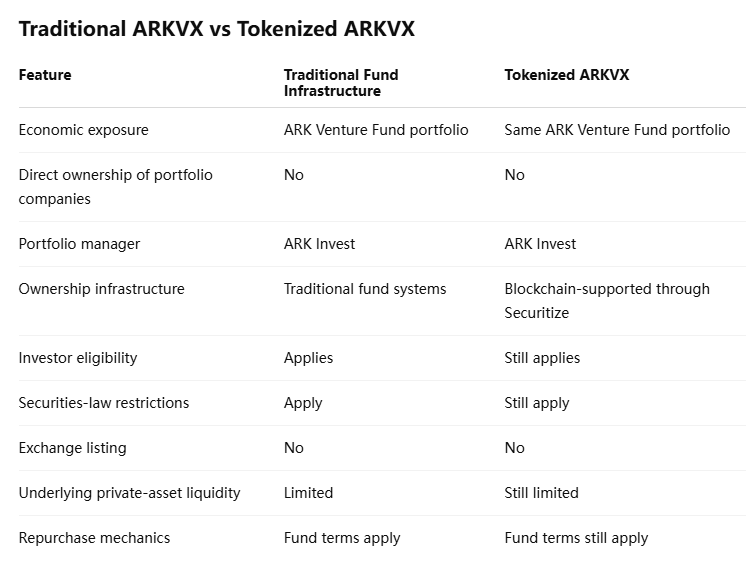
The comparison shows why tokenization should be viewed as an infrastructure change rather than an economic transformation. The investment risks, management strategy and portfolio remain those of ARKVX. What changes is how ownership can be recorded and administered.
Changing the wrapper does not automatically change the asset underneath it.
Why Securitize Matters More Than Ethereum Alone
Describing the project only as “ARK puts a fund on Ethereum” misses a large part of the institutional architecture. Ethereum provides programmable blockchain infrastructure, but a regulated fund also needs investor identity, securities compliance, transfer controls and legally recognized ownership records. Securitize is important because it connects those requirements to the blockchain layer.
By August 2026, Securitize said it had approximately $5 billion in tokenized assets under management and had worked with institutions including BlackRock, Apollo, BNY, Hamilton Lane, KKR and VanEck. This places ARK's launch within a broader shift in which traditional asset managers are using common tokenization infrastructure rather than building every component themselves.
Institutional tokenization is therefore likely to develop as a stack. The blockchain handles programmable state and settlement, while transfer agents, broker-dealers, custodians, administrators and investment managers continue to perform regulated functions around that state.
For ARKVX, Ethereum matters, but the regulated connection between Ethereum and the legal fund interest matters more.
Why Is ARKVX a Harder Tokenization Test Than a Treasury Fund?
The first wave of institutional RWA adoption concentrated heavily on Treasury and money-market products. These assets are relatively standardized, have transparent pricing and generally offer deep liquidity. They are therefore easier to integrate with blockchain systems without introducing large valuation or redemption uncertainties.
ARKVX is substantially more complex. Its portfolio includes private and early-stage companies whose securities may have limited transaction history and can be difficult to price. The fund is actively managed, so the portfolio can also change over time rather than remaining a fixed basket of tokenized assets. Liquidity is intentionally restricted through the interval-fund structure.
Those characteristics make ARK Venture Fund tokenization more interesting from an infrastructure perspective. Blockchain has to support a product whose legal and economic constraints remain complex instead of relying on a highly liquid underlying asset to make the user experience simple.
If that model works, the addressable tokenization market expands far beyond Treasury bills. Private equity, venture exposure, alternative investment funds and other restricted products can potentially adopt blockchain infrastructure without pretending to behave like liquid public-market securities.
MEXC View: Tokenization Is Moving Up the Capital Stack
The institutional RWA market initially proved itself with assets that were easy to standardize: cash-equivalent products, Treasury funds and other instruments with clear valuations and established liquidity. ARKVX shows tokenization beginning to move toward investments that are structurally more difficult.
That is important because it changes what blockchain is being asked to solve. With a Treasury fund, the challenge is largely efficient issuance and settlement. With an actively managed venture fund, the infrastructure must also coexist with private-company valuation uncertainty, investor eligibility and limited liquidity.
The opportunity therefore is not to make every financial asset trade like crypto. It is to make existing securities infrastructure more programmable while preserving the rules that give each product its legal meaning.
If this approach scales, the long-term RWA market may be defined less by how many assets can be wrapped into tokens and more by how many existing financial products can migrate their ownership, servicing and settlement processes onto shared digital infrastructure.
Risks and Limitations
ARKVX remains a complex and high-risk investment regardless of the technology used to represent its shares.
- Private-company valuation risk: holdings may be difficult to value and can change materially between financing events.
- Limited liquidity: ARKVX shares are not exchange-listed and should not be treated as continuously tradable.
- Repurchase risk: periodic repurchase offers may be limited or oversubscribed.
- Portfolio risk: ARK actively manages the fund, so holdings and exposure can change.
- Eligibility restrictions: blockchain representation does not remove securities-law or investor requirements.
- Technology risk: smart contracts, wallets and digital custody create additional operational dependencies.
- Ownership confusion: ARKVX investors do not directly own the fund's portfolio-company shares.
The central limitation is therefore conceptual as well as financial. A token can move quickly while the asset it represents remains illiquid, restricted and difficult to value. Blockchain modernizes the infrastructure; it does not repeal the economics of private markets.
ARK Venture Fund tokenization Modernizes Access, Not the Assets
ARK Venture Fund tokenization is notable because it brings a relatively complex investment vehicle onto blockchain infrastructure without changing what investors economically own. Eligible investors receive exposure to ARKVX, while the fund continues to own and manage the underlying portfolio of private and public companies. OpenAI, Anthropic, Stripe and other holdings are not individually converted into freely tradable tokens through this structure.
The same principle applies to liquidity. Ethereum can provide programmable ownership records and support digital transfer workflows, but ARKVX remains an interval fund with limited liquidity and periodic repurchase mechanics. Tokenization cannot automatically create a secondary market for private-company exposure or remove the restrictions embedded in the fund's legal structure.
That is precisely why the development matters. Institutional tokenization does not need to transform every asset into a 24/7 permissionless instrument to create value. It can improve onboarding, ownership records, transfer controls and fund administration while preserving existing securities laws and product structures.
The ARKVX launch therefore represents a more mature form of RWA adoption. The underlying venture assets remain private, difficult to value and relatively illiquid, while the ownership infrastructure around them becomes programmable. If that model proves scalable, tokenization can expand beyond liquid Treasury products and begin modernizing the administrative layer of private capital itself.
Sources
Securitize — ARK Invest Tokenizes ARK Venture Fund (ARKVX):
https://investors.securitize.io/news/news-details/2026/ARK-Invest-Tokenizes-ARK-Venture-Fund-ARKVX-with-Securitize/default.aspx
ARK Invest — ARK Venture Fund:
https://www.ark-funds.com/funds/arkvx
ARK Invest — ARK Venture Fund Reports:
https://www.ark-funds.com/reports-venture
Risk Disclaimer: This article is for reference only and does not constitute investment advice. The cryptocurrency market is highly volatile. Please make decisions cautiously based on your individual circumstances.
You May Also Like
Do ETFs Really Diversify Risk? From Sector Concentration to Cross-Market Allocation
USDC MiCA: Is Europe Raising the Bar for Stablecoins?