The post Can The Edmonton Oilers’ Fortunes In Goal Improve With Tristan Jarry? appeared on BitcoinEthereumNews.com. The Edmonton Oilers have acquired Tristan JarryThe post Can The Edmonton Oilers’ Fortunes In Goal Improve With Tristan Jarry? appeared on BitcoinEthereumNews.com. The Edmonton Oilers have acquired Tristan Jarry

Can The Edmonton Oilers’ Fortunes In Goal Improve With Tristan Jarry?

The Edmonton Oilers have acquired Tristan Jarry from the Pittsburgh Penguins in a multi-player deal that saw them part ways with Stuart Skinner. (Photo by Justin Berl/Getty Images)

Getty Images

A new era has begun for the Edmonton Oilers. On Friday morning, the team announced that GM Stan Bowman had acquired goaltender Tristan Jarry and right wing Sam Poulin from the Pittsburgh Penguins in exchange for goaltender Stuart Skinner, defenseman Brett Kulak and a second-round pick in the 2029 draft.

In a secondary deal, the Oilers also acquired defenseman Spencer Stastney from the Nashville Predators in exchange for a third-round pick in 2027.

With Stanley Cup expectations following losses in the Final in both 2023 and 2024, Jarry offers the potential for a more stable crease after Skinner’s mercurial run with his hometown team.

In six seasons in Edmonton, Skinner amassed a regular-season record of 109-62-18 with a .904 save percentage and 2.74 goals-against average. Selected by the Oilers in the third round of the 2017 draft, two years after Connor McDavid’s arrival, Skinner has been the team’s starter through its most successful run since the great teams of the 1980s. But he was shaky enough in his playoff appearances to cause the team to turn to backup Calvin Pickard at times in both the 2023 and 2024 post-seasons, and couldn’t deliver a championship when the stakes were at their highest.

This season, the noise intensified as the Oilers struggled out of the gate. Skinner leaves with a save perentage of .891 and goals-against of 2.83 this season — both career lows for him. But after going 2-0-1 in his last three games, he departs with a record of 11-8-4 as the Oilers sit in the first wild-card spot in the Western Conference with an overall record of 14-11-6.

Jarry, 30, is returning to a city where he had success before joining the NHL. Drafted 44th overall by the Penguins in 2013, the native of Surrey, B.C. played his junior hockey with the WHL’s Edmonton Oil Kings. In 2013-14, Jarry backstopped the Oil Kings to a WHL championship and the Memorial Cup.

The move will be an easy adjustment, as Jarry lives and trains in Edmonton during the off-season. His contract term also aligns with the Oilers’ current Stanley Cup window. His current five-year deal with a cap hit of $5.375 million expires at the end of the 2027-28 season — the same time as Connor McDavid’s new two-year contract extension.

The downside is that the Oilers needed to include Kulak in the deal in order to make the money work. They’re tight to the salary-cap ceiling and Skinner’s cap hit is just $2.6 million. Kulak is a reliable defensive defenseman and an Edmonton native, but taking his $2.75 million cap hit off the books offers just enough room to bring in Jarry.

Both Skinner and Kulak are on expiring contracts and can become unrestricted free agents at the end of this season.

With their current roster situation, including defenseman Jake Walman being placed on long-term injured reserve on Thursday, PuckPedia currently shows the Oilers with $934,167 in available cap space after the trades and Friday’s other roster moves were executed.

Jarry’s career numbers with the Penguins are good. In 10 seasons, he’s 161-100-32, with a .909 save percentage and 2.74 goals-against average. This year, he has been right at .909 and dropped his GAA to 2.66 while putting up a record of 9-3-1. And while most pre-season projections expected the Penguins to sit near the bottom of the standings, they’re also in the playoff mix at 14-8-7, currently sitting in the second wild-card spot in the ultra-tight Eastern Conference.

As frustrated as Oilers fans have been with Skinner’s inconsistency, Jarry’s playoff resume doesn’t deliver much immediate comfort. He was in the minors when the Penguins won their Stanley Cups in 2016 and 2017, has played just eight post-season games over three seasons in his career and has been plagued by injuries, especially at the most important time of year.

That hasn’t been an issue for the last three seasons, since the Penguins failed to qualify for the playoffs. Jarry’s injury history has been better in recent years but last season, a rough start in his first three games led to an early benching, then a five-game conditioning stint with the AHL’s Wilkes-Barre/Scranton Penguins in the fall of 2024. In January of 2025, he cleared waivers and suited up for seven more AHL games.

After closing out a successful five-game homestand with a record of 3-1-1, the Oilers now hit the road for five games, including high-profile stops in Toronto and Montreal and a visit to Pittsburgh next Tuesday, Dec. 16.

The Penguins are 0-1-2 in their last three games, and Jarry took the loss on Thursday in Pittsburgh’s 4-2 defeat at the hands of the Montreal Canadiens. They’ll host the Utah Mammoth and San Jose Sharks in weekend matinee games before closing out their homestand against the Oilers.

Every meeting between the Edmonton Oilers’ Connor McDavid and the Pittsburgh Penguins’ Sidney Crosby is must-see TV. With the high stakes of both teams’ playoff chases and the added intrigue of this goalie swap, there are plenty of storylines on deck for the national broadcast on the NHL on TNT.

Source: https://www.forbes.com/sites/carolschram/2025/12/12/can-the-edmonton-oilers-fortunes-in-goal-improve-with-tristan-jarry/
Market Opportunity
Multichain Logo
Multichain Price(MULTI)
$0.03963
$0.03963$0.03963
+6.47%
USD
Multichain (MULTI) Live Price Chart
Disclaimer: The articles reposted on this site are sourced from public platforms and are provided for informational purposes only. They do not necessarily reflect the views of MEXC. All rights remain with the original authors. If you believe any content infringes on third-party rights, please contact [email protected] for removal. MEXC makes no guarantees regarding the accuracy, completeness, or timeliness of the content and is not responsible for any actions taken based on the information provided. The content does not constitute financial, legal, or other professional advice, nor should it be considered a recommendation or endorsement by MEXC.

You May Also Like

Building a DEXScreener Clone: A Step-by-Step Guide

Building a DEXScreener Clone: A Step-by-Step Guide

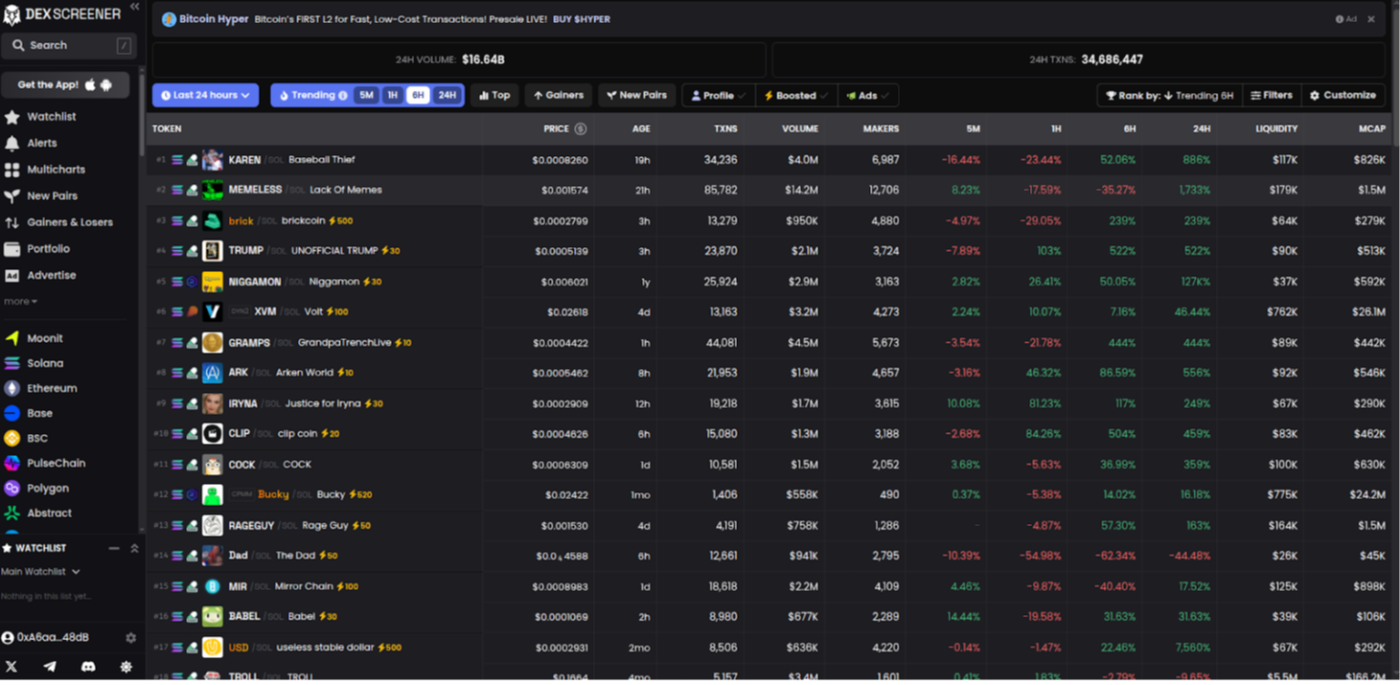
DEX Screener is used by crypto traders who need access to on-chain data like trading volumes, liquidity, and token prices. This information allows them to analyze trends, monitor new listings, and make informed investment decisions. In this tutorial, I will build a DEXScreener clone from scratch, covering everything from the initial design to a functional app. We will use Streamlit, a Python framework for building full-stack apps.
Share
Hackernoon2025/09/18 15:05
Which DOGE? Musk's Cryptic Post Explodes Confusion

Which DOGE? Musk's Cryptic Post Explodes Confusion

A viral chart documenting a sharp decline in U.S. federal employment during President Trump's second term has sparked unexpected confusion in cryptocurrency markets
Share
Coinstats2025/12/20 01:13
Google's AP2 protocol has been released. Does encrypted AI still have a chance?

Google's AP2 protocol has been released. Does encrypted AI still have a chance?

Following the MCP and A2A protocols, the AI Agent market has seen another blockbuster arrival: the Agent Payments Protocol (AP2), developed by Google. This will clearly further enhance AI Agents' autonomous multi-tasking capabilities, but the unfortunate reality is that it has little to do with web3AI. Let's take a closer look: What problem does AP2 solve? Simply put, the MCP protocol is like a universal hook, enabling AI agents to connect to various external tools and data sources; A2A is a team collaboration communication protocol that allows multiple AI agents to cooperate with each other to complete complex tasks; AP2 completes the last piece of the puzzle - payment capability. In other words, MCP opens up connectivity, A2A promotes collaboration efficiency, and AP2 achieves value exchange. The arrival of AP2 truly injects "soul" into the autonomous collaboration and task execution of Multi-Agents. Imagine AI Agents connecting Qunar, Meituan, and Didi to complete the booking of flights, hotels, and car rentals, but then getting stuck at the point of "self-payment." What's the point of all that multitasking? So, remember this: AP2 is an extension of MCP+A2A, solving the last mile problem of AI Agent automated execution. What are the technical highlights of AP2? The core innovation of AP2 is the Mandates mechanism, which is divided into real-time authorization mode and delegated authorization mode. Real-time authorization is easy to understand. The AI Agent finds the product and shows it to you. The operation can only be performed after the user signs. Delegated authorization requires the user to set rules in advance, such as only buying the iPhone 17 when the price drops to 5,000. The AI Agent monitors the trigger conditions and executes automatically. The implementation logic is cryptographically signed using Verifiable Credentials (VCs). Users can set complex commission conditions, including price ranges, time limits, and payment method priorities, forming a tamper-proof digital contract. Once signed, the AI Agent executes according to the conditions, with VCs ensuring auditability and security at every step. Of particular note is the "A2A x402" extension, a technical component developed by Google specifically for crypto payments, developed in collaboration with Coinbase and the Ethereum Foundation. This extension enables AI Agents to seamlessly process stablecoins, ETH, and other blockchain assets, supporting native payment scenarios within the Web3 ecosystem. What kind of imagination space can AP2 bring? After analyzing the technical principles, do you think that's it? Yes, in fact, the AP2 is boring when it is disassembled alone. Its real charm lies in connecting and opening up the "MCP+A2A+AP2" technology stack, completely opening up the complete link of AI Agent's autonomous analysis+execution+payment. From now on, AI Agents can open up many application scenarios. For example, AI Agents for stock investment and financial management can help us monitor the market 24/7 and conduct independent transactions. Enterprise procurement AI Agents can automatically replenish and renew without human intervention. AP2's complementary payment capabilities will further expand the penetration of the Agent-to-Agent economy into more scenarios. Google obviously understands that after the technical framework is established, the ecological implementation must be relied upon, so it has brought in more than 60 partners to develop it, almost covering the entire payment and business ecosystem. Interestingly, it also involves major Crypto players such as Ethereum, Coinbase, MetaMask, and Sui. Combined with the current trend of currency and stock integration, the imagination space has been doubled. Is web3 AI really dead? Not entirely. Google's AP2 looks complete, but it only achieves technical compatibility with Crypto payments. It can only be regarded as an extension of the traditional authorization framework and belongs to the category of automated execution. There is a "paradigm" difference between it and the autonomous asset management pursued by pure Crypto native solutions. The Crypto-native solutions under exploration are taking the "decentralized custody + on-chain verification" route, including AI Agent autonomous asset management, AI Agent autonomous transactions (DeFAI), AI Agent digital identity and on-chain reputation system (ERC-8004...), AI Agent on-chain governance DAO framework, AI Agent NPC and digital avatars, and many other interesting and fun directions. Ultimately, once users get used to AI Agent payments in traditional fields, their acceptance of AI Agents autonomously owning digital assets will also increase. And for those scenarios that AP2 cannot reach, such as anonymous transactions, censorship-resistant payments, and decentralized asset management, there will always be a time for crypto-native solutions to show their strength? The two are more likely to be complementary rather than competitive, but to be honest, the key technological advancements behind AI Agents currently all come from web2AI, and web3AI still needs to keep up the good work!
Share
PANews2025/09/18 07:00