As Bitcoin nears $87K, stablecoin spending takes focus. Here’s how Remittix compares to Digitap’s live omni-bank app and why $TAP stands out for 2026.As Bitcoin nears $87K, stablecoin spending takes focus. Here’s how Remittix compares to Digitap’s live omni-bank app and why $TAP stands out for 2026.

Remittix Vs Digitap ($TAP): Who Wins The Stablecoin Spending Boom As Bitcoin Trades Near $87K?

bitcoin17 main

As Bitcoin hovers near $87K, attention is shifting from pure price speculation to real-world utility, especially in stablecoin spending and crypto-powered banking. That shift is happening just as two crypto presale contenders, Remittix (RTX) and Digitap ($TAP), race to capture users looking for practical ways to spend, move, and earn with digital assets.

The timing feels deliberate. Digitap has rolled out its 12 Days of Christmas event, layering its presale with rotating bonuses, account upgrades, and short-window rewards. For investors scanning the market for the best crypto to buy now, the seasonal push adds a clear sense of momentum at a time when most projects are staying quiet.

Features Driving Digitap Use: Fiat, Crypto, And Cards

Before comparing numbers, it’s important to understand why Digitap is gaining traction. The project positions itself as a live crypto banking app, not just a roadmap. 

Users can already manage 20+ fiat currencies and 100+ cryptocurrencies in one interface, move funds globally via SEPA, SWIFT, and blockchain rails, and spend directly using Digitap cards.

digitap3258 1

This matters in today’s market. As volatility compresses upside for large-cap coins, capital is rotating into altcoins to buy that solve real problems. Digitap’s value proposition, global payment freedom with user control, fits neatly into that trend.

Trust is part of the equation as well. Digitap works alongside licensed banking partners, connects users to established payment rails, and relies on audited smart contracts rather than closed systems. With more than 100,000 wallets already linked to the presale, the project appears to be attracting steady interest despite a more cautious market backdrop.

OVER $300K IN BONUSES, PRIZES, GIVEAWAYS. DIGITAP CHRISTMAS SALE IS LIVE

Remittix VS $TAP Presale Numbers — What the Stage Data Shows

Remittix is currently priced at $0.119, with the next stage at $0.123. Roughly 74% of the current presale stage is completed, with about $29 million raised so far. These figures show solid traction, but much of the early upside has already been captured compared to its starting price of $0.015.

chart54949

Digitap tells a different story. $TAP began at $0.0125 and is now priced at $0.0371, with the next increase set at $0.0383. About 57% of the current round is complete, and nearly 150 million tokens have been sold. Importantly, these percentages reflect stage progress, not the full presale.

digitap3258 2

To put this into perspective, moving from the current presale price near $0.037 to the planned listing price of $0.14 represents a potential uplift of roughly 3.8×, assuming execution milestones are met. That mathematical asymmetry is why $TAP is increasingly framed as a crypto to buy now rather than later.

Where $TAP Demand Could Come From Beyond Transfers

Remittix focuses on crypto-to-fiat remittances, aiming to streamline cross-border payments. Built on Ethereum, RTX has a fixed supply of 1.5 billion tokens, no buy or sell taxes, and staking yields projected between 4% and 8% annually. Presale buyers face no vesting, while team tokens are locked for three years, a structure designed to reduce early sell pressure.

Digitap, however, expands beyond transfers into a full financial ecosystem. The $TAP token fuels cashback, fee reductions, staking, governance, and VIP account access. With a fixed 2 billion supply, zero inflation, no transaction taxes, and multiple burn mechanisms, $TAP is designed around long-term scarcity rather than short-term hype.

Where Remittix optimizes one core function, Digitap integrates payments, banking, rewards, and governance into a single loop, an important distinction as users increasingly demand utility they can access daily.

digitap3258 3

What “Spendable Crypto” Requires: Compliance, UX, And Rewards

The stablecoin spending boom favors platforms that combine compliance, usability, and incentives. Remittix benefits from simplicity and a focused remittance narrative, but Digitap’s breadth creates more demand vectors for its token. Every payment, transfer, cashback reward, and staking action reinforces $TAP’s role inside the ecosystem.

The ongoing 12 Days of Christmas campaign amplifies this effect. Every 12 hours, new rewards unlock, ranging from free Premium and PRO accounts to token bonuses, encouraging repeat engagement at a time when many investors are sitting on the sidelines. In a bear-leaning market, that kind of activity matters.

Digitap

Why “Spend, Not Trade” Could Define The Next Altcoins to Buy Cycle

Both projects are part of the broader wave of crypto presales with real utility, but they appeal to different risk profiles. Remittix offers exposure to a specialized payments niche, while Digitap positions itself as a holistic financial layer for crypto-native users.

For investors evaluating the best crypto to buy now, Digitap’s combination of early-stage pricing, live product, transparent tokenomics, and seasonal momentum makes it one of the more compelling altcoins to buy heading into the next market phase. 

As Bitcoin consolidates near all-time highs, projects that turn crypto into something spendable, not just tradable, are likely to define the next cycle.

Discover how Digitap is unifying cash and crypto by checking out their project here:

Presale: https://presale.digitap.app

Website: https://digitap.app 

Social: https://linktr.ee/digitap.app 

Win $250K: https://gleam.io/bfpzx/digitap-250000-giveaway

Market Opportunity
TAP Protocol Logo
TAP Protocol Price(TAP)
$0.1631
$0.1631$0.1631
-0.06%
USD
TAP Protocol (TAP) Live Price Chart
Disclaimer: The articles reposted on this site are sourced from public platforms and are provided for informational purposes only. They do not necessarily reflect the views of MEXC. All rights remain with the original authors. If you believe any content infringes on third-party rights, please contact [email protected] for removal. MEXC makes no guarantees regarding the accuracy, completeness, or timeliness of the content and is not responsible for any actions taken based on the information provided. The content does not constitute financial, legal, or other professional advice, nor should it be considered a recommendation or endorsement by MEXC.

You May Also Like

Building a DEXScreener Clone: A Step-by-Step Guide

Building a DEXScreener Clone: A Step-by-Step Guide

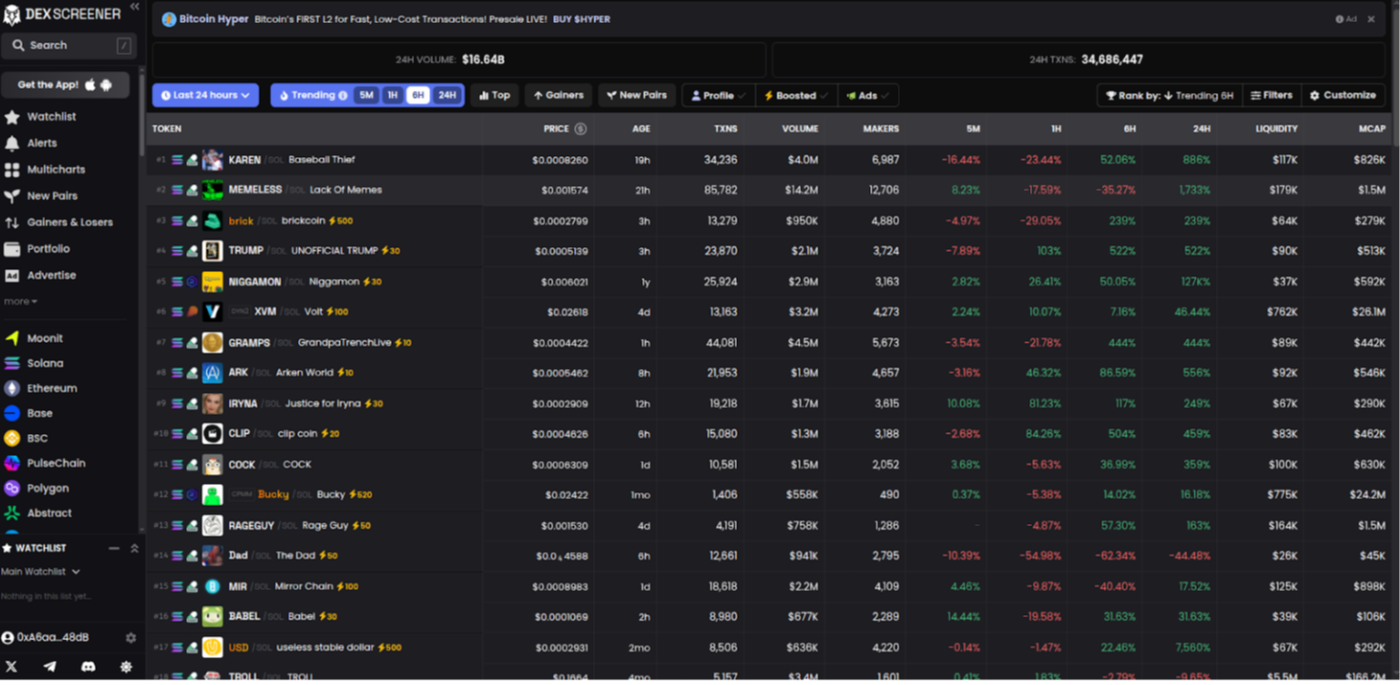
DEX Screener is used by crypto traders who need access to on-chain data like trading volumes, liquidity, and token prices. This information allows them to analyze trends, monitor new listings, and make informed investment decisions. In this tutorial, I will build a DEXScreener clone from scratch, covering everything from the initial design to a functional app. We will use Streamlit, a Python framework for building full-stack apps.
Share
Hackernoon2025/09/18 15:05
Which DOGE? Musk's Cryptic Post Explodes Confusion

Which DOGE? Musk's Cryptic Post Explodes Confusion

A viral chart documenting a sharp decline in U.S. federal employment during President Trump's second term has sparked unexpected confusion in cryptocurrency markets
Share
Coinstats2025/12/20 01:13
Google's AP2 protocol has been released. Does encrypted AI still have a chance?

Google's AP2 protocol has been released. Does encrypted AI still have a chance?

Following the MCP and A2A protocols, the AI Agent market has seen another blockbuster arrival: the Agent Payments Protocol (AP2), developed by Google. This will clearly further enhance AI Agents' autonomous multi-tasking capabilities, but the unfortunate reality is that it has little to do with web3AI. Let's take a closer look: What problem does AP2 solve? Simply put, the MCP protocol is like a universal hook, enabling AI agents to connect to various external tools and data sources; A2A is a team collaboration communication protocol that allows multiple AI agents to cooperate with each other to complete complex tasks; AP2 completes the last piece of the puzzle - payment capability. In other words, MCP opens up connectivity, A2A promotes collaboration efficiency, and AP2 achieves value exchange. The arrival of AP2 truly injects "soul" into the autonomous collaboration and task execution of Multi-Agents. Imagine AI Agents connecting Qunar, Meituan, and Didi to complete the booking of flights, hotels, and car rentals, but then getting stuck at the point of "self-payment." What's the point of all that multitasking? So, remember this: AP2 is an extension of MCP+A2A, solving the last mile problem of AI Agent automated execution. What are the technical highlights of AP2? The core innovation of AP2 is the Mandates mechanism, which is divided into real-time authorization mode and delegated authorization mode. Real-time authorization is easy to understand. The AI Agent finds the product and shows it to you. The operation can only be performed after the user signs. Delegated authorization requires the user to set rules in advance, such as only buying the iPhone 17 when the price drops to 5,000. The AI Agent monitors the trigger conditions and executes automatically. The implementation logic is cryptographically signed using Verifiable Credentials (VCs). Users can set complex commission conditions, including price ranges, time limits, and payment method priorities, forming a tamper-proof digital contract. Once signed, the AI Agent executes according to the conditions, with VCs ensuring auditability and security at every step. Of particular note is the "A2A x402" extension, a technical component developed by Google specifically for crypto payments, developed in collaboration with Coinbase and the Ethereum Foundation. This extension enables AI Agents to seamlessly process stablecoins, ETH, and other blockchain assets, supporting native payment scenarios within the Web3 ecosystem. What kind of imagination space can AP2 bring? After analyzing the technical principles, do you think that's it? Yes, in fact, the AP2 is boring when it is disassembled alone. Its real charm lies in connecting and opening up the "MCP+A2A+AP2" technology stack, completely opening up the complete link of AI Agent's autonomous analysis+execution+payment. From now on, AI Agents can open up many application scenarios. For example, AI Agents for stock investment and financial management can help us monitor the market 24/7 and conduct independent transactions. Enterprise procurement AI Agents can automatically replenish and renew without human intervention. AP2's complementary payment capabilities will further expand the penetration of the Agent-to-Agent economy into more scenarios. Google obviously understands that after the technical framework is established, the ecological implementation must be relied upon, so it has brought in more than 60 partners to develop it, almost covering the entire payment and business ecosystem. Interestingly, it also involves major Crypto players such as Ethereum, Coinbase, MetaMask, and Sui. Combined with the current trend of currency and stock integration, the imagination space has been doubled. Is web3 AI really dead? Not entirely. Google's AP2 looks complete, but it only achieves technical compatibility with Crypto payments. It can only be regarded as an extension of the traditional authorization framework and belongs to the category of automated execution. There is a "paradigm" difference between it and the autonomous asset management pursued by pure Crypto native solutions. The Crypto-native solutions under exploration are taking the "decentralized custody + on-chain verification" route, including AI Agent autonomous asset management, AI Agent autonomous transactions (DeFAI), AI Agent digital identity and on-chain reputation system (ERC-8004...), AI Agent on-chain governance DAO framework, AI Agent NPC and digital avatars, and many other interesting and fun directions. Ultimately, once users get used to AI Agent payments in traditional fields, their acceptance of AI Agents autonomously owning digital assets will also increase. And for those scenarios that AP2 cannot reach, such as anonymous transactions, censorship-resistant payments, and decentralized asset management, there will always be a time for crypto-native solutions to show their strength? The two are more likely to be complementary rather than competitive, but to be honest, the key technological advancements behind AI Agents currently all come from web2AI, and web3AI still needs to keep up the good work!
Share
PANews2025/09/18 07:00