The post The Hidden Difference Behind Card Payments appeared on BitcoinEthereumNews.com. Fintech Card payments often look identical at the checkout, but what happensThe post The Hidden Difference Behind Card Payments appeared on BitcoinEthereumNews.com. Fintech Card payments often look identical at the checkout, but what happens

The Hidden Difference Behind Card Payments

Fintech

Card payments often look identical at the checkout, but what happens behind the scenes can be very different.

Key takeaways
  • On-us transactions happen when issuer and acquirer are the same bank and stay on internal rails.
  • Off-us transactions involve different banks and require card networks and interbank settlement.
  • The difference has major implications for payment speed, fees, and infrastructure design. 

The key distinction is whether a transaction is processed on-us or off-us – a technical detail that has major consequences for speed, cost, and financial infrastructure.

Same bank or different banks makes all the difference

At its core, the on-us versus off-us question is simple: are the cardholder’s bank and the merchant’s bank the same institution, or not? That single factor determines whether a payment stays within one bank’s internal systems or needs to travel through global card networks and interbank settlement layers.

On-us transactions stay inside one bank

An on-us transaction occurs when the card issuer and the merchant acquirer are the same bank. In this case, the entire payment flow remains internal. Authorization, clearing, and settlement are handled within the bank’s own rails, without relying on external networks.

A typical example would be a Standard Bank card used at a merchant that is also acquired by Standard Bank. Because issuer and acquirer are the same, routing is simpler, processing is faster, and costs are usually lower.

Off-us transactions rely on card networks

Off-us transactions come into play when the cardholder’s bank and the merchant’s bank are different. Here, the issuer and acquirer are separate institutions, which means the transaction must be routed through a card network such as Visa, Mastercard, or RuPay.

For example, a Standard Bank card used at a merchant acquired by Alfa Bank triggers an off-us flow. The payment moves from the merchant to the acquirer, across the card network to the issuer, and later through interbank settlement. This adds complexity, time, and additional fees.

Why this matters for the financial system

While the concept is straightforward, the implications are significant. On-us transactions are typically faster and cheaper because they avoid network fees and interbank settlement. Off-us transactions, on the other hand, depend on global payment networks and clearing systems, making them more expensive and operationally complex.

As banks, fintechs, and regulators rethink payment infrastructure, the balance between internal rails and network-based payments plays a growing role in discussions around efficiency, resilience, and cost reduction.


The information provided in this article is for educational purposes only and does not constitute financial, investment, or trading advice. Coindoo.com does not endorse or recommend any specific investment strategy or cryptocurrency. Always conduct your own research and consult with a licensed financial advisor before making any investment decisions.

Author

Alexander Zdravkov is a person who always looks for the logic behind things. He has more than 3 years of experience in the crypto space, where he skillfully identifies new trends in the world of digital currencies. Whether providing in-depth analysis or daily reports on all topics, his deep understanding and enthusiasm for what he does make him a valuable member of the team.

Next article

Source: https://coindoo.com/on-us-vs-off-us-transactions-the-hidden-difference-behind-card-payments/

Disclaimer: The articles reposted on this site are sourced from public platforms and are provided for informational purposes only. They do not necessarily reflect the views of MEXC. All rights remain with the original authors. If you believe any content infringes on third-party rights, please contact [email protected] for removal. MEXC makes no guarantees regarding the accuracy, completeness, or timeliness of the content and is not responsible for any actions taken based on the information provided. The content does not constitute financial, legal, or other professional advice, nor should it be considered a recommendation or endorsement by MEXC.

You May Also Like

Telos Advisers Welcomes Stephen Gardner as a Strategic Advisory Board Member

Telos Advisers Welcomes Stephen Gardner as a Strategic Advisory Board Member

Former Amtrak CEO brings more than 25 years of leadership experience in rail, infrastructure delivery, and national transportation policy NEWARK, N.J.–(BUSINESS
Share
AI Journal2026/02/03 02:16
CEO Sandeep Nailwal Shared Highlights About RWA on Polygon

CEO Sandeep Nailwal Shared Highlights About RWA on Polygon

The post CEO Sandeep Nailwal Shared Highlights About RWA on Polygon appeared on BitcoinEthereumNews.com. Polygon CEO Sandeep Nailwal highlighted Polygon’s lead in global bonds, Spiko US T-Bill, and Spiko Euro T-Bill. Polygon published an X post to share that its roadmap to GigaGas was still scaling. Sentiments around POL price were last seen to be bearish. Polygon CEO Sandeep Nailwal shared key pointers from the Dune and RWA.xyz report. These pertain to highlights about RWA on Polygon. Simultaneously, Polygon underlined its roadmap towards GigaGas. Sentiments around POL price were last seen fumbling under bearish emotions. Polygon CEO Sandeep Nailwal on Polygon RWA CEO Sandeep Nailwal highlighted three key points from the Dune and RWA.xyz report. The Chief Executive of Polygon maintained that Polygon PoS was hosting RWA TVL worth $1.13 billion across 269 assets plus 2,900 holders. Nailwal confirmed from the report that RWA was happening on Polygon. The Dune and https://t.co/W6WSFlHoQF report on RWA is out and it shows that RWA is happening on Polygon. Here are a few highlights: – Leading in Global Bonds: Polygon holds 62% share of tokenized global bonds (driven by Spiko’s euro MMF and Cashlink euro issues) – Spiko U.S.… — Sandeep | CEO, Polygon Foundation (※,※) (@sandeepnailwal) September 17, 2025 The X post published by Polygon CEO Sandeep Nailwal underlined that the ecosystem was leading in global bonds by holding a 62% share of tokenized global bonds. He further highlighted that Polygon was leading with Spiko US T-Bill at approximately 29% share of TVL along with Ethereum, adding that the ecosystem had more than 50% share in the number of holders. Finally, Sandeep highlighted from the report that there was a strong adoption for Spiko Euro T-Bill with 38% share of TVL. He added that 68% of returns were on Polygon across all the chains. Polygon Roadmap to GigaGas In a different update from Polygon, the community…
Share
BitcoinEthereumNews2025/09/18 01:10
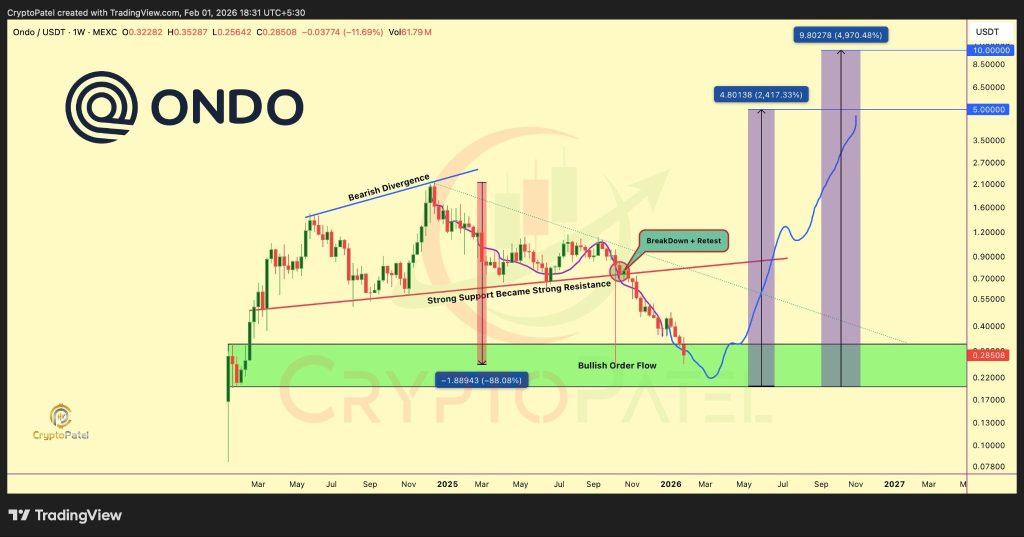
ONDO Price Crashes 88% From All-Time Highs, But Analyst Says ‘Last Hope’ Zone Is Here

ONDO Price Crashes 88% From All-Time Highs, But Analyst Says ‘Last Hope’ Zone Is Here

The ONDO price has drifted into a part of the chart that usually gets traders paying attention. After months of downside, the price is now sitting inside a zone
Share
Captainaltcoin2026/02/03 02:30