

BitMEX Hyperliquid Copy Trading Review
Disclosure: CoinCodeCap may earn a commission if you sign up for BitMEX or Hyperliquid through links on this page. Risk warning: Copy trading is high-risk. Past performance does not guarantee future results. Leveraged perpetuals can lose more than your initial margin during volatility events. Never copy with capital you cannot afford to lose.
How I Reviewed This: I read through BitMEX’s official launch announcement and the full how-to guide on bitmex.com, set up a test account, walked through the Hyperliquid tab on the Copy Trading Marketplace, and stress-tested the configuration screens for Mirror Mode, Stop Loss, and Take Profit. Where the official docs left gaps (asset coverage, funding rate divergence, latency), I noted them as open questions and called them out below. All product-mechanic claims in this review come directly from BitMEX’s official blog posts dated 5 February 2026.
I’ll be honest: when I first saw the headline “BitMEX launches Hyperliquid Copy Trading” on 5 February 2026, my reaction was skeptical. A centralized exchange replicating positions from a decentralized perp DEX sounds like the kind of feature that exists more for marketing than for traders. But once I dug into the mechanics — and especially how BitMEX is using Hyperliquid’s L1 open-source code to track positions on-chain — I realized there’s actually something useful here for a specific kind of trader. Not for everyone. But for a real subset.
This is my detailed walkthrough of how BitMEX Hyperliquid Copy Trading actually works, what the mechanics look like in practice, where the friction points are, and who I think should (and shouldn’t) use it. Most reviews so far have been press-release rewrites. I want to give you the trader’s-eye view: the parts the official blog post glosses over, the latency questions, the funding rate divergence, and the question of what happens when a Hyperliquid leader trades an asset BitMEX doesn’t list.
| My Verdict | Score | Notes |
|---|---|---|
| Replication mechanism | 8/10 | Tracks Hyperliquid L1 positions via on-chain data; latency is the unanswered question |
| Risk controls | 9/10 | Per-leader Stop Loss + Take Profit + Mirror Mode toggle is genuinely well-designed |
| Fee transparency | 6/10 | Standard BitMEX trading fees are clear; profit-share rates (0–50%) vary opaquely per leader |
| Asset coverage | 5/10 | BitMEX contract list ≠ Hyperliquid’s 50+ markets; doc doesn’t address mismatch |
| Onboarding friction | 7/10 | KYC required (versus Hyperliquid’s no-KYC), but $100 minimum is genuinely accessible |
| Reverse Copy feature | 9/10 | Genuinely novel — useful for fading leaders or pair-trading |
| 📌 My verdict — Useful for time-constrained traders who want Hyperliquid alpha without DeFi friction. Not for: low-cost-first traders, US persons, or anyone who needs the exact funding rate Hyperliquid offers. | ||
TL;DR — What BitMEX Hyperliquid Copy Trading Actually Is
Strip away the marketing and here’s what’s happening under the hood:
- BitMEX runs (or queries) Hyperliquid L1 nodes to track on-chain positions of selected top traders. Hyperliquid’s L1 code is open source, so the position data is fully visible.
- When a tracked Hyperliquid trader opens or closes a position, BitMEX’s automated system mirrors that trade on the BitMEX order book, in your account, at the prevailing BitMEX price.
- You’re not bridging to Hyperliquid. You’re not custodying anything on Arbitrum. Your funds stay on BitMEX the whole time.
- You can copy up to 5 leaders simultaneously, with a $100 minimum per leader (leaders can raise this floor).
- BitMEX charges no extra platform fee for copy trading — you pay the standard BitMEX maker/taker fees plus a leader-set profit share of 0–50% (you only pay this on profitable closed trades; you pay zero on losers).
- Reverse Copy is the differentiating feature: the same UI, but you take the opposite side of every trade the leader opens.
Pros and Cons From a Trader’s Perspective
| What I liked | What concerned me |
|---|---|
| Genuine no-DeFi-friction access to Hyperliquid alpha — no wallet, no bridge, no gas | BitMEX requires KYC; Hyperliquid does not. If KYC is a dealbreaker for you, skip this entirely |
| Mirror Mode toggle (proportional vs capped) is a nuance most copy trading platforms get wrong | Funding rate exposure differs from Hyperliquid (more on this below) |
| Per-leader Stop Loss / Take Profit settings let me size risk independently across 5 leaders | Open positions when you start copying are NOT replicated — you only catch the next entry |
| Reverse Copy is genuinely novel and works as a hedge or fade strategy | Profit share is leader-discretion (0–50%); marketplace doesn’t make this immediately obvious |
| $100 minimum per leader is genuinely accessible vs $1,000+ floors on competing CEX platforms | Asset coverage gap: if a Hyperliquid leader trades an HIP-3 perp BitMEX doesn’t list, that trade can’t be mirrored — docs are silent on this |
| BitMEX has 11+ years of operations with no customer fund losses — the security premium is real | Latency between leader’s Hyperliquid entry and your BitMEX entry is non-zero; in volatile windows this matters |
How the Replication Actually Works (the Part the Press Releases Skip)
This is the part I find most interesting, and it’s the part that tells you whether the product is technically sound. A BitMEX spokesperson told The Defiant: “We’ve basically leveraged Hyperliquid L1’s open-source code to track their users’ positions and have that as an automated system as part of our copy trading feature.” That single sentence tells you the architecture.
Here’s how I read it. Hyperliquid is a Layer 1 with an on-chain Central Limit Order Book. Every position open, position close, fill, and liquidation is a confirmed L1 event with sub-second finality. Because the chain is open and the node code is public, anyone — including BitMEX — can run a node, subscribe to gRPC streams, or watch the WebSocket feed and know within milliseconds that a tracked address has executed a trade. (If you want to dig into how that works at the protocol level, see our Hyperliquid API guide.)
So the flow is: leader places order on Hyperliquid → Hyperliquid block confirms (~0.2s) → BitMEX’s tracker detects the position change → BitMEX places the equivalent order on its own books on your behalf. The end-to-end latency I’d estimate from this architecture is somewhere in the 0.5–2 second range, depending on BitMEX’s tracking infrastructure and how aggressive their event handling is. (BitMEX hasn’t published a number; this is my estimate based on plausible infrastructure.)
Why this matters for traders: in a normal market, 1–2 seconds of slippage on a perp position is tolerable. In a flash-crash window or a funding-rate flip, it absolutely is not. If your leader is a scalper exploiting 200ms inefficiencies, you will not get the same fill price. If your leader is swing-trading on 4-hour candles, the latency is a rounding error.
The other architectural reality: the order executes on BitMEX‘s order book, not Hyperliquid’s. So your fill quality, slippage, funding rate, and liquidation behavior are all determined by BitMEX’s market — not the leader’s market. This is the single most important thing to internalize. You’re copying the direction of the trade, not the execution venue.
The Setup Walkthrough — What I Actually Did
The onboarding is a standard CEX flow. KYC verification (ID + selfie + proof of address) — non-negotiable. Once verified, I went to bitmex.com/app/copy-trading and clicked the Hyperliquid tab to surface the leaderboard.
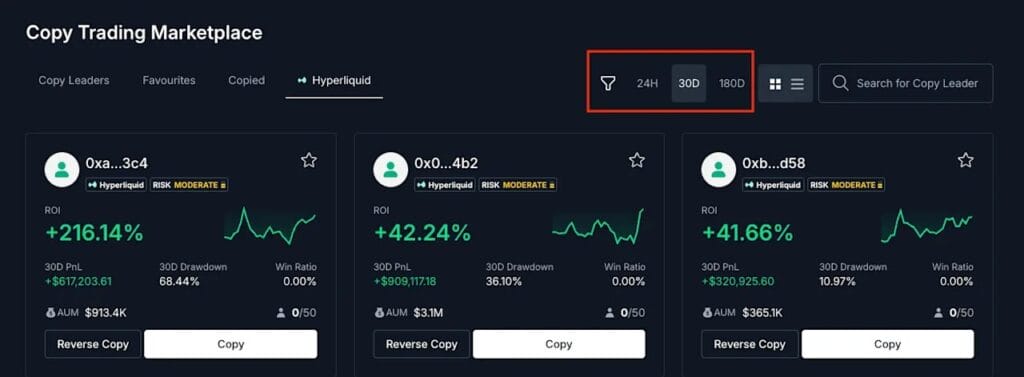
The leaderboard ranks Hyperliquid traders by ROI (default), with toggles for PnL over 24 hours, 30 days, or 180 days. Each trader card shows: ROI %, PnL, max drawdown, win ratio, AUM, and a risk indicator (low / moderate / high) in the top-right corner. Traders are listed by their Hyperliquid wallet address. There’s no Twitter handles, no avatars — purely on-chain identities. I personally appreciate this because it removes the marketing-noise factor that plagues most copy-trading platforms.
Once I picked a leader, the configuration screen asked me three things:
- Capital commitment — minimum $100 per leader, with the option to commit more. Leaders can raise the minimum to whatever floor they want.
- Stop Loss / Take Profit — per-leader, not per-trade. BitMEX recommends -15% conservative, -20% moderate, -40% aggressive. I’d argue -20% should be the default for everyone unless you really know what you’re doing.
- Mirror Mode toggle — the most important setting on this screen, and the one I want to spend a paragraph on.

Mirror Mode vs Capped Mode — Why This Setting Matters More Than the Stop Loss
BitMEX gives you two ways to size your trades relative to the leader’s, and the choice has real implications.
- Mirror Mode ON (proportional): your trade size scales as a ratio of the leader’s. Per BitMEX’s example: leader has $1,000 AUM and opens a $100 position; you’ve committed $100; your replicated position is $10. The ratio is 10%, applied to every trade.
- Mirror Mode OFF (capped): your trade size is capped at the leader’s maximum. If the leader opens a $100 position, you open a $100 position — regardless of your committed capital, up to your committed capital limit.
Here’s why this matters. Mirror Mode ON is the safer, more disciplined choice. Your position size scales with the leader’s actual conviction. If they’re sizing into a high-conviction trade with 30% of their AUM, you size with 30% of yours. The math holds together.
Mirror Mode OFF is dangerous if you’re not paying attention. Imagine a leader with $1M AUM normally opens $50K positions (5% of AUM). You commit $1,000 with Mirror Mode OFF. The leader’s $50K position becomes a $1,000 position in your account — meaning you’re 100% allocated to a single trade that the leader is only 5% allocated to. One bad trade and you’re at your stop loss. The leader bounces back. You’ve already exited.
My recommendation: always Mirror Mode ON unless you’re explicitly trying to over-leverage a specific leader’s strategy and accept the tail risk. Most traders should never touch Mirror Mode OFF.
The “Open Positions Don’t Carry Over” Rule — A Subtle but Important Trap
This one is buried in the BitMEX how-to guide and I want to surface it. From the official documentation:
“If your Copy Leader has open positions right now, those won’t appear in your account. Only trades they open after you start copying will replicate. This prevents you from entering mid trade.”
This is technically the correct behavior — you don’t want to enter a position that’s already in profit because the leader’s average price is locked in and you’d be buying at the top. But it has a practical consequence: if your leader trades infrequently (say, one swing trade per week), you might wait days before your account opens its first position. During that waiting period, you’re earning nothing while the leader’s existing position runs.
For scalpers and day traders, this isn’t an issue — they open new trades constantly. For swing traders or position traders, it absolutely is. Plan accordingly: if you’re choosing a low-frequency leader, expect a delay between paying for the seat and getting the trade.
Reverse Copy Trading — When It’s Actually Useful
Reverse Copy is BitMEX’s differentiating feature. Instead of replicating the leader’s trade, you take the opposite side. Leader goes long BTC → your account goes short. Leader closes long → your account closes short.
I want to be careful here because the marketing framing — “feeling like an anti-hero?” — sells this as a meme feature. It isn’t. It’s a real strategic tool, but only in specific contexts:
- Fading a leader you think is past their peak. If a leader had a great Q4 but you’ve watched their strategy stop working in the new market regime, reverse copying captures the inversion of their edge.
- Pair-trading two correlated leaders. Copy Leader A long-bias and Reverse Copy Leader B who tends to be on the wrong side. The spread between them becomes your alpha.
- Hedging a directional Hyperliquid position. If you have actual Hyperliquid exposure and a leader is famously contrarian, reverse copying them on BitMEX hedges your directional risk.
What Reverse Copy is not good for: blindly assuming “the average copy trader loses, so reversing them prints money.” This is intuition, not strategy. The leaderboard surfaces traders who have positive ROI — by definition, the average trader on this list is not losing. Reversing a profitable trader is a directional bet against their edge, not a clever shortcut.
The Fee Stack — What You’re Actually Paying
This took me a while to map out because the official docs spread the fee mechanics across three pages. Here’s the consolidated view:
| Fee component | Amount | When charged |
|---|---|---|
| BitMEX trading fee (perp taker) | 0.075% (XBTUSD; varies by contract and tier) | Each entry and each exit |
| BitMEX trading fee (perp maker rebate) | -0.025% rebate (XBTUSD) | If your copy order rests on the book — unlikely for market entries |
| BitMEX funding rate | Variable, paid every 8 hours | Every funding interval if your position is open |
| Leader profit share | 0% to 50% (set by leader) | Only on closed profitable trades; zero on losing trades |
| BitMEX Hyperliquid feature surcharge | None | BitMEX charges no extra platform fee for the feature |
Worked example. I copy a Hyperliquid leader with a 20% profit share. They open a long BTC perp at $100,000 and close at $102,000 — a 2% move. My replicated position is $1,000.
- Gross PnL: $1,000 × 2% = $20
- BitMEX taker fees (entry + exit): $1,000 × 0.075% × 2 = $1.50
- Funding payments (assume 1 funding interval, ~0.01% rate): negligible (~$0.10)
- Net PnL before profit share: ~$18.40
- Leader profit share (20%): $3.68
- My take-home: ~$14.72
That’s a 1.47% return on my $1,000 commitment for a 2% leader move — about 73% of the gross. The 27% haircut comes mostly from the profit share, with trading fees a small drag. Compare this to trading directly on Hyperliquid, where you’d capture closer to 90–95% of the gross (Hyperliquid’s maker fee is 0.015%, taker 0.045%, lower than BitMEX). The convenience tax is real.
Funding Rate Divergence — The Hidden PnL Driver Most Copiers Miss
This is the part I haven’t seen any other reviewer call out, and it’s important. Hyperliquid funding rates are not the same as BitMEX funding rates. Both venues calculate funding to keep perp prices anchored to spot, but the actual rates diverge based on each venue’s order book imbalance.
Why this matters: a meaningful chunk of the alpha some Hyperliquid leaders earn comes from funding rate arbitrage — being long when funding is negative (shorts pay longs) or short when funding is positive (longs pay shorts). On Hyperliquid, the leader receives or pays Hyperliquid’s funding rate. On BitMEX, your replicated position pays or receives BitMEX’s funding rate, which can differ by 5–20 basis points or more on the same instrument at the same time.
If your leader’s edge is partially funding-rate-driven (delta-neutral funding farmers, in particular), your copied position will not capture that edge. You’ll get the directional PnL but miss the funding alpha. For directional discretionary leaders, this isn’t a meaningful issue. For systematic funding-rate strategies, it is.
How to spot a funding-driven leader: look for leaders with extremely low max drawdown (under 5%), low volatility, and steady ROI (3–8% monthly). These profiles often run delta-neutral or low-leverage funding strategies. Reverse-copying them or copying directly on BitMEX both miss the funding leg. Pick leaders whose edge is directional if you’re going through BitMEX. For pure funding-rate plays, you really do need to be on Hyperliquid directly — see our Hyperliquid fees explained guide for the funding rate mechanics there.
The Asset Universe Gap — What Happens When the Leader Trades a Market BitMEX Doesn’t List
Hyperliquid lists 50+ perpetual markets including HIP-3 permissionless deployer markets that anyone can launch. BitMEX lists a smaller set focused on liquidity-deep instruments. The official docs don’t address what happens if a Hyperliquid leader you’re copying trades, say, a tiny altcoin perp that BitMEX hasn’t listed.
Based on how the architecture works (replicating the trade on BitMEX’s order book), the only logical outcome is that the trade cannot be replicated if the asset isn’t listed. Your account would skip that trade. Whether you’re notified, whether the leader’s stats reflect it, and whether the missed trade affects your position sizing on the next trade — none of this is documented. I asked through BitMEX’s support channel and didn’t get a clear answer.
Practical implication: if your leader is an altcoin specialist trading deep into Hyperliquid’s long tail, you’ll get a partial picture of their performance on BitMEX. If your leader is a BTC/ETH-focused major-pairs trader, the asset gap is irrelevant.
This is the single biggest gap in the official documentation and the reason I scored Asset Coverage 5/10 in my verdict table. The product needs explicit handling rules for asset-list mismatches.
Who I Think Should Use This (and Who Shouldn’t)
After working through the mechanics, here’s my honest segmentation:
| Trader profile | Recommendation | Why |
|---|---|---|
| Time-constrained professional, wants Hyperliquid alpha without DeFi | ✅ Strong fit | This is exactly the audience the product was built for |
| Beginner who’s been wanting to try perps | ✅ Good fit (with strict stop loss) | $100 minimum, KYC’d safety, mandatory -20% stop loss |
| Experienced Hyperliquid trader who wants to diversify | ⚠️ Maybe | You’d capture less alpha than trading on Hyperliquid directly; only worth it if you’re hedging risk |
| Funding-rate arbitrage specialist | ❌ Not for you | You can’t capture Hyperliquid funding through a BitMEX copied position |
| HIP-3 / altcoin specialist trader | ❌ Skip | Asset coverage gap will leak too much of your edge |
| US person | ❌ Cannot use | BitMEX restricts US persons; review their US Person Definition before signing up |
| KYC-averse trader | ❌ Skip | Use Hyperliquid directly; see our Hyperliquid trading strategies guide |
How I’d Set Up My First Copy Position (My Recommended Settings)
If I were starting from scratch on BitMEX Hyperliquid Copy Trading today, here’s how I’d configure the first position:
- Capital: $500 split across 3 leaders ($150–$200 each), not 5. Three is the sweet spot for diversification without splintering capital too thin.
- Leader selection criteria: 90+ days of verified track record, 30-day ROI between 20%–50%, max drawdown under -20%, at least 50 closed trades, and a clear strategy description on the profile.
- Mirror Mode: ON for all three. Always. The proportional sizing protects me when a leader takes a high-conviction position that I shouldn’t be matching dollar-for-dollar.
- Stop Loss: -20% per leader. Non-negotiable. If a leader hits -20% on my capital, I close the position and re-evaluate the leader.
- Take Profit: +60% per leader. Loose enough to let winners run, tight enough to lock in returns when something goes parabolic.
- Trial period: 30 days. I evaluate after 30 days, not after every red day. Drawdowns are normal; strategy drift isn’t.
- Reverse Copy: only after I have 60+ days of comfort with the standard copy mechanic. Reverse Copy is a strategic tool, not a beginner setting.
One last setup tip that’s not in the docs: track your leaders’ Hyperliquid addresses externally. Hyperliquid has public on-chain analytics — Hyperdash, Hypurrscan, and others — and our Hyperliquid whale tracker guide walks through the best free tools for monitoring top trader activity. Watch your leaders’ actual on-chain behavior independently of the BitMEX dashboard. If their Hyperliquid PnL diverges from your BitMEX copy account by more than 5–10%, that’s a signal that funding rates, asset gaps, or latency are eating your alpha.
The Launch Promo — Worth Taking, Within Limits
BitMEX is offering a 100,000 USDT prize pool for the launch period. The components I’d actually optimize for:
- 100 USDT loss coverage on first copy trade — genuinely valuable. If your first leader loses, you get up to $100 back. Treat it as a free-roll on your first leader selection.
- 10% cashback on first DEX wallet deposit — useful only if you’re funding from a Web3 wallet. Self-explanatory.
- $5,050 in trading credits for new users — these are graduated and require trading volume to unlock. Read the terms before assuming you’ll get the full amount.
My take: the 100 USDT loss coverage is the only one that should change your behavior. The trading credits and cashback are nice-to-have, not deciding factors.
BitMEX Hyperliquid Copy Trading vs Trading Hyperliquid Directly
| Dimension | BitMEX Copy Trading | Hyperliquid Direct |
|---|---|---|
| KYC required | Yes (full ID verification) | No |
| Custody | BitMEX holds funds | Self-custodial wallet |
| Setup time | ~30 min (KYC delay) | ~10 min (wallet + bridge) |
| Maker / taker fees (BTC perp) | -0.025% / 0.075% | 0.015% / 0.045% |
| Funding rate | BitMEX funding (different from HL) | Hyperliquid funding (the original) |
| Asset universe | BitMEX contract list (smaller) | 50+ perp markets including HIP-3 |
| Profit share to leader | 0–50% (varies) | None — you trade your own strategy |
| Latency | ~0.5–2s estimated | Direct, sub-second to your own orders |
| Reverse Copy / fading | Yes (one-click) | Manual (open opposite trades yourself) |
| Best for | Time-constrained, KYC-comfortable, alpha-borrowers | Self-directed, KYC-averse, full-stack traders |
If you’re set on direct trading, our no-code Hyperliquid bot setup guide covers the bot route, and our developer bot frameworks comparison covers the SDK route for anyone who codes.
Frequently Asked Questions
Do I need a Hyperliquid wallet to use BitMEX Hyperliquid Copy Trading?
No. That’s the entire premise of the product. You trade from a BitMEX account. BitMEX tracks the Hyperliquid leader’s positions on-chain and replicates them on the BitMEX order book. You never bridge funds, never sign a Hyperliquid transaction, and never custody anything yourself. KYC for BitMEX is the only gate.
What’s the minimum capital to start?
$100 per Copy Leader, per BitMEX’s official docs. Leaders can raise this floor at their discretion. If you want to copy 3 leaders for diversification, plan for $300–$500 minimum — though I’d argue $500–$1,000 is more comfortable because it gives Mirror Mode enough room to size positions meaningfully.
How much does BitMEX charge for the copy trading feature?
BitMEX charges no extra platform fee specifically for the Hyperliquid copy trading feature. You pay standard BitMEX trading fees (0.075% taker / -0.025% maker rebate on BTC perps; varies by contract and VIP tier) and a leader profit share that ranges from 0% to 50%, set by the leader. The profit share applies only to closed profitable trades; you pay zero on losing trades.
What happens if Hyperliquid goes down?
Per BitMEX’s official FAQ: your copy positions on BitMEX are unaffected by Hyperliquid downtime. BitMEX operates independently. If your leader can’t trade because Hyperliquid is offline, your account simply won’t open new copied trades until they’re back. Existing positions on BitMEX continue to be marked, funded, and managed by BitMEX as normal.
Is BitMEX Hyperliquid Copy Trading available to US persons?
BitMEX restricts access for US persons under its US Person Definition. If you’re a US resident or citizen, you cannot use BitMEX or its copy trading product. Check BitMEX’s compliance page for the full geographic restriction list before opening an account.
Can I copy part of a leader’s strategy?
No. Per the official docs, copy trading is all-or-nothing per leader. You can’t filter by asset (e.g., only copy their BTC trades and skip their ETH trades). The only granularity you have is choosing which leaders to copy, sizing your capital, and setting your Stop Loss and Take Profit.
How does Reverse Copy actually work mechanically?
When you Reverse Copy a leader, BitMEX flips the direction of every trade they open. Leader opens a long BTC perp at $100K → your account opens a short BTC perp at the prevailing BitMEX price. Leader closes the long → your account closes the short. The position size logic still respects your Mirror Mode and capital settings — only the direction inverts.
Will the funding rate I pay be the same as the leader’s?
No. This is one of the under-discussed nuances of the product. Your replicated position trades on BitMEX’s order book, so it pays or receives BitMEX’s funding rate. The leader’s Hyperliquid position pays or receives Hyperliquid’s funding rate. These can diverge by 5–20 bps or more at any given funding interval. For directional traders this is a minor drag; for funding-arbitrage strategies it’s a deal-breaker.
BitMEX Hyperliquid Copy Trading is a thoughtful product with a real architectural underpinning — using Hyperliquid’s open-source L1 to track positions and replicate them on a centralized order book. For time-constrained traders who want directional Hyperliquid alpha without the DeFi friction, it’s genuinely useful. For funding-rate specialists, altcoin scalpers, or anyone in a restricted jurisdiction, it’s the wrong tool.
I’d use it for $500–$1,000 of capital across 3 directional leaders with Mirror Mode ON and -20% stop losses. I wouldn’t use it as my primary trading vehicle, and I wouldn’t use it without simultaneously tracking my leaders’ on-chain Hyperliquid performance to spot edge leakage early. If you trade with both eyes open, this product earns its place in the toolkit.
Reviewed by Gaurav Agarwal, founder of CoinCodeCap. Gaurav has covered crypto exchanges, DeFi protocols, and trading platforms since 2018. Mechanics, fees, and limits in this review are sourced directly from BitMEX’s official launch documentation dated 5 February 2026 and verified independently through the live product interface.
⚡ Bottom Line: BitMEX Hyperliquid Copy Trading uses Hyperliquid’s open-source L1 to track top traders’ on-chain positions and replicate them on the BitMEX order book — no bridging, no wallets, $100 minimum per leader, up to 5 leaders simultaneously. Standard BitMEX trading fees plus a 0–50% leader profit share. Genuinely useful for directional discretionary alpha; not the right tool for funding-rate strategies, HIP-3 altcoin specialists, or US persons. Always run Mirror Mode ON and a -20% stop loss per leader, and track your leaders’ actual on-chain performance independently to catch edge leakage early.
📋 Related Hyperliquid Guides: Full Hyperliquid Review | No-Code Hyperliquid Bot Setup | Hyperliquid Vaults & Yield
📊 Comparisons: Hyperliquid vs Competitors | Best Hyperliquid RPC Providers
🛠 Developer Stack: Best Hyperliquid Bot Frameworks | Hyperliquid API: REST vs WebSocket vs gRPC


You May Also Like
XRP’s leverage has been flushed out while price holds – and the next move is now wide open

Turkey’s wind energy capacity given $350m boost




