STABLE Token Unlock: How the 82B Lock Changes Supply
Overview
Stable published Version 2.0 of its whitepaper on August 14, 2026, introducing a Universal Lock that will govern 82 billion STABLE tokens, equivalent to 82% of the token’s 100 billion maximum supply. The mechanism replaces separate vesting arrangements for the team, investors, advisors and the locked portion of the ecosystem allocation with one proportional release schedule.
The STABLE Token Unlock begins on December 8, 2027, and consists of seven overlapping release floors. Each floor distributes tokens daily and linearly over 180 days, except the final floor, which runs for 183 days. Under the base schedule, the complete locked pool enters circulation by December 8, 2029.
The whitepaper also introduces a safety floor linked to STABLE’s market price. If the token’s 30-day volume-weighted average price is below $0.025 immediately before a release floor begins, that floor may be deferred in three-month increments for up to nine months. The mechanism can postpone supply but cannot permanently cancel it.
Importantly, October 5, 2026, is the stated effective date of the Universal Lock. The whitepaper says Foundation tokens released above the original 8% day-one allocation before that date will be relocked. This creates a difference between current third-party circulating-supply estimates and the 18% circulation baseline used by the revised whitepaper.
Key Takeaways
- STABLE has a fixed total supply of 100 billion tokens.
- The Universal Lock covers 82 billion STABLE, while 18 billion form the whitepaper’s circulation baseline.
- Seven release floors begin between December 2027 and June 2029.
- A 30-day VWAP below $0.025 can delay a floor by up to nine months.
- All remaining locked tokens must be released by December 8, 2029.
What Changed in the STABLE Token Unlock?
Which Tokens Enter the Universal Lock?
The Universal Lock covers 82 billion STABLE divided among three allocation groups. The team’s entire 25 billion allocation is included, as is the complete 25 billion assigned to investors and advisors. The remaining 32 billion comes from the ecosystem and community allocation.
Stable allocated 40 billion tokens, or 40% of supply, to ecosystem and community development. Eight billion unlocked on December 8, 2025, while the other 32 billion will enter the Universal Lock. A separate Genesis Distribution of 10 billion tokens was placed into circulation from the first day.
Under the whitepaper’s effective-date accounting, these two unlocked portions produce an 18 billion circulating baseline. The other 82 billion become subject to the same proportional release rules regardless of whether the tokens belong to insiders, advisors or the Foundation.
How Does the New Schedule Replace Earlier Vesting?
The earlier tokenomics assigned different vesting arrangements to different stakeholder groups. In particular, team and investor allocations were expected to follow a one-year cliff and subsequent linear vesting.
Version 2.0 replaces those arrangements with a single schedule. Every locked pool releases at the same proportional rate, and no allocation receives a faster pathway. This reduces the possibility that one insider group gains liquidity materially earlier than another.
The change also applies to certain Foundation tokens that may already have unlocked. The whitepaper states that Foundation tokens released between the December 8, 2025 token generation event and the October 5, 2026 effective date, beyond the original 8% day-one amount, will be relocked.
Because the effective date had not arrived when Version 2.0 was published, the 18% figure should be understood as the planned baseline under the revised mechanism—not necessarily the exact circulating supply shown by market-data platforms before October 5.
How the Seven-Stage Release Schedule Works
When Does Each STABLE Token Unlock Begin?
Each release floor is calculated against the fixed 82 billion-token locked pool. The percentage does not recalculate as earlier floors distribute their tokens.
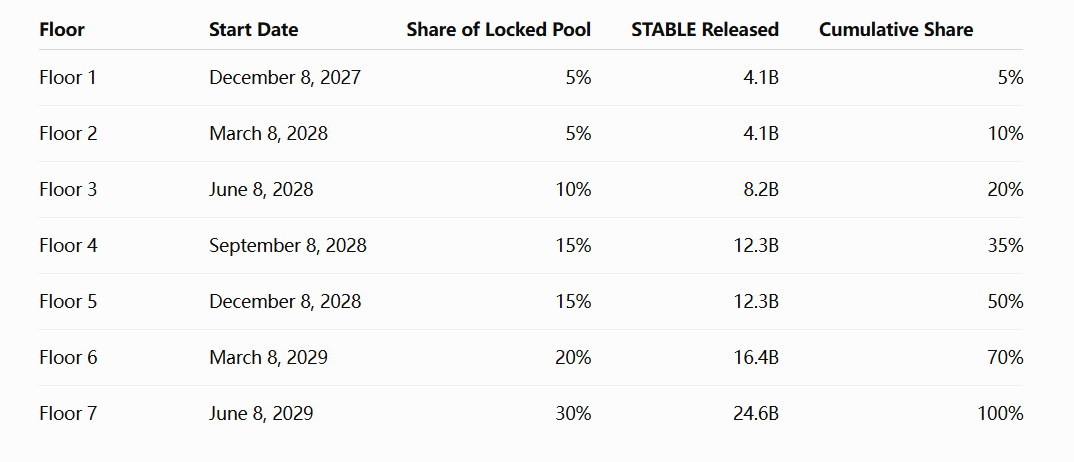
This structure means that 82% of supply is not simply frozen until the end of 2029. Releases begin in December 2027 and expand progressively as larger floors start.
Why Do Overlapping Linear Releases Matter?
A floor’s start date is not a single cliff unlock. Once activated, its allocation enters circulation daily and linearly over 180 calendar days. Floor 7 uses 183 days so that its final release lands on December 8, 2029.
New floors begin every three months even though earlier floors generally remain active for six months. As a result, two or more release streams may operate simultaneously. Daily emissions can therefore increase when a larger floor starts before the preceding floor has completed.
This design reduces the shock associated with releasing an entire allocation on one date, but it does not eliminate dilution. The relevant measure for traders will be the combined daily emission rate across all active floors, not merely the percentage assigned to the next scheduled floor.
The STABLE Token Unlock should consequently be evaluated against spot-market depth, trading volume, staking demand, ecosystem incentives and the behavior of recipients. A large unlocked quantity does not automatically become immediate sell pressure, but it creates transferable supply that can enter the market.
What Does the $0.025 Safety Floor Actually Do?
Can a Low Price Stop Token Dilution?
No. The safety floor can defer a release but cannot permanently remove it from the schedule. Before each floor begins, Stable will calculate the token’s 30-day volume-weighted average spot price across eligible venues.
If the VWAP is below $0.025 on the day before the scheduled start, the floor is delayed by three calendar months. The test can be applied again, allowing delays to accumulate for a maximum of nine months. After that limit, the floor starts regardless of price.
The eligible venue basket initially includes Bybit, Bithumb, Kraken, BitMart, MEXC and Binance Alpha. Coinbase and Upbit are added automatically if either platform lists STABLE for ordinary spot trading. Derivatives, perpetual futures, options, margin trading and synthetic volume are excluded from the calculation.
Why Does December 8, 2029 Remain the Final Deadline?
The safety floor terminates automatically on December 8, 2029. Any tokens still held back because of price-based deferrals, along with any other tokens remaining in the locked pool, must be released in full on that date.
This creates an important trade-off. The mechanism may reduce emissions during a weak market, but repeated delays could concentrate more supply near the final deadline. It postpones potential dilution instead of eliminating it.
The $0.025 threshold should not be interpreted as a guaranteed price floor. Stable does not commit to buying tokens, defending the market price or reducing the maximum supply when the threshold is breached. The rule only changes the timing of scheduled releases.
Investors should therefore distinguish between a price-sensitive vesting mechanism and direct market support. The former adjusts circulating-supply timing; the latter would require capital deployment or token purchases, neither of which is established by this mechanism.
Supply, Governance and Market Implications
Does Locking 82% Eliminate Near-Term Sell Pressure?
The Universal Lock substantially limits new circulating supply from team, investor and locked Foundation allocations before December 2027. It also aligns the timing of insider releases and makes the long-term schedule more predictable.
However, the currently transferable 18 billion-token baseline remains economically relevant. Circulating tokens can still be sold, used for liquidity, delegated or deployed in ecosystem programs. Market performance will therefore depend on demand for STABLE as well as restrictions on future supply.
The network itself uses USDT as its gas and primary settlement asset. Users can transact without holding STABLE, while STABLE primarily supports security, governance and validator coordination. This separation improves payment usability but means network usage may not translate mechanically into transactional demand for the native token.
Assessing the STABLE Token Unlock requires more than comparing locked and circulating percentages. Investors must examine staking participation, validator rewards, governance demand, treasury distribution, spot liquidity and the destinations of newly released tokens.
Do Locked Tokens Still Carry Governance Power?
Yes. The revised whitepaper states that locked STABLE retains voting rights. The Universal Lock governs when tokens become transferable and enter circulation, but it does not suspend their participation in governance.
This distinction creates a potential concentration issue. Team, investor, advisor and Foundation allocations can influence governance before their tokens become liquid. With 82% of supply covered by the locked pool, the distribution of voting authority may look very different from the distribution of tradable supply.
Governance participation should therefore be analyzed separately from market circulation. Relevant indicators include voter turnout, delegation patterns, proposal thresholds, the share of votes controlled by large allocations and whether independent holders can meaningfully influence decisions.
A long lock can align stakeholders with the network’s development, but it does not by itself ensure decentralized governance. The quality of that alignment will depend on how voting power is exercised and whether governance activity becomes broadly distributed over time.
The Universal Lock Delays Supply but Does Not Remove It
Stable’s revised tokenomics create a clearer and more uniform release system for 82 billion STABLE. Applying the same proportional schedule to the team, investors, advisors and the Foundation reduces differences between insider vesting arrangements and makes future emissions easier to model.
The seven-floor structure also avoids releasing each allocation through a single cliff. Daily linear distribution spreads supply over time, while the $0.025 safety floor allows the protocol to postpone a release during sustained market weakness. Neither feature, however, guarantees price stability.
The central limitation is the final deadline. Every token in the locked pool is scheduled to enter circulation no later than December 8, 2029. If several floors are delayed, emissions may shift toward the later portion of the schedule and could become more concentrated as the deadline approaches.
Investors should also avoid treating the reported 82% lock as a description of current circulating supply without qualification. October 5, 2026, is the Universal Lock’s stated effective date, and the whitepaper plans to relock certain Foundation tokens released before then. Current third-party figures may consequently differ from the revised 18% baseline.
The STABLE Token Unlock improves supply transparency, but its market effect will depend on actual recipient behavior, liquidity and demand for validator and governance participation. The schedule delays dilution and defines its path; it does not remove the eventual increase in transferable supply.
Sources
https://www.stable.xyz/whitepaper.pdf
https://defillama.com/unlocks/stable
https://www.coinglass.com/currencies/STABLE/vesting
Risk Disclaimer: This article is for reference only and does not constitute investment advice. The cryptocurrency market is highly volatile. Please make decisions cautiously based on your individual circumstances.
You May Also Like

Dell’s AI Server Forecast and $9.7B Pentagon Win Put Infrastructure Demand Back in Focus

Netherlands vs Algeria Prediction 2026: Who Will Win, Odds, Team News and Key Players

MEXC On-chain Daily Report: Japan's Ruling Party Proposes Launch of Crypto ETF Trading