Macro investor Michael Green, who is known as the Cassandra of Passive Investing, has sharpened his critique of Bitcoin, arguing that its design makes it economically brittle and socially corrosive, setting up a winner-takes-all outcome “like a Monopoly game.” In an interview with journalist Phil Rosen, Green said “the most important thing to understand is […]Macro investor Michael Green, who is known as the Cassandra of Passive Investing, has sharpened his critique of Bitcoin, arguing that its design makes it economically brittle and socially corrosive, setting up a winner-takes-all outcome “like a Monopoly game.” In an interview with journalist Phil Rosen, Green said “the most important thing to understand is […]

Bitcoin Could End ‘Like A Monopoly Game,’ Claims Wall Street Cassandra Michael Green

Macro investor Michael Green, who is known as the Cassandra of Passive Investing, has sharpened his critique of Bitcoin, arguing that its design makes it economically brittle and socially corrosive, setting up a winner-takes-all outcome “like a Monopoly game.”

In an interview with journalist Phil Rosen, Green said “the most important thing to understand is that Bitcoin has marketed itself as multiple different things to try to appeal to investors at various points in time,” but has failed on its original brief. Under the Satoshi white paper, he noted, BTC was meant to be “a peer-to-peer payment system” that removed the dependence of payment rails on banks. “By moving to a distributed ledger and a peer-to-peer system, we’d be able to get banks out of the system.”

“That’s been a total failure,” he argued. “There are almost no real transactions that are occurring in Bitcoin. We have tons of transaction activity in speculative markets trading Bitcoin, but the actual quantity of retail transactions or peer-to-peer payments that occur over the Bitcoin network are remarkably small.”

Green distinguished between emergency government “money printing” and day-to-day bank credit. “There’s money printing that comes from the government, in which they largely are trying to smooth over mistakes that have been made,” he said, describing stimulus as a way to “basically create a do-over by printing money.”

More frequent, he added, is the expansion of money when banks lend: when a bank grants a $1,000 loan, “they simply created a new account for you called your checking account that has $1,000 in it… That expansion is totally normal and it has a credit function associated with it.”

“Bitcoin destroys the ability to do that because it was intentionally designed to skip the banking system,” Green contended. Rather than a full credit system, “it is effectively just a monetary system where what you’re really seeing is Bitcoin is effectively the tokens that are paid to the accounting firms that keep the blockchain in order… every Bitcoin that’s out there is basically a payment to Deloitte & Touche.”

Why Bitcoin Is Supposedly A ‘Monopoly Game’

Because its supply is capped and banks cannot create new BTC via lending, “no new money can be created. There is no capacity for mistake forgiveness in that type of framework,” he said. That makes the system “very limiting. Interest rates and credit spreads are just too high for a real economy framework.” Despite dramatic price gains, he concluded, Bitcoin “hasn’t emerged as a payment system” or “in any meaningful economic context.”

Green’s harshest criticism was distributional. “Because we have a finite quantity of it, ultimately, that means everybody who is born after the Bitcoin has been released finds themselves in deficit,” he said. He compared this to “a serf living off land in the 14th century that didn’t belong to you,” where “there was no other land that would ever become available to you.” That, he argued, “creates a deeply unequal society.”

Although he said he “was an early adopter of Bitcoin” and initially thought it was “a really interesting idea” of private money, he now believes “if you run through the simulation, Bitcoin, because there is a finite quantity of tokens, means that it basically plays like a Monopoly game.”

In that game, “you can’t add additional players as the game is being played… because they’re just going to lose very quickly. They don’t have any other properties. They don’t have any other money.” “How does every game of Monopoly end?” he asked. “Someone wins. With a single winner.”

“That’s exactly what we’ve seen within Bitcoin,” Green maintained, citing “increased concentration” and a Gini coefficient “beyond anything we’ve ever seen in the real world.” Instead of democratizing access, he argued, Bitcoin builds “a system that ultimately collapses upon itself and locks people out. Far from democratizing access, it does the exact opposite.”

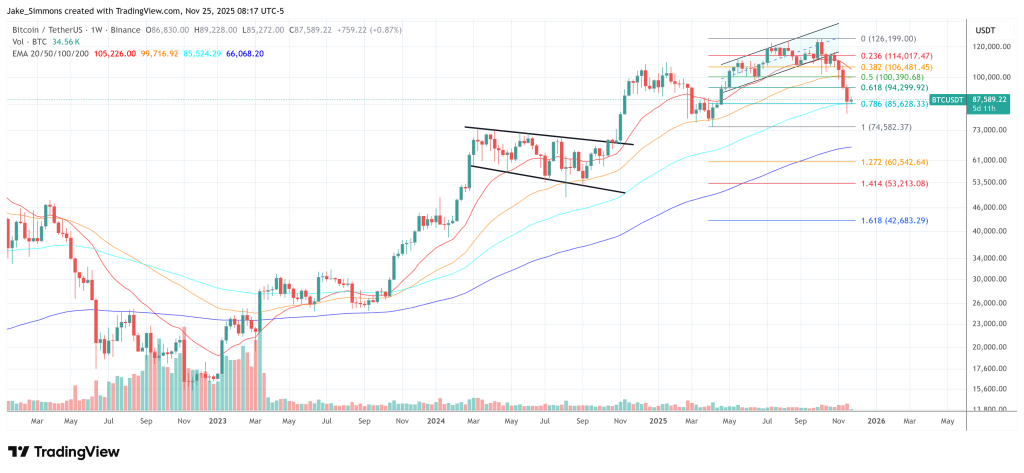
At press time, BTC traded at $87,589.
Bitcoin price
Market Opportunity
Wink Logo
Wink Price(LIKE)
$0.003015
$0.003015$0.003015
-7.00%
USD
Wink (LIKE) Live Price Chart
Disclaimer: The articles reposted on this site are sourced from public platforms and are provided for informational purposes only. They do not necessarily reflect the views of MEXC. All rights remain with the original authors. If you believe any content infringes on third-party rights, please contact [email protected] for removal. MEXC makes no guarantees regarding the accuracy, completeness, or timeliness of the content and is not responsible for any actions taken based on the information provided. The content does not constitute financial, legal, or other professional advice, nor should it be considered a recommendation or endorsement by MEXC.

You May Also Like

Ethereum Options Expiry Shows Risks Below $2,900

Ethereum Options Expiry Shows Risks Below $2,900

The post Ethereum Options Expiry Shows Risks Below $2,900 appeared on BitcoinEthereumNews.com. Ether (ETH) has been unable to sustain prices above $3,400 for the
Share
BitcoinEthereumNews2025/12/25 10:24
Fed forecasts only one rate cut in 2026, a more conservative outlook than expected

Fed forecasts only one rate cut in 2026, a more conservative outlook than expected

The post Fed forecasts only one rate cut in 2026, a more conservative outlook than expected appeared on BitcoinEthereumNews.com. Federal Reserve Chairman Jerome Powell talks to reporters following the regular Federal Open Market Committee meetings at the Fed on July 30, 2025 in Washington, DC. Chip Somodevilla | Getty Images The Federal Reserve is projecting only one rate cut in 2026, fewer than expected, according to its median projection. The central bank’s so-called dot plot, which shows 19 individual members’ expectations anonymously, indicated a median estimate of 3.4% for the federal funds rate at the end of 2026. That compares to a median estimate of 3.6% for the end of this year following two expected cuts on top of Wednesday’s reduction. A single quarter-point reduction next year is significantly more conservative than current market pricing. Traders are currently pricing in at two to three more rate cuts next year, according to the CME Group’s FedWatch tool, updated shortly after the decision. The gauge uses prices on 30-day fed funds futures contracts to determine market-implied odds for rate moves. Here are the Fed’s latest targets from 19 FOMC members, both voters and nonvoters: Zoom In IconArrows pointing outwards The forecasts, however, showed a large difference of opinion with two voting members seeing as many as four cuts. Three officials penciled in three rate reductions next year. “Next year’s dot plot is a mosaic of different perspectives and is an accurate reflection of a confusing economic outlook, muddied by labor supply shifts, data measurement concerns, and government policy upheaval and uncertainty,” said Seema Shah, chief global strategist at Principal Asset Management. The central bank has two policy meetings left for the year, one in October and one in December. Economic projections from the Fed saw slightly faster economic growth in 2026 than was projected in June, while the outlook for inflation was updated modestly higher for next year. There’s a lot of uncertainty…
Share
BitcoinEthereumNews2025/09/18 02:59
Arizona Senator Proposes Exempting Bitcoin and Crypto from Taxes

Arizona Senator Proposes Exempting Bitcoin and Crypto from Taxes

Understanding the specific tax exemption proposal's scope, mechanics, and limitations provides foundation for evaluating feasibility and implications. The exemption presumably covers capital gains taxes on cryptocurrency appreciation at state level, though personal income tax and corporate tax treatment requires clarification. Scope questions include whether exemption applies to trading profits, mining income, staking rewards, DeFi yields, NFT sales, and business cryptocurrency revenue.
Share
MEXC NEWS2025/12/25 11:47