Durante los primeros 10 meses del 2025 el valor de las ventas del sector ha caído 4.8%, su primer tropiezo desde el 2016, excluyendo el 2020 por su carácter atípico.Durante los primeros 10 meses del 2025 el valor de las ventas del sector ha caído 4.8%, su primer tropiezo desde el 2016, excluyendo el 2020 por su carácter atípico.

Envíos automotrices de México caen 14% afectados por aranceles de Trump

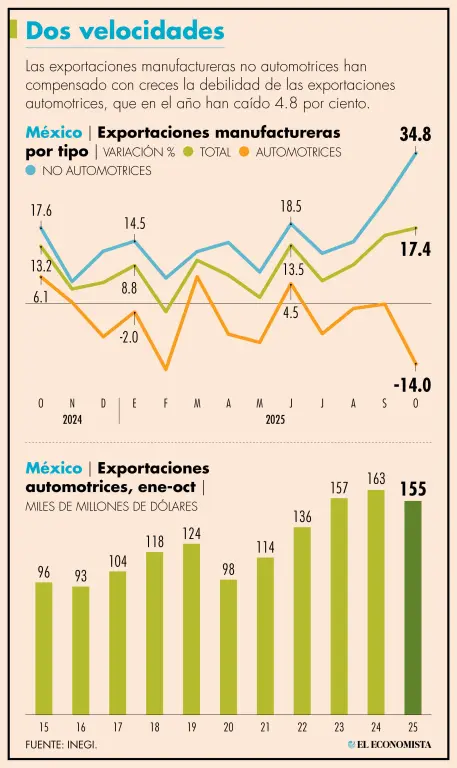
Las exportaciones automotrices de México disminuyeron 14% a tasa interanual en octubre, a 16,122.1 millones de dólares, afectadas por los aranceles del presidente de Estados Unidos, Donald Trump.

En el acumulado de los 10 primeros meses de 2025, estas ventas tuvieron una caída de 4.8%, a 154,946.5 millones de dólares, desliz que resulta el primero para la variable desde el pandémico 2020, aunque si se hace un lado ese año por su carácter atípico, sería el primero desde el 2016, cuando cayó 3.1 por ciento.

Las exportaciones manufactureras reflejan la marcada integración en las cadenas productivas de ambos países, destacando que los envíos manufactureros presentan un crecimiento anual de 8.6% de enero a octubre.

“Sin embargo, en el rubro automotriz se observa una dinámica diferente, pues registró una contracción de 4.8% en lo que va del año, acentuando los retos que mantienen las exportaciones automotrices mexicanas ante la imposición de aranceles vigentes para la industria”, comentaron Janneth Quiroz Zamora y Kevin Louis Castro, analistas de Monex.

Este deterioro se acentuó en septiembre tras el anuncio de Trump de un arancel de 25.0% a los camiones pesados a partir del 1 de octubre, que si bien se pospuso para el 1 de noviembre, generó cautela entre los importadores estadounidenses.

“Si bien la tasa arancelaria efectiva promedio que pagaron las exportaciones mexicanas dirigidas a Estados Unidos fue de 4.68% en agosto y el 84.5% de ellas cumplió con las reglas del T-MEC (un avance notable frente al 47.8% del mismo periodo de 2024), es probable que los aranceles vigentes de nuestro principal socio comercial permanezcan en los próximos meses, como parte de la estrategia de negociación de Trump: (retirar aranceles a cambio de concesiones de México en la revisión del tratado)”, opinaron los analistas de Monex.

Te puede interesar

  • El Economista

    Empresas

    Exportaciones mexicanas aumentan 14.2% impulsadas por manufacturas no automotrices

  • El Economista

    Economía

    Debilidad económica genera recorte de expectativas para 2025 a rango de 0.2 a 0.6%

“Trump no ha abandonado el proteccionismo comercial, por lo que no se pueden descartar nuevos aranceles o el cobro más agresivo de los aranceles anunciados en meses previos”, consideraron Gabriela Siller y Jesús Anacarsis López Flores, analistas de Banco Base.

El 1 de noviembre entraron también en vigor en Estados Unidos los aranceles de 10% para las importaciones de autobuses.

Con datos al mes de agosto, 82.96% de las importaciones de camiones pesados que realiza Estados Unidos (partida 8704) se originó en México.

“Con la entrada en vigor de este arancel se espera que deteriore aún más las exportaciones automotrices a Estados Unidos y el desempeño de la industria de fabricación de equipo de transporte en México”, dijeron los analistas de Banco Base.

Las exportaciones de manufacturas no automotrices explican 63.2% de las exportaciones totales de México de enero a octubre de 2025, subiendo desde 58.1% en el mismo periodo del 2024 y su mayor proporción para un periodo igual desde 2009 (65.0 por ciento).

Para los analistas de Banco Base, esto se debe a que los aranceles que Estados Unidos impuso a México bajo la Ley de Poderes Económicos de Emergencia Internacional (IEEPA), no se están cobrando al pie de la letra y el cumplimiento de México con el T-MEC se mantiene elevado, mientras que los aranceles sectoriales que se aplican al sector automotriz sí se están cobrando.

Por esta razón, las exportaciones automotrices acumulan una contracción en 2025, mientras que las exportaciones manufactureras distintas al sector automotriz siguen creciendo.

El 83.9% de las exportaciones no petroleras entre enero y octubre del 2025 se dirigen a Estados Unidos y acumulan un crecimiento de 8.0%, explicado por las exportaciones distintas al sector automotriz que acumulan un avance de 15.1%, mientras que las exportaciones automotrices acumulan un retroceso de 5.9%, consecuencia de los aranceles impuestos por la Administración Trump.
imageEnlace imagen

Gráfico EE

Market Opportunity
PortugalNationalTeam Logo
PortugalNationalTeam Price(POR)
$0.4678
$0.4678$0.4678
+0.34%
USD
PortugalNationalTeam (POR) Live Price Chart
Disclaimer: The articles reposted on this site are sourced from public platforms and are provided for informational purposes only. They do not necessarily reflect the views of MEXC. All rights remain with the original authors. If you believe any content infringes on third-party rights, please contact [email protected] for removal. MEXC makes no guarantees regarding the accuracy, completeness, or timeliness of the content and is not responsible for any actions taken based on the information provided. The content does not constitute financial, legal, or other professional advice, nor should it be considered a recommendation or endorsement by MEXC.

You May Also Like

CME Group to launch options on XRP and SOL futures

CME Group to launch options on XRP and SOL futures

The post CME Group to launch options on XRP and SOL futures appeared on BitcoinEthereumNews.com. CME Group will offer options based on the derivative markets on Solana (SOL) and XRP. The new markets will open on October 13, after regulatory approval.  CME Group will expand its crypto products with options on the futures markets of Solana (SOL) and XRP. The futures market will start on October 13, after regulatory review and approval.  The options will allow the trading of MicroSol, XRP, and MicroXRP futures, with expiry dates available every business day, monthly, and quarterly. The new products will be added to the existing BTC and ETH options markets. ‘The launch of these options contracts builds on the significant growth and increasing liquidity we have seen across our suite of Solana and XRP futures,’ said Giovanni Vicioso, CME Group Global Head of Cryptocurrency Products. The options contracts will have two main sizes, tracking the futures contracts. The new market will be suitable for sophisticated institutional traders, as well as active individual traders. The addition of options markets singles out XRP and SOL as liquid enough to offer the potential to bet on a market direction.  The options on futures arrive a few months after the launch of SOL futures. Both SOL and XRP had peak volumes in August, though XRP activity has slowed down in September. XRP and SOL options to tap both institutions and active traders Crypto options are one of the indicators of market attitudes, with XRP and SOL receiving a new way to gauge sentiment. The contracts will be supported by the Cumberland team.  ‘As one of the biggest liquidity providers in the ecosystem, the Cumberland team is excited to support CME Group’s continued expansion of crypto offerings,’ said Roman Makarov, Head of Cumberland Options Trading at DRW. ‘The launch of options on Solana and XRP futures is the latest example of the…
Share
BitcoinEthereumNews2025/09/18 00:56
The Rise of the Heli-Trek: How Fly-Out Adventures Are Redefining Everest Travel

The Rise of the Heli-Trek: How Fly-Out Adventures Are Redefining Everest Travel

Planning to embark on a Gokyo Ri Trek, Mera Peak, or Island Peak? Keep reading to know how the “Fly-Out” model is evolving Khumbu travel.  For a very long time,
Share
Techbullion2025/12/25 12:26
UK crypto holders brace for FCA’s expanded regulatory reach

UK crypto holders brace for FCA’s expanded regulatory reach

The post UK crypto holders brace for FCA’s expanded regulatory reach appeared on BitcoinEthereumNews.com. British crypto holders may soon face a very different landscape as the Financial Conduct Authority (FCA) moves to expand its regulatory reach in the industry. A new consultation paper outlines how the watchdog intends to apply its rulebook to crypto firms, shaping everything from asset safeguarding to trading platform operation. According to the financial regulator, these proposals would translate into clearer protections for retail investors and stricter oversight of crypto firms. UK FCA plans Until now, UK crypto users mostly encountered the FCA through rules on promotions and anti-money laundering checks. The consultation paper goes much further. It proposes direct oversight of stablecoin issuers, custodians, and crypto-asset trading platforms (CATPs). For investors, that means the wallets, exchanges, and coins they rely on could soon be subject to the same governance and resilience standards as traditional financial institutions. The regulator has also clarified that firms need official authorization before serving customers. This condition should, in theory, reduce the risk of sudden platform failures or unclear accountability. David Geale, the FCA’s executive director of payments and digital finance, said the proposals are designed to strike a balance between innovation and protection. He explained: “We want to develop a sustainable and competitive crypto sector – balancing innovation, market integrity and trust.” Geale noted that while the rules will not eliminate investment risks, they will create consistent standards, helping consumers understand what to expect from registered firms. Why does this matter for crypto holders? The UK regulatory framework shift would provide safer custody of assets, better disclosure of risks, and clearer recourse if something goes wrong. However, the regulator was also frank in its submission, arguing that no rulebook can eliminate the volatility or inherent risks of holding digital assets. Instead, the focus is on ensuring that when consumers choose to invest, they do…
Share
BitcoinEthereumNews2025/09/17 23:52