Crypto.com is moving deeper into prediction markets with plans to staff an internal market-making desk, a step that is drawing renewed attention to how these platformsCrypto.com is moving deeper into prediction markets with plans to staff an internal market-making desk, a step that is drawing renewed attention to how these platforms

Crypto.com Hires Internal Market Maker for Predictions – Is the Exchange Trading Against Users?

Crypto.com is moving deeper into prediction markets with plans to staff an internal market-making desk, a step that is drawing renewed attention to how these platforms operate and whether exchanges may end up trading directly against their own users.

The Singapore-based cryptocurrency exchange is recruiting a quantitative trader to join a team responsible for buying and selling financial contracts tied to the outcomes of sporting events on its prediction market platform.

Liquidity or Conflict? Crypto.com’s Market-Making Role Sparks Debate

According to a recent Bloomberg report, the role would sit on Crypto.com’s market-making desk and involve actively trading against customer orders to support liquidity across sports contracts and other derivatives offered on the company’s U.S. platform.

The hiring effort comes as prediction markets expand rapidly across both crypto and traditional finance.

These platforms allow users to trade contracts that settle based on real-world outcomes, such as sports results or political events, with prices reflecting the market’s implied probability.

While prediction markets have long presented themselves as neutral venues where participants trade against each other, the use of in-house market makers has raised questions about conflicts of interest.

Market making has become a sensitive issue for event-contract exchanges, particularly those operating under U.S. federal oversight.

Critics argue that when an exchange or its affiliate takes the opposite side of customer trades, the structure begins to resemble a traditional sportsbook that profits from customer losses.

Those concerns have already surfaced elsewhere in the industry. Kalshi, one of the most prominent regulated prediction market operators, runs an internal unit known as Kalshi Trading.

Polymarket, a major decentralized platform, is also reported to be building its own internal market-making team.

Crypto.com’s job listing states that the new hire would seek to “maximize profits while carefully managing risks,” language that has fueled debate over whether the firm is effectively trading against its users.

In response, in a report, a Crypto.com spokesperson said the company does not rely on proprietary trading as a revenue source and described its business model as providing customer access to digital assets and event contracts for a fee while remaining risk neutral.

The spokesperson added that the internal market maker does not receive preferential access to customer order flow or proprietary data and operates under rules disclosed to the Commodity Futures Trading Commission, which oversees derivatives markets in the U.S.

Prediction Markets Hit Record Volumes, but Trading Rules Stir Concerns

The exchange has also taken steps to attract external liquidity providers. Like its competitors, Crypto.com has sought to bring in professional trading firms to ensure continuous buying and selling, particularly in high-volume sports markets.

However, company rules grant designated market makers on sports contracts a three-second head start over smaller traders, a policy that has drawn scrutiny for potentially allowing large participants to adjust prices ahead of retail users.

The broader industry continues to grow despite these concerns, with prediction markets linked to sports and politics having driven much of the recent surge in activity.

Platforms including Kalshi, Polymarket, and Limitless recorded a combined $44 billion in trading volume this year, with Kalshi reaching roughly $1 billion in weekly volume at its peak.
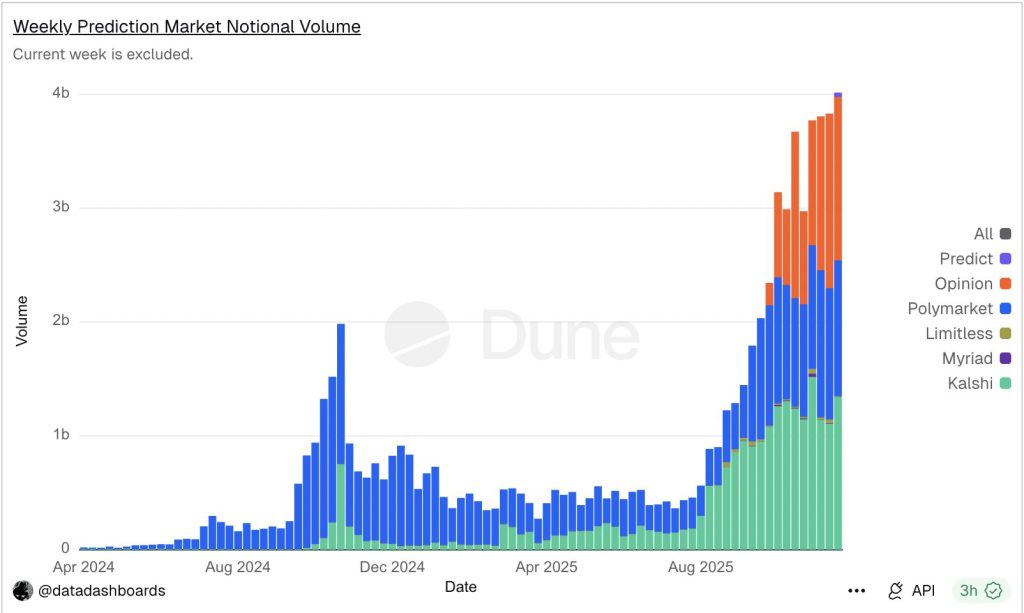
Source: Dune Analytics

On-chain prediction markets have expanded even faster, with monthly volume climbing from under $100 million in early 2024 to more than $13 billion, according to joint research from Keyrock and Dune Analytics.

Major crypto firms are also entering the space. Coinbase recently rolled out prediction market trading on its platform and agreed to acquire The Clearing Company as part of its push to scale regulated event-based markets. The move followed Kalshi’s $300 million Series D raise at a $5 billion valuation, showing investor interest in the sector.

Disclaimer: The articles reposted on this site are sourced from public platforms and are provided for informational purposes only. They do not necessarily reflect the views of MEXC. All rights remain with the original authors. If you believe any content infringes on third-party rights, please contact [email protected] for removal. MEXC makes no guarantees regarding the accuracy, completeness, or timeliness of the content and is not responsible for any actions taken based on the information provided. The content does not constitute financial, legal, or other professional advice, nor should it be considered a recommendation or endorsement by MEXC.

You May Also Like

CME Group to launch options on XRP and SOL futures

CME Group to launch options on XRP and SOL futures

The post CME Group to launch options on XRP and SOL futures appeared on BitcoinEthereumNews.com. CME Group will offer options based on the derivative markets on Solana (SOL) and XRP. The new markets will open on October 13, after regulatory approval.  CME Group will expand its crypto products with options on the futures markets of Solana (SOL) and XRP. The futures market will start on October 13, after regulatory review and approval.  The options will allow the trading of MicroSol, XRP, and MicroXRP futures, with expiry dates available every business day, monthly, and quarterly. The new products will be added to the existing BTC and ETH options markets. ‘The launch of these options contracts builds on the significant growth and increasing liquidity we have seen across our suite of Solana and XRP futures,’ said Giovanni Vicioso, CME Group Global Head of Cryptocurrency Products. The options contracts will have two main sizes, tracking the futures contracts. The new market will be suitable for sophisticated institutional traders, as well as active individual traders. The addition of options markets singles out XRP and SOL as liquid enough to offer the potential to bet on a market direction.  The options on futures arrive a few months after the launch of SOL futures. Both SOL and XRP had peak volumes in August, though XRP activity has slowed down in September. XRP and SOL options to tap both institutions and active traders Crypto options are one of the indicators of market attitudes, with XRP and SOL receiving a new way to gauge sentiment. The contracts will be supported by the Cumberland team.  ‘As one of the biggest liquidity providers in the ecosystem, the Cumberland team is excited to support CME Group’s continued expansion of crypto offerings,’ said Roman Makarov, Head of Cumberland Options Trading at DRW. ‘The launch of options on Solana and XRP futures is the latest example of the…
Share
BitcoinEthereumNews2025/09/18 00:56
The Rise of the Heli-Trek: How Fly-Out Adventures Are Redefining Everest Travel

The Rise of the Heli-Trek: How Fly-Out Adventures Are Redefining Everest Travel

Planning to embark on a Gokyo Ri Trek, Mera Peak, or Island Peak? Keep reading to know how the “Fly-Out” model is evolving Khumbu travel.  For a very long time,
Share
Techbullion2025/12/25 12:26
UK crypto holders brace for FCA’s expanded regulatory reach

UK crypto holders brace for FCA’s expanded regulatory reach

The post UK crypto holders brace for FCA’s expanded regulatory reach appeared on BitcoinEthereumNews.com. British crypto holders may soon face a very different landscape as the Financial Conduct Authority (FCA) moves to expand its regulatory reach in the industry. A new consultation paper outlines how the watchdog intends to apply its rulebook to crypto firms, shaping everything from asset safeguarding to trading platform operation. According to the financial regulator, these proposals would translate into clearer protections for retail investors and stricter oversight of crypto firms. UK FCA plans Until now, UK crypto users mostly encountered the FCA through rules on promotions and anti-money laundering checks. The consultation paper goes much further. It proposes direct oversight of stablecoin issuers, custodians, and crypto-asset trading platforms (CATPs). For investors, that means the wallets, exchanges, and coins they rely on could soon be subject to the same governance and resilience standards as traditional financial institutions. The regulator has also clarified that firms need official authorization before serving customers. This condition should, in theory, reduce the risk of sudden platform failures or unclear accountability. David Geale, the FCA’s executive director of payments and digital finance, said the proposals are designed to strike a balance between innovation and protection. He explained: “We want to develop a sustainable and competitive crypto sector – balancing innovation, market integrity and trust.” Geale noted that while the rules will not eliminate investment risks, they will create consistent standards, helping consumers understand what to expect from registered firms. Why does this matter for crypto holders? The UK regulatory framework shift would provide safer custody of assets, better disclosure of risks, and clearer recourse if something goes wrong. However, the regulator was also frank in its submission, arguing that no rulebook can eliminate the volatility or inherent risks of holding digital assets. Instead, the focus is on ensuring that when consumers choose to invest, they do…
Share
BitcoinEthereumNews2025/09/17 23:52