Zürich firm is the only Swiss company among 18 participants in the central bank’s programme to test synchronised settlement of tokenised assets / digital money Zürich firm is the only Swiss company among 18 participants in the central bank’s programme to test synchronised settlement of tokenised assets / digital money

Swiss Startup UAC Labs Selected for Bank of England Synchronisation Lab

For feedback or concerns regarding this content, please contact us at [email protected]

Zürich firm is the only Swiss company among 18 participants in the central bank’s programme to test synchronised settlement of tokenised assets / digital money

UAC Labs AG, a Zürich-based financial technology company, has been selected by the Bank of England as one of 18 firms to participate in its RT2 Synchronisation Lab, a programme designed to test how the settlement of tokenised assets and digital money can be synchronised with payments in central bank money. UAC Labs is the only Swiss-domiciled participant in the programme and one of only five firms based outside the United Kingdom.

In the Synchronisation Lab, UAC Labs will test its patent-pending Coordination State Machine (CSM) protocol, which enables atomic multi-party settlement across different ledgers and payment systems without requiring smart contracts, blockchain bridges, or changes to existing custody arrangements. UAC Labs is one of only two participants whose name primary area of focus is as a “decentralised solution provider.”

“We are honoured to have been selected for the Synchronisation Lab. Our core belief is that
financial institutions need coordination across heterogeneous systems, not migration to a
single blockchain,” said George Heyward II, CEO and Co-Founder of UAC Labs AG. “Our protocol enables assets to remain in existing custody arrangements while settlement becomes atomic and simultaneous across any combination of traditional and digital rails. We look forward to demonstrating this in the Lab environment.”

The RT2 Synchronisation Lab is part of the Bank of England’s RTGS Future Roadmap, which sets out the next phase of development for the United Kingdom’s core payments infrastructure. The Lab will run from spring to autumn 2026 in a non-live environment, testing how synchronised settlement can reduce settlement risk, improve efficiency, and support innovation in tokenised asset markets. Participants will demonstrate their solutions across
use cases including payment-versus-payment for foreign exchange, delivery-versus-payment for tokenised securities, collateral optimisation, and digital money issuance.

Read More on Fintech : Global Fintech Interview with Kristin Kanders, Head of Marketing & Engagement, Plynk App

UAC Labs AG was founded in Zürich in 2025 by George Heyward II, who brings 30 years of
institutional finance experience building fixed income businesses for major financial
institutions, and Dr. Alexander Hobbs, whose background spans theoretical astrophysics
and blockchain architecture. The company has filed a provisional patent (USPTO 63/915,624) for its Coordination State Machine technology and has achieved live testnet deployments coordinating settlement across multiple blockchain networks.

“Being selected alongside major global financial market infrastructure providers demonstrates that the coordination approach to settlement is gaining recognition at the highest level,” added Heyward. “For a newly formed Zürich company to be part of this programme is a milestone for both UAC Labs and the Swiss financial technology ecosystem.”

Catch more Fintech Insights : When DeFi Protocols Become Self-Evolving Organisms

[To share your insights with us, please write to [email protected] ]

The post Swiss Startup UAC Labs Selected for Bank of England Synchronisation Lab appeared first on GlobalFinTechSeries.

Market Opportunity
Lorenzo Protocol Logo
Lorenzo Protocol Price(BANK)
$0.03666
$0.03666$0.03666
-1.31%
USD
Lorenzo Protocol (BANK) Live Price Chart
Disclaimer: The articles reposted on this site are sourced from public platforms and are provided for informational purposes only. They do not necessarily reflect the views of MEXC. All rights remain with the original authors. If you believe any content infringes on third-party rights, please contact [email protected] for removal. MEXC makes no guarantees regarding the accuracy, completeness, or timeliness of the content and is not responsible for any actions taken based on the information provided. The content does not constitute financial, legal, or other professional advice, nor should it be considered a recommendation or endorsement by MEXC.

You May Also Like

XRPL Sidechain Proposal Targets Options Trading and Leverage
XRPL Sidechain Proposal Targets Options Trading and Leverage

The post XRPL Sidechain Proposal Targets Options Trading and Leverage appeared on BitcoinEthereumNews.com. James is dedicated to demystifying intricate technological
Share
BitcoinEthereumNews2026/03/03 00:31
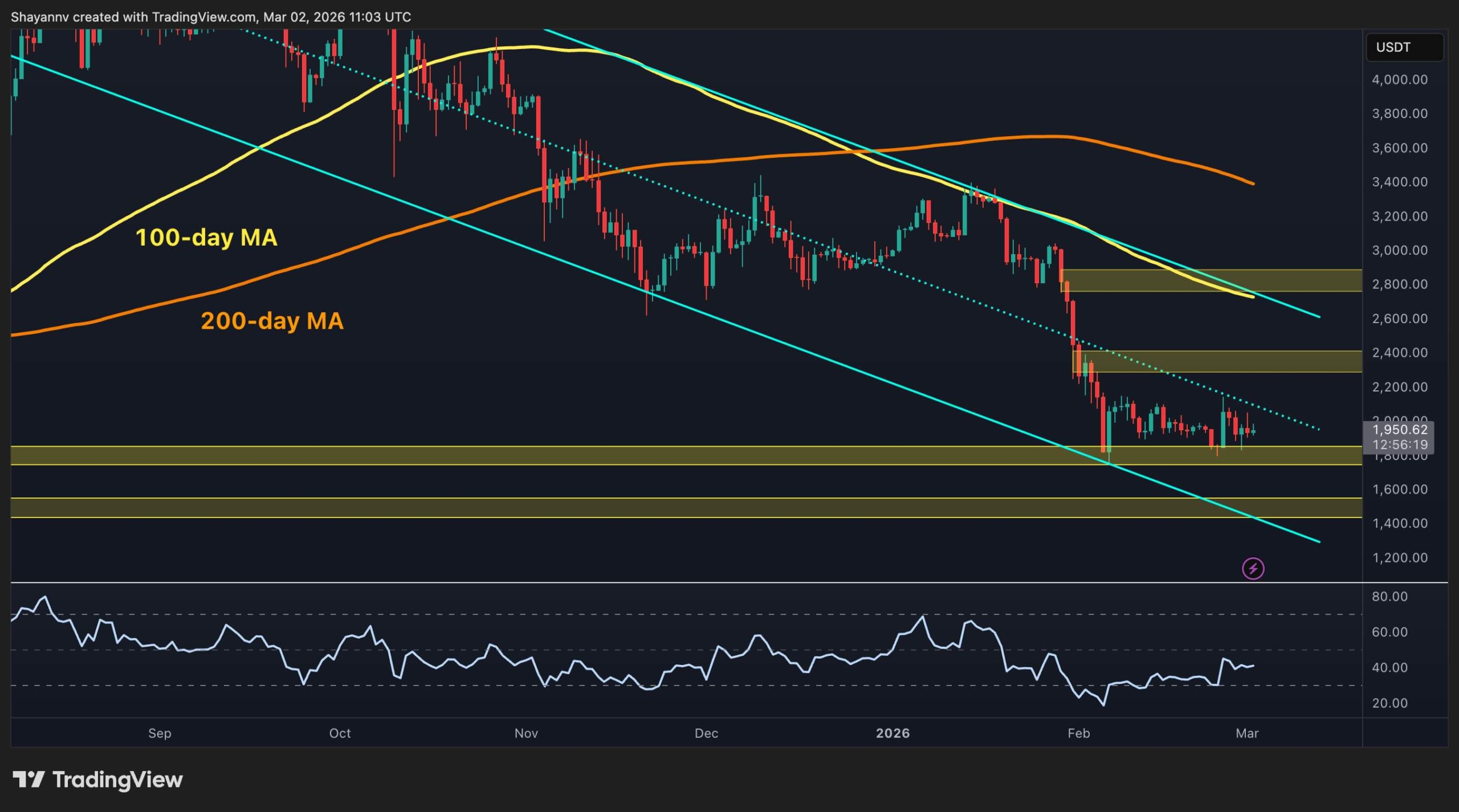
Will ETH Drop Below $1.8K Amid Escalating Macro Uncertainty?

Will ETH Drop Below $1.8K Amid Escalating Macro Uncertainty?

The post Will ETH Drop Below $1.8K Amid Escalating Macro Uncertainty? appeared on BitcoinEthereumNews.com. Home » ETH ‘; } function loadTrinityPlayer(targetWrapper
Share
BitcoinEthereumNews2026/03/03 00:16
Michael Saylor Pushes Digital Capital Narrative At Bitcoin Treasuries Unconference

Michael Saylor Pushes Digital Capital Narrative At Bitcoin Treasuries Unconference

The post Michael Saylor Pushes Digital Capital Narrative At Bitcoin Treasuries Unconference appeared on BitcoinEthereumNews.com. The suitcoiners are in town.  From a low-key, circular podium in the middle of a lavish New York City event hall, Strategy executive chairman Michael Saylor took the mic and opened the Bitcoin Treasuries Unconference event. He joked awkwardly about the orange ties, dresses, caps and other merch to the (mostly male) audience of who’s-who in the bitcoin treasury company world.  Once he got onto the regular beat, it was much of the same: calm and relaxed, speaking freely and with confidence, his keynote was heavy on the metaphors and larger historical stories. Treasury companies are like Rockefeller’s Standard Oil in its early years, Michael Saylor said: We’ve just discovered crude oil and now we’re making sense of the myriad ways in which we can use it — the automobile revolution and jet fuel is still well ahead of us.  Established, trillion-dollar companies not using AI because of “security concerns” make them slow and stupid — just like companies and individuals rejecting digital assets now make them poor and weak.  “I’d like to think that we understood our business five years ago; we didn’t.”  We went from a defensive investment into bitcoin, Saylor said, to opportunistic, to strategic, and finally transformational; “only then did we realize that we were different.” Michael Saylor: You Come Into My Financial History House?! Jokes aside, Michael Saylor is very welcome to the warm waters of our financial past. He acquitted himself honorably by invoking the British Consol — though mispronouncing it, and misdating it to the 1780s; Pelham’s consolidation of debts happened in the 1750s and perpetual government debt existed well before then — and comparing it to the gold standard and the future of bitcoin. He’s right that Strategy’s STRC product in many ways imitates the consols; irredeemable, perpetual debt, issued at par, with…
Share
BitcoinEthereumNews2025/09/18 02:12