Stablecoin USX Experiences Brief Price Disruption on Solana Network USX, a dollar-pegged stablecoin native to the Solana blockchain, encountered a temporary deviationStablecoin USX Experiences Brief Price Disruption on Solana Network USX, a dollar-pegged stablecoin native to the Solana blockchain, encountered a temporary deviation

USX Stablecoin Recovers After Short Depeg Caused by DEX Selling Pressure
Usx Stablecoin Recovers After Short Depeg Caused By Dex Selling Pressure

Stablecoin USX Experiences Brief Price Disruption on Solana Network

USX, a dollar-pegged stablecoin native to the Solana blockchain, encountered a temporary deviation from its peg on decentralized exchanges early Friday. Heavy selling pressure and limited liquidity on platforms like Orca and Raydium caused USX to dip significantly before Solstice Finance stepped in with liquidity injections to stabilize the token.

According to a recent alert on X, PeckShieldAlert reported USX briefly trading as low as $0.10 in secondary markets amid the event. The sharp decline was linked to isolated trades executed amidst extraordinarily thin liquidity conditions, highlighting potential vulnerabilities of stablecoins during market stress.

Source: PeckShieldAlert

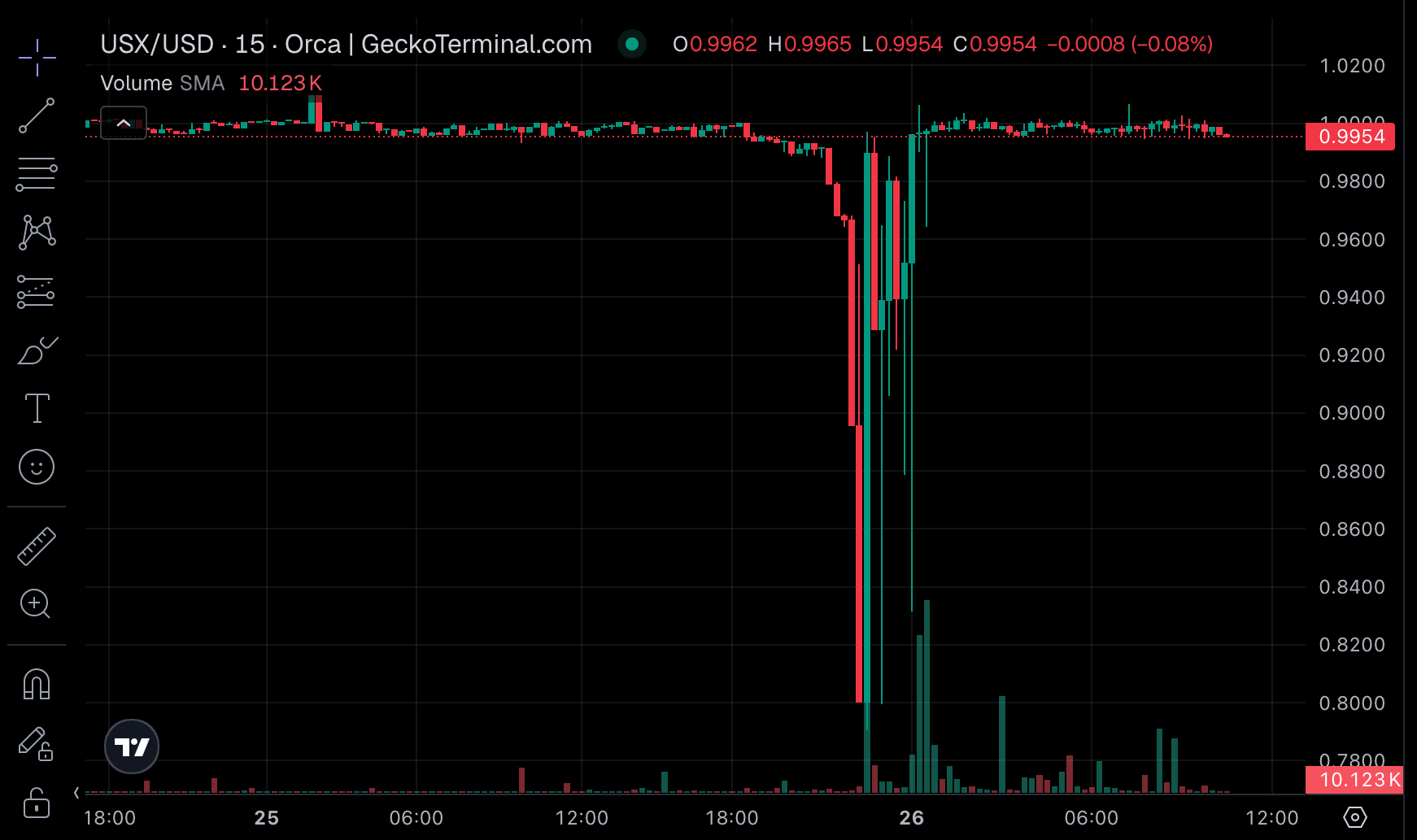
Data from GeckoTerminal revealed a more moderate decline, with the USX/USD trading pair plunging to approximately $0.80 within a 15-minute window on Orca’s pool. However, as liquidity improved, USX rebounded and stabilized near its intended peg of $1, highlighting the resilience of the market amidst the brief turmoil.
USX 15-min chartSource: GeckoTerminal.com

Solstice Finance reported initiating liquidity injections around 04:30 UTC, which contributed to the price recovery. The issuer reassured market participants that USX’s reserves are overcollateralized and that primary redemptions remain unaffected. The company has also engaged a third-party to verify its collateral levels and expressed commitment to supporting secondary markets to prevent similar episodes in the future.

Additionally, Solstice clarified that it continues to facilitate 1:1 redemptions for institutional partners with permissioned access, and it is actively working with partner entities to deepen secondary market liquidity. The implementation of these measures aims to mitigate the risk of abrupt peg deviations and bolster confidence in USX as a stable currency within the Solana ecosystem.

USX currently maintains a market capitalization of approximately $284 million, according to data from CoinMarketCap, reflecting its established presence and utility on the Solana blockchain. Despite the recent liquidity event, the stablecoin’s fundamentals remain sound, with resilience demonstrated through swift recovery efforts.

The Growing Concerns Over Stablecoin Stability

The incident underscores ongoing concerns about stablecoin stability amidst rapid industry expansion. Since the passage of the U.S. GENIUS Act in July, which provides a regulatory framework for dollar-pegged tokens, the stablecoin market has expanded sharply, with total market capitalization reaching around $308.5 billion, according to DefiLlama. This growth has attracted major financial institutions, payment providers, and crypto-native firms eager to participate in the evolving landscape.

However, regulators and industry experts warn that this rapid expansion increases systemic risks. The European Central Bank’s Dutch central bank governor, Olaf Sleijpen, recently highlighted potential macroeconomic shocks from stablecoin volatility, suggesting that authorities might need to treat stablecoins as sources of systemic risk rather than mere regulatory concerns. Sleijpen emphasized that any instability could prompt rapid sales of reserve assets, heightening market stress and affecting broader economic conditions.

In a comprehensive IMF report, global financial regulators examined the complexities and risks associated with stablecoins, citing fragmented regulations across jurisdictions and challenges in cross-chain interoperability as critical concerns. The report highlights the importance of coherent international standards to safeguard financial stability amid increasing stablecoin adoption. As the market continues to evolve, the resilience of stablecoins under stress will be tested, emphasizing the need for robust oversight and risk management frameworks.

This article was originally published as USX Stablecoin Recovers After Short Depeg Caused by DEX Selling Pressure on Crypto Breaking News – your trusted source for crypto news, Bitcoin news, and blockchain updates.

Market Opportunity
Wink Logo
Wink Price(LIKE)
$0.002348
$0.002348$0.002348
-5.89%
USD
Wink (LIKE) Live Price Chart
Disclaimer: The articles reposted on this site are sourced from public platforms and are provided for informational purposes only. They do not necessarily reflect the views of MEXC. All rights remain with the original authors. If you believe any content infringes on third-party rights, please contact [email protected] for removal. MEXC makes no guarantees regarding the accuracy, completeness, or timeliness of the content and is not responsible for any actions taken based on the information provided. The content does not constitute financial, legal, or other professional advice, nor should it be considered a recommendation or endorsement by MEXC.

You May Also Like

Republic Europe Offers Indirect Kraken Stake via SPV

Republic Europe Offers Indirect Kraken Stake via SPV

Republic Europe launches SPV for European retail access to Kraken equity pre-IPO.
Share
bitcoininfonews2026/01/30 13:32
cpwrt Limited Positions Customer Support as a Strategic Growth Function

cpwrt Limited Positions Customer Support as a Strategic Growth Function

For many growing businesses, customer support is often viewed as a cost center rather than a strategic function. cpwrt limited challenges this perception by providing
Share
Techbullion2026/01/30 13:07
How is the xStocks tokenized stock market developing?

How is the xStocks tokenized stock market developing?

Author: Heechang Compiled by: TechFlow xStocks offers a tokenized stock service, allowing investors to trade tokenized versions of popular US stocks like Tesla in real time. While still in its early stages, it’s already showing some interesting signs of growth. Observation 1: Trading is concentrated in Tesla (TSLA) As in many emerging markets, trading activity has quickly concentrated on a handful of stocks. Data shows a high concentration of trading volume in the most well-known and volatile stocks, with Tesla being the most prominent example. This concentration is not surprising: liquidity tends to accumulate in assets that retail investors already favor, and early adopters often use familiar high-beta stocks to test new infrastructure. Observation 2: Liquidity decreases on weekends Data shows that on-chain equity trading volume drops to 30% or less of weekday levels over the weekend. Unlike crypto-native assets, which trade seamlessly around the clock, tokenized stocks still inherit the behavioral inertia of traditional market trading hours. Traders appear less willing to trade when reference markets (such as Nasdaq and the New York Stock Exchange) are closed, likely due to concerns about arbitrage, price gaps, and the inability to hedge positions off-chain. Observation 3: Prices move in line with the Nasdaq Another key signal comes from pricing behavior during the initial launch period. Initially, xStocks tokens traded at a significant premium to their Nasdaq counterparts, reflecting market enthusiasm and potential friction in bridging fiat liquidity. However, these premiums gradually diminished over time. Current trading patterns show that the token price is at the upper limit of Tesla's intraday price range and is highly consistent with the Nasdaq reference price. Arbitrageurs appear to be maintaining this price discipline, but there are still small deviations from the intraday highs, indicating some market inefficiencies that may present opportunities and risks for active traders. New opportunities for Korean stock investors? South Korean investors currently hold over $100 billion in US stocks, with trading volume increasing 17-fold since January 2020. Existing infrastructure for South Korean investors to trade US stocks is limited by high fees, long settlement times, and slow cash-out processes, creating opportunities for tokenized or on-chain mirror stocks. As the infrastructure and platforms supporting on-chain US stock markets continue to improve, a new group of South Korean traders will enter the crypto market, which is undoubtedly a huge opportunity.
Share
PANews2025/09/18 08:00