

Bitcoin Price is Plunging! What’s Driving the Drop? Is it Heading Back Below $80,000?

The post Bitcoin Price is Plunging! What’s Driving the Drop? Is it Heading Back Below $80,000? appeared first on Coinpedia Fintech News
Bitcoin price has once again been trading under pressure after failing to sustain higher levels, leaving the broader crypto market cautious. The pullback below $85,000 comes at a time when risk appetite has weakened across global markets, with investors showing hesitation toward volatile assets. While the move has sparked concerns about a deeper correction, the current decline appears to be driven more by demand fatigue and macro positioning than by panic selling. The key question now is whether Bitcoin is merely consolidating or setting up for another leg lower.
What’s Driving Bitcoin Lower Today
Bitcoin isn’t falling because of a crash event. It’s sliding because support broke, buyers hesitated, broader crypto weakened, and macro conditions discouraged fresh risk-taking—all happening at the same time. Bitcoin’s decline today is being driven by the following factors.
Key Support Broken
Bitcoin slipped below the $88,000–$87,000 support zone, a level that had held multiple times earlier. Once this floor failed, technical selling accelerated, dragging BTC toward the $85,000–$85,200 area. This move triggered stop-losses and short-term de-risking rather than panic liquidation.
Buyers Stepped Back at Higher Levels
Spot demand failed to absorb supply near resistance. Without aggressive buyers defending the breakout zone, rallies faded quickly. This lack of follow-through left Bitcoin vulnerable once the price slipped below support.
Broader Crypto Market Turned Risk-Off
Selling pressure wasn’t isolated to Bitcoin. Most major cryptocurrencies traded in the red, pulling the total crypto market lower over the past 24 hours. When the broader market weakens together, Bitcoin typically absorbs the largest share of selling pressure.
Macro Headwinds Are Capping Risk Appetite
A combination of geopolitical uncertainty and the Federal Reserve holding rates steady without dovish guidance has kept investors cautious. As a result, capital has leaned toward safer assets, while high-risk exposure like crypto has seen reduced inflows.
Bitcoin Breaks Down the Bear Flag Structure
Bitcoin’s latest pullback is now reflecting clearly on the higher-timeframe chart. After failing to hold above the $90,000 region, BTC has slipped back below a critical support zone, shifting market sentiment toward caution. The weekly structure shows fading bullish control as buyers struggle to defend key levels amid weak follow-through.
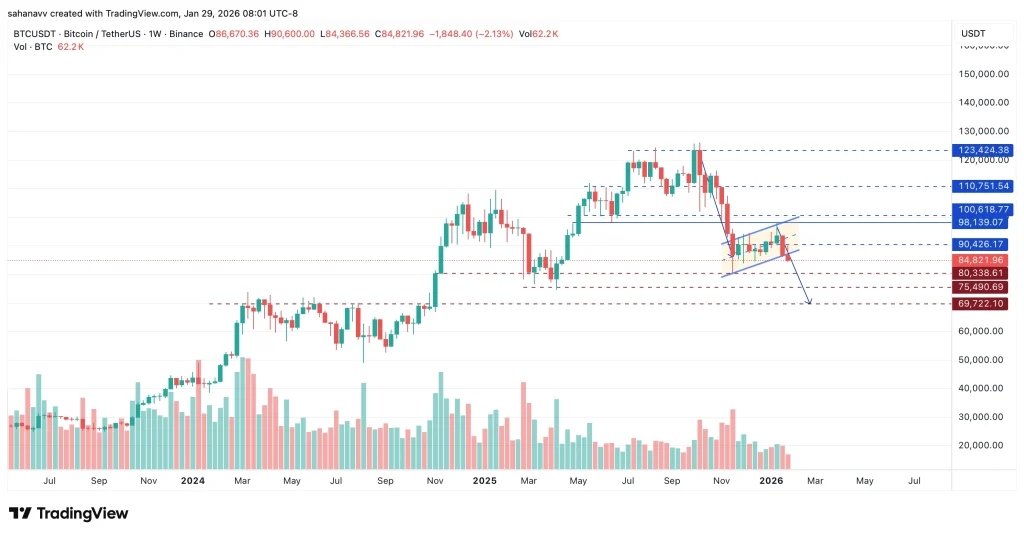
The weekly chart shows Bitcoin breaking below the $88,000–$85,000 support band, which is the channel of a bear flag. Volume has not expanded on the rebound attempts, indicating weak buyer conviction. If BTC fails to reclaim $90,000–$92,000, the structure opens downside risk toward $80,000, followed by deeper support near $75,000. The broader trend remains corrective unless price reclaims former resistance decisively.
What’s Next? Will BTC Price Drop Below $80,000?
Bitcoin’s weekly structure continues to lean bearish, with selling pressure increasingly absorbing buying volume. The weekly MACD has turned negative again, while the RSI is drifting toward lower support, reflecting weakening momentum. From a pattern perspective, confirmation of the bear flag breakdown would open downside risk toward the $70,000 region, aligning with the projected length of the flag’s pole. However, the $80,400 support zone remains critical. If buyers manage to defend this level, a short-term rebound could emerge. Failure to hold it, however, would likely keep Bitcoin testing lower demand zones.
You May Also Like

The Channel Factories We’ve Been Waiting For

Shanghai residents flock to sell gold as its price hit record highs
