Morgan Stanley S&P 500 Outlook: Why Strategists Say the Market Has Bottomed
TLDR
- Morgan Stanley strategist Michael Wilson says the S&P 500 is unlikely to make new lows
- Wilson recommends a “barbell” strategy: cyclicals plus quality growth stocks like the Magnificent 7
- Oil prices are now the main driver of market behavior, according to Morgan Stanley’s Serena Tang
- Three oil scenarios outlined: de-escalation ($80–$90), ongoing constraints ($100–$110), or severe shock ($150+)
- The 10-year Treasury yield at 4.50% is flagged as a key risk level for equity markets
Morgan Stanley is telling investors the worst may be over for the S&P 500 — but only if oil prices don’t spiral further out of control.
Strategist Michael Wilson said Monday he does not expect the S&P 500 to make meaningful new lows. He said the market is building a base and that investors should start adding exposure to certain stocks.
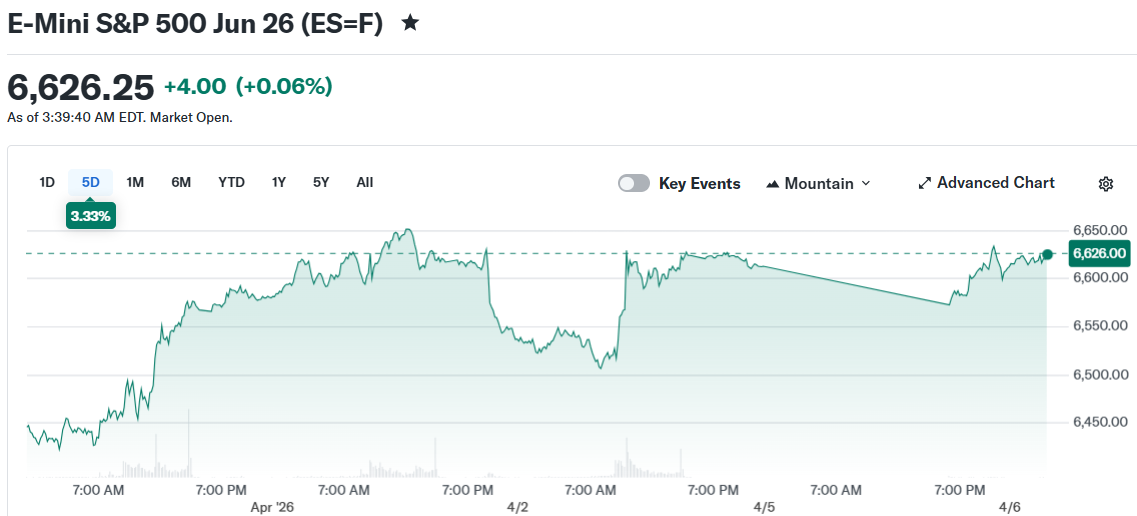 E-Mini S&P 500 Jun 26 (ES=F)
Wilson pointed to the index bouncing from support levels he had flagged weeks earlier, in the 6,300–6,500 range.
The S&P 500’s forward price-to-earnings multiple has fallen 18% from its peak over the past six months. Wilson said that level of compression has historically only happened during recessions or Federal Reserve tightening cycles — neither of which is Morgan Stanley’s base case.
Where Morgan Stanley Says to Invest Now
Wilson recommends a barbell approach. On one side: cyclical sectors like Financials, Consumer Discretionary, and short-cycle Industrials. On the other: quality growth names, especially the hyperscalers.
The Magnificent 7 now trades at around 24x forward earnings — close to Consumer Staples at 22x — but with more than three times the earnings growth. Wilson said the group is at the 2nd percentile of its valuation range since 2023.
He flagged 4.50% on the 10-year Treasury yield as a key threshold. Moves above that level have historically put pressure on equity valuations.
Hard economic data is also starting to support the recovery story. The March ISM Manufacturing PMI came in at 52.7, above consensus, and U.S. hotel revenue per available room rose 8% over the past six months.
Oil Is Now Driving Every Market Decision
Separately, Morgan Stanley Chief Cross-Asset Strategist Serena Tang said oil has become the central variable in markets — shaping how investors read growth, inflation, central bank policy, and risk.
Tang outlined three scenarios. In a de-escalation scenario, oil stabilizes around $80–$90 a barrel. Equities outperform, bond yields fall, and cyclical sectors lead. She calls it a “classic risk-on environment.”
If oil stays in the $100–$110 range, markets can absorb it, but with friction. The S&P 500 would likely trade in a wide range, quality companies with strong balance sheets would outperform, and credit markets would come under strain.
In the most severe scenario — oil above $150 — Tang says investors would shift to a recession playbook, moving into government bonds, cash, and defensive sectors.
Tang noted that in an oil shock, stocks and bonds can fall together, breaking the traditional 60/40 portfolio cushion. Over the past month, equity valuations dropped about 15% on a forward price-to-earnings basis.
The post Morgan Stanley S&P 500 Outlook: Why Strategists Say the Market Has Bottomed appeared first on CoinCentral.


추천 콘텐츠

Upbit Announces Crucial Server Maintenance: All Services to Halt on April 12 for Enhanced Stability

United Health Products Gains FDA Approval for New Clinical Study Plan to Address Warning Letter