

‘Scrappy’ outfits


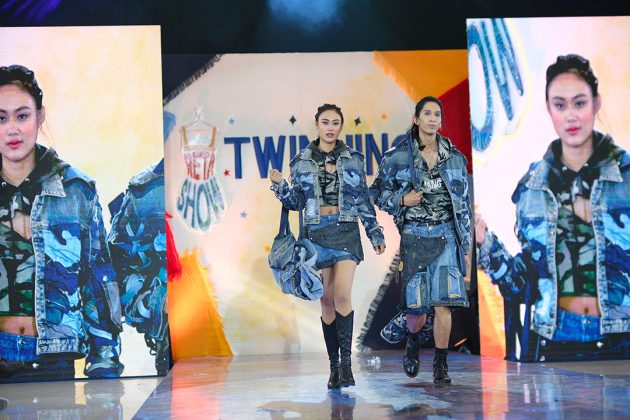
A Quezon City contest focuses on making new clothes from old
OLD CLOTHES were given life anew at Retashow, the Quezon City government’s sustainability project that promotes its own textile waste programs. The show, with 10 finalists, awarded three winners with P70,000 each and a plaque.
The show was held at SM Fairview on April 24. The clothes were judged by designer Avel Bacudio, director of the Department of Science and Technology – Philippine Textile Research Institute (DoST-PTRI) Julius Leaño, Jr., and Wear Forward founder Prince Jimdel Ventura. The clothes were judged by their wearability as well as the amount of recycled materials used: each outfit had to be made of 70% recycled material.
This year — the contest’s third edition — the theme was centered around “twinning,” so designers had to make two looks.
Nino Casiwan used old curtains, kitchen towels, and scrap fabrics from his own studio to make patchwork shorts set, twinning with a Mod-inspired skirt.
Edel Santiago used discarded white cotton, and dyes using mangosteen, coconut husk, and onions. This made for a rather exciting terno–bolero with a tulip skirt, and a matching wide-lapelled jacket on the male model. Fabric was patched onto lace as a binder.
Janeth Belchez used sheer fabric made as a balintawak native dress. On this, she used her version of the rags Filipino households sew together from fabric scraps, this time made from satin scrap, which dotted the skirt. On another outfit, puffed sleeves were stuffed with more scraps, giving them volume and movement.
Evelyn Rocela made clothes for kids: a vest set for a boy was made with woven scraps bound by a base of denim, while a matching outfit on a girl was a full-length coat in this make (very grunge).
Danryl Purisima made a polo shirt ensemble, and a casual denim look that unfolds into a longer outfit. Jashmin Iballo, meanwhile, used leopard-print scraps, with some avant-garde elements like hoods. Catrina Lopez combined satin ruching with a jean patchwork skirt and a denim corset top — the twinning outfit placed the satin on the jacket.
Ron Renigado also made a denim patchwork outfit, but this one was buttoned at the back, and had a denim pussybow and an apron. A matching dress is made similarly but zipped up the front (someone in the show bought this off the runway).
Sophia Servando made sundresses with printed chintz and batik from curtains and dasters, the average Filipino housedress. Finally, Prince Galang made outfits with a denim lattice. A maxi skirt turned into a mini, and the leftovers fold into a bag. Pants unzipped to turn into shorts, and the extra legs turned into bags.
The winners were Prince Galang, Ron Renigado, and Nino Casiwan.
SUSTAINABILITY
Ms. Belmonte discussed the city’s own sustainability efforts, chief among them the single-use plastic ban and the passage of City Ordinance SP-3472, S-2025, or the Textile Sustainability and Circularity Ordinance of Quezon City. This aims to create a system for the collection, processing, and distribution of textile products for repair, reuse, and recycling. Kilo/s QC, the weight-based secondhand clothing store in the Quezon City Hall complex, uses its proceeds to pay for public school tutoring programs (which reduced by 2,000 children the 7,000 non-reading children in Quezon City).
“We have created readers out of our non-readers because of textile reuse and recycling,” she said in a speech.
Furthermore, the project has diverted around 10,000 kilograms worth of clothes from landfills. A Circularity Hub in Payatas launched last year provides livelihood to women there and trains them as weavers for a cultural enterprise. On a smaller scale, the city collects discarded corporate wear to give to job applicants who can’t afford them.
“Through our initiatives, we have shown what sustainability can truly be,” said the mayor. On her own part, Ms. Belmonte said that she regularly repeats outfits, even for special occasions — so much so, that according to her, people have started to feel sorry for her clothing budget. In a mix of English and Filipino, she said, “When it comes to sustainable fashion, one of the strongest messages we can send is using clothes that are already in our wardrobe.” — Joseph L. Garcia


추천 콘텐츠

XRP Quantum Risk: 77 Billion Tokens Face Future Cryptographic Threats

WSJ: Trump's new FDA pick is a disaster




