

Bitcoin’s Fed cut trade flips as bond market turns into the risk
Bloomberg reported on May 22 that bond traders are fully pricing in a Fed interest rate hike by year-end, with interest rate swaps implying the Fed's benchmark rate at least 25 basis points higher by the end of 2026.
The same day, Fed Governor Christopher Waller said the Fed should remove its easing bias and called rate cut talk “crazy” as inflation held above target and the labor market stayed stable.
Bitcoin lost the $76,000 footing on May 22, a move tied to US-Iran uncertainty and the repricing of Fed rate expectations.
That price action captures only part of the macro repricing underway, as the rate-cut tailwind that supported risk assets through much of early 2026 has become a rate-hike risk, and the bond market has taken over the job of setting financial conditions before the Fed makes a formal move.
Kevin Warsh took the oath as Fed chair on May 22, with the FOMC selecting him unanimously.
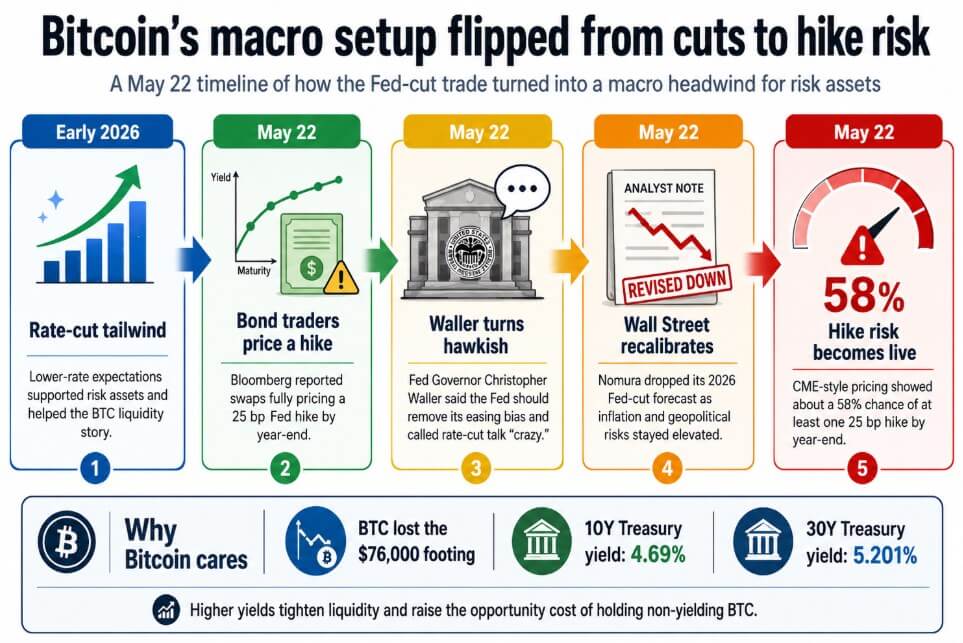 A five-step timeline traces how Bitcoin's macro backdrop moved from rate-cut tailwind to 58% hike probability on May 22, with the 10-year yield hitting 4.69%.
Nomura dropped its 2026 Fed rate cut forecast on persistent inflation and geopolitical risks, while CME FedWatch pricing showed roughly a 58% chance of at least one 25-basis-point hike by the end of the year.
Long-term Treasury yields had already been climbing before bond traders fully priced a hike, with the 30-year yield reaching 5.201%, its highest since 2007, while the 10-year yield hit 4.69%, its highest since January 2025.
Both figures reflect real borrowing costs tightening well before any FOMC action, putting the risk-free rate in direct competition with assets that offer no yield.
For Bitcoin, Treasuries at these levels raise the opportunity cost of holding a non-yielding asset as the market reprices the risk-free rate, and that repricing is already underway.
The 1999 parallel
Reports noted that the two-month correlation between US equities and the 10-year Treasury yield fell to -0.70, the lowest reading since 1999.
Charles Schwab strategist Kevin Gordon put the rolling 30-day figure at approximately -0.68, describing a structural condition in which equities and Treasury yields have been moving in opposite directions to a historically rare degree.
Global equity funds recorded their first weekly outflow in nine weeks in the period ending May 22.
BTC has traded as a high-beta risk asset through most of 2025 and into 2026, moving with equity sentiment on both the way up and the way down.
With the -0.70 correlation putting equities on the wrong side of any further yield move, higher yields tighten the BTC liquidity environment and weigh on equities, which drag crypto lower as part of the broader risk complex.
A Fed hike, or even the sustained expectation of one, attacks BTC's investment case through four mechanisms that build on each other.
| Pressure channel | What changes | Why it matters for BTC |
|---|---|---|
| Liquidity | Higher expected policy rates weaken the case for easier financial conditions | Less capital flows into speculative assets |
| Real-yield competition | 10-year yield at 4.69% makes Treasuries more attractive | BTC has no yield, so its opportunity cost rises |
| Risk appetite | Equities fall as yields rise | BTC gets dragged into the broader risk-off move |
| Narrative damage | “Fed cuts are coming” loses its timeline | One of crypto’s cleanest bullish macro catalysts weakens |
Higher expected policy rates reduce the case for easier financial conditions, pulling potential liquidity away from speculative assets. The 10-year yield at 4.69% makes Treasuries harder to dismiss as competition for capital, raising the opportunity cost of holding a non-yielding asset.
With equities selling off as yields climb, BTC follows suit in the risk-off flow, and the “Fed cuts are coming” thesis, which functioned as one of the cleanest macro catalysts for crypto through late 2025, no longer has a clear timeline to lean on.
Those four mechanisms activate well before a recession or a full-blown credit event. The bond market, making borrowing more expensive, is sufficient to tighten financial conditions, reduce risk appetite, and pull speculative assets lower.
BTC's trajectory from here runs through the 10-year Treasury yield, and whether it retreats from 4.69% or pushes higher sets the macro ceiling on risk appetite more concretely than any on-chain catalyst.
Where the trade goes from here
In the bull case, geopolitical uncertainty around Iran fades, oil prices recede, and Treasury yields pull back from recent highs.
The Fed keeps its options open without validating June hike expectations, CME hike odds fall below 40%, and the 10-year retraces toward 4.4%.
In that version, Bitcoin rebuilds the late-2026 easing narrative, in which ETF inflows return, spot demand recovers, and the rate-cut trade restores the liquidity environment BTC has been positioned for.
| Scenario | Macro setup | Key level to watch | Bitcoin implication |
|---|---|---|---|
| Bull case | Iran risk fades, oil cools, Treasury yields retreat | 10-year falls toward 4.4%; hike odds drop below 40% | BTC rebuilds the late-2026 easing narrative |
| Base case | Fed keeps optionality, but hike risk stays live | 10-year stays near 4.5%–4.7%; CME hike odds remain elevated | BTC remains choppy and macro-sensitive |
| Bear case | Sticky inflation keeps Waller-style hawkishness in place | 10-year pushes back to 4.69% or higher | Treasuries compete with BTC and risk appetite weakens |
| Stress case | Yields rise while equity-yield correlation remains deeply negative | 30-year stays near or above 5.2%; equity outflows continue | BTC trades as part of a broader risk-asset drawdown |
In the bear case, sticky inflation keeps Waller-style hawkishness in place across the FOMC, one hike becomes the consensus base case, and the 10-year pushes back toward 4.69% or above.
In that version, BTC stays range-bound near current levels, Treasuries continue to compete with speculative assets for capital, and the -0.70 equity-yield correlation acts as a structural drag.
Bitcoin's next move depends on whether Treasury yields can pull back enough to give risk assets room to recover. At 4.69% on the 10-year and 5.201% on the 30-year, the bond market is already doing the Fed's tightening work, and the market has priced BTC accordingly.
The post Bitcoin’s Fed cut trade flips as bond market turns into the risk appeared first on CryptoSlate.


추천 콘텐츠

Rubio Drops Iran Breakthrough Bombshell as Nuclear Deal Talks Heat Up

Binance Australia Mandates Sender and Beneficiary Info for All Crypto Transfers Starting July 1, 2026

XRP to $300? Ripple President Just Confirmed This About XRP ledger


인기 뉴스
더보기
