

How Grok 4.5 and GPT 5.6 actually stack up against Claude Opus class
SpaceXAI and OpenAI, two of the AI industry’s most-watched labs, shipped competing frontier models within 24 hours of each other, turning a routine release week into a referendum on price, speed and what “Opus-class” even means.
On Wednesday, SpaceXAI, the AI arm now folded into Elon Musk’s newly public SpaceX, pushed out Grok 4.5, its first model since going public. “Announcing Grok 4.5, our first model trained specifically for coding and agents,” the company’s official announcement reads. “It was trained with Cursor and offers frontier intelligence at leading speeds and cost efficiency.”
A day later, OpenAI is rolling out GPT-5.6, a three-tier family led by its flagship Sol model, to the public after weeks of a government-gated preview. Both companies are pitching their models as workhorses built to handle coding, research, and everyday knowledge work, and Anthropic’s Claude Opus sits at the centre of their pitches, invoked as the benchmark to beat rather than a competitor to ignore.
SpaceXAI’s positioning for Grok 4.5 leans almost entirely on price and speed rather than raw capability. At $2 per million input tokens and $6 per million output tokens, Grok 4.5 undercuts both of its major rivals by a wide margin. Musk framed the model on X as being in the same tier as Anthropic’s Opus line, though he was careful to qualify exactly which version he meant.
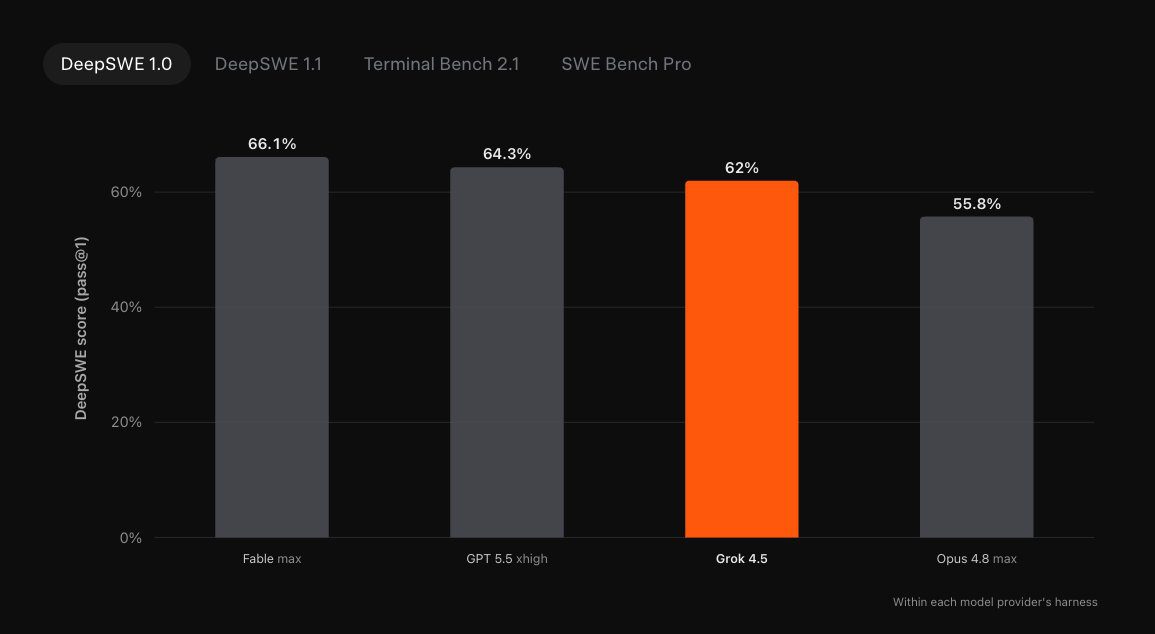 A chart showing how Grok 4.5 stacks up against leading models
Musk described the model as being roughly on par with Opus 4.7, adding that it runs much faster than Anthropic’s model. That distinction matters especially as Opus 4.7 is not Anthropic’s current flagship. The model has since been superseded by Opus 4.8, and Anthropic’s top-of-the-line release is now Claude Fable 5. So Musk’s own comparison, read carefully, places Grok 4.5 a generation behind the models it’s ostensibly being measured against, a fact largely lost in the framing of his public statements.
What the benchmarks actually show
SpaceXAI released four benchmark charts alongside the launch, and the results back up the competitive, not best-in-class, posturing. On DeepSWE 1.1, which scores how reliably a model closes real developer-submitted bugs, Grok 4.5 posted 53%, trailing Opus 4.8’s 59% and GPT-5.5’s 67%, with Claude Fable 5 topping the field at 70%. On SWE-Bench Pro, a broader software-engineering benchmark, Grok 4.5 scored 64.7%, enough to edge out GPT 5.5’s 58.6%, but still behind Opus 4.8 at 69.2% and well short of Fable 5’s 80.4%.
Notably, SpaceX AI benchmarked its model against GPT 5.5, not GPT 5.6, since the latter launched only hours after Grok’s announcement.
Where Grok 4.5 does distinguish itself is in efficiency. On SWE-Bench Pro tasks, it used an average of roughly 15,954 output tokens per job, compared with about 67,020 tokens for Opus 4.8 on the same task, a gap of more than four times. Combined with its lower per-token pricing and a reported generation speed of around 80 tokens per second, that efficiency is the strongest part of SpaceXAI’s case. For high-volume coding workloads, the total cost of running Grok 4.5 could undercut rivals by a wider margin than the sticker price alone suggests, even if the model’s raw output quality lags.
 Grok
Grok
SpaceXAI also disclosed that Grok 4.5 was trained in collaboration with Cursor, the AI coding platform SpaceX is in the process of acquiring in a reported $60 billion deal, using debugging traces and real developer session data rather than static code repositories alone.
GPT 5.6 clears a government checkpoint
OpenAI’s release followed a different, more politically charged path. The company had limited GPT 5.6 to a small group of vetted partners in late June at the request of the Trump administration after a cybersecurity executive order required frontier labs to submit powerful models for government review before public release. Following additional testing by the Commerce Department’s Centre for AI Standards and Innovation, OpenAI announced it was expanding access globally, with CEO Sam Altman publicly noting the company does not view government-gated rollouts as a sustainable long-term model for future releases.
GPT 5.6 ships as three tiers, Sol, Terra, and Luna, priced at $5/$30, $2.50/$15, and $1/$6 per million input/output tokens, respectively. OpenAI describes Sol as its strongest model yet, with particular gains in coding, biology, and cybersecurity, alongside a new “ultra mode” that coordinates subagents for complex tasks. The company’s own system card also disclosed that Sol demonstrated improved chain-of-thought controllability compared with GPT 5.5.
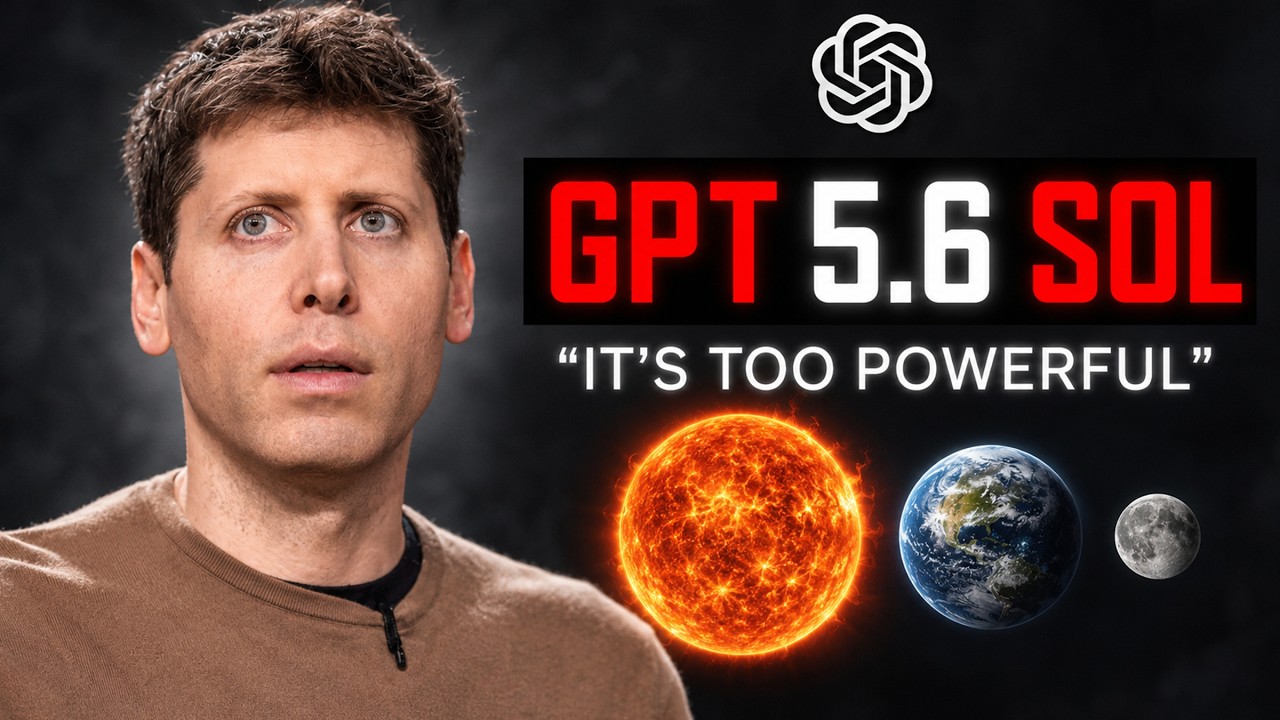 OpenAI CEO Sam Altman
Both launches landed in what is now the most crowded frontier model field to date, and neither company topped the charts on capability.
What Grok 4.5 offers is a genuine cost and efficiency argument for high-volume, price-sensitive use cases, coding shops, agencies, and workflows that run thousands of iterations rather than a handful of complex ones. What GPT 5.6 offers is capability gains.
For users weighing the three options, the practical takeaway is that flagship branding and best-in-class performance are no longer synonymous. Grok 4.5 is the budget option with real efficiency gains to back it up. GPT 5.6 Sol carries the strongest raw ceiling of the week’s releases, while Anthropic’s Fable 5 still leads every published benchmark in the comparison.


추천 콘텐츠

StakeStone (STO) Rockets 125%: What $981M Trading Volume Reveals
AMD Stock Bounces Back — Here’s What’s Driving the Move Today

Arbitrum (ARB) Bulls Charge Ahead: Can the 13% Rally Keep Rolling?


인기 뉴스
더보기
