Hyperliquid RWA Perpetuals Hit $500B—Is TradFi Moving Onchain?
Overview
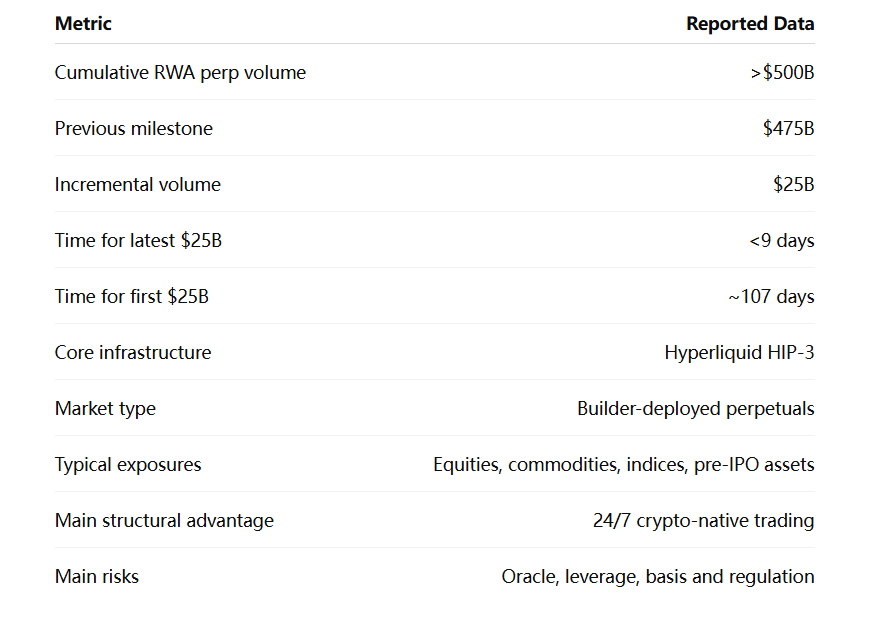
Hyperliquid RWA perpetuals have crossed a major milestone, with TradeXYZ-linked markets surpassing $500 billion in cumulative trading volume. The figure does not represent assets deposited, TVL or open interest. It measures the total notional value traded across perpetual contracts tied to traditional assets such as equities, commodities, indices and other real-world exposures.
The pace of growth is particularly notable. TradeXYZ reportedly needed around 107 days to generate its first $25 billion in cumulative volume, while the move from $475 billion to $500 billion took less than nine days. That acceleration suggests demand for crypto-native access to traditional-market price exposure is expanding beyond a niche experiment.
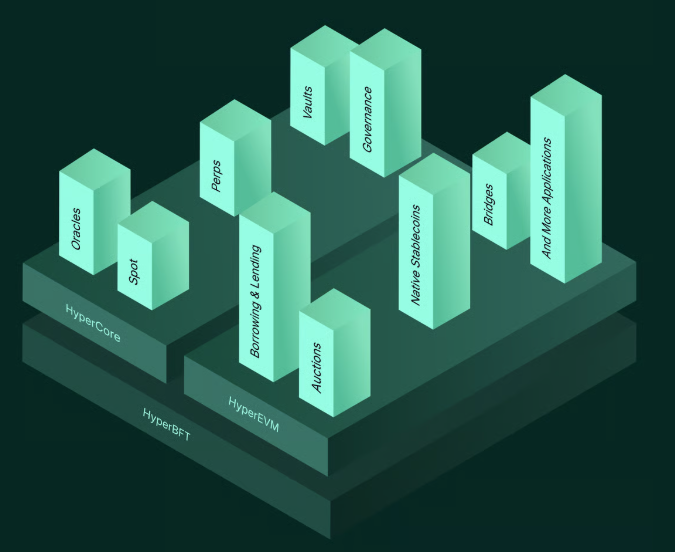
The broader infrastructure is enabled by Hyperliquid’s HIP-3 framework, which allows qualified builders to deploy their own perpetual markets while inheriting HyperCore’s order-book and margining architecture. Builders are responsible for market definitions, oracle configuration and operating parameters, while the protocol provides the underlying execution environment.
The significance of the $500 billion milestone is therefore not that $500 billion of stocks or commodities have moved onchain. It is that more than $500 billion in cumulative trading exposure has changed hands through blockchain-based perpetual contracts.
Key Takeaways
- TradeXYZ-linked Hyperliquid RWA perpetuals have surpassed $500 billion in cumulative trading volume.
- The latest $25 billion reportedly took less than nine days, compared with about 107 days for the first $25 billion.
- HIP-3 allows builders to deploy perpetual markets for assets beyond conventional crypto tokens.
- Traders receive price exposure without owning the underlying stock, commodity or index.
- The main opportunities are 24/7 trading and faster market creation, while oracle, leverage, basis and regulatory risks remain significant.
Why Did Hyperliquid RWA Perpetuals Reach $500B?
How Fast Is TradeXYZ Growing?
The most important signal is not only the $500 billion total but the rate at which incremental volume is being added. TradeXYZ reportedly took roughly 107 days to generate its first $25 billion in cumulative trading volume. By contrast, the increase from $475 billion to $500 billion required less than nine days.
That compression suggests the market is becoming substantially more active as traders become familiar with perpetual contracts linked to traditional assets. It may also reflect a broader expansion of available markets, deeper liquidity and increasing acceptance of Hyperliquid as an execution venue for exposures that historically belonged almost entirely to regulated securities and derivatives exchanges.
However, cumulative volume naturally rises over time and should not be confused with capital retained on the platform. A trader can generate many dollars of notional turnover using a much smaller amount of collateral, particularly when leverage and repeated position changes are involved.
TradeXYZ Growth Snapshot
What Is TradeXYZ?
TradeXYZ operates markets built through Hyperliquid’s HIP-3 framework. Rather than functioning as a conventional centralized exchange with its own separate matching engine, the builder can create perpetual markets while using Hyperliquid’s underlying HyperCore infrastructure.
Under HIP-3, deployers define contract specifications, oracle methodology, leverage limits and other market parameters. The markets inherit HyperCore’s order books and margining stack, while each builder-deployed perpetual DEX can maintain its own market configuration.
This architecture is important because it decentralizes part of the listing process. Hyperliquid itself does not need to manually create every new perpetual contract. Builders can introduce markets for additional asset categories if they satisfy protocol requirements, including staking and operating standards.
What Are Hyperliquid RWA Perpetuals?
How Can Traders Get Stock Exposure Without Owning Shares?
Hyperliquid RWA perpetuals provide synthetic price exposure rather than legal ownership of the underlying asset. A trader can take a long or short position on a contract referencing an equity, commodity or other traditional asset without receiving the actual share certificate, shareholder rights or physical commodity.
That distinction is fundamental. Someone trading a perpetual linked to a listed stock does not automatically receive dividends, voting rights or direct legal ownership in the company. The product is a derivative whose value is designed to track the referenced market through oracle prices, funding mechanisms and trading activity.
This makes the product closer to a leveraged derivative than to a tokenized stock. Tokenized securities generally attempt to represent actual ownership or economic rights linked to a regulated security, while a perpetual contract primarily delivers price exposure.
Why Do These Contracts Not Expire?
A perpetual contract is designed to remain open without a fixed expiry date. Traditional futures typically mature on specific dates, requiring traders to close or roll positions if they want to maintain exposure. Perpetuals remove that scheduled rollover.
Funding mechanisms help keep the contract price aligned with its reference market. Depending on market conditions, traders on one side of the position may periodically pay traders on the other side. This creates an economic incentive that helps prevent the perpetual price from drifting indefinitely away from the underlying reference price.
The absence of expiry is attractive to crypto-native traders because it simplifies position management. However, it also creates ongoing funding costs and can become more complicated when the referenced traditional market is closed while the perpetual continues trading.
Why Are Traders Moving Traditional Asset Exposure Onchain?
Why Does 24/7 Trading Matter?
One of the clearest advantages is continuous market access. Traditional U.S. equity markets still operate around defined sessions, even as extended-hours trading expands. Crypto-native perpetual markets can remain open around the clock, including nights and weekends.
That becomes particularly relevant when major information arrives outside regular market hours. Earnings announcements, geopolitical developments, commodity shocks or corporate news can occur when the underlying exchange is closed. A perpetual market may therefore provide traders with a venue for expressing views before traditional trading resumes.
The feature is especially useful for globally distributed crypto traders who are already accustomed to 24/7 markets. Instead of switching between separate brokerage, futures and crypto platforms, they can manage several forms of exposure through one trading environment.
Could Hyperliquid Become a Price-Discovery Venue?
Potentially, but with important limitations. If a widely traded traditional asset is unavailable on its primary exchange while a liquid perpetual continues operating, the perpetual price can become an early signal of how traders expect the underlying market to reopen.
That does not make the perpetual price the official market price. During market closures, the reference asset itself may not be actively trading, so liquidity can become thinner and disagreement over fair value can increase. When the underlying venue reopens, the two prices may converge sharply.
This creates both opportunity and risk. Onchain perpetual markets could contribute useful information during off-hours, but traders should not assume every overnight move represents a reliable forecast of the next official opening price.
How Does HIP-3 Power Hyperliquid RWA Perpetuals?
What Does HIP-3 Allow Builders to Do?
HIP-3 enables permissionless builder-deployed perpetual markets. A deployer is responsible for defining the market, operating its oracle and determining contract parameters such as leverage limits, while Hyperliquid provides the execution stack.
The protocol requires substantial HYPE staking from deployers and gives validators the ability to slash that stake if market operation creates protocol-level problems. This mechanism is designed to create economic accountability for builders that control important parts of the contract specification and oracle process.
HIP-3 markets also inherit HyperCore’s high-performance order books and margining infrastructure. From a user perspective, that creates a relatively unified trading experience even though different builders can operate different markets.
Why Are Oracles So Important?
Traditional-asset perpetuals are only as reliable as the price references used to settle and margin them. Hyperliquid’s documentation explicitly notes that perpetual markets work best when the underlying asset has a well-defined economic price that is difficult to manipulate.
For equities and commodities, this becomes more challenging when the primary underlying market is closed. Builders must determine how to update oracle prices, handle stale data and manage extreme price moves. Poor oracle design can create incorrect liquidations or allow a market to trade far from reasonable economic value.
Hyperliquid therefore gives deployers significant responsibility but also imposes operational and staking requirements intended to discourage weak or malicious market design.
Can Hyperliquid RWA Perpetuals Compete With Traditional Derivatives Markets?
Where Does Hyperliquid Have an Advantage?
Speed and accessibility are the clearest advantages. New markets can potentially be deployed more quickly than traditional exchange-listed derivatives, while users can access them through a crypto-native account structure without waiting for conventional market hours.
The platform also supports composability with a broader onchain ecosystem. Collateral, trading activity and protocol incentives can potentially interact within the same blockchain environment rather than being split among multiple clearing, brokerage and settlement systems.
For some traders, the combination of leverage, 24/7 operation and rapid listing can make Hyperliquid RWA perpetuals more flexible than traditional products.
Where Does TradFi Still Have an Advantage?
Traditional derivatives markets remain substantially stronger in regulatory clarity, institutional participation, legal infrastructure, clearing and long-established liquidity. Major futures and securities venues operate under mature surveillance, margin and default-management frameworks that have been tested across multiple market crises.
Ownership rights also remain fundamentally different. A perpetual linked to a stock does not make the holder a shareholder, while regulated securities infrastructure provides legally recognized ownership and investor protections.
Institutional users therefore may view onchain perpetuals as an additional trading venue rather than a direct replacement for established derivatives markets.
What Are the Biggest Risks?
What Happens When the Underlying Market Is Closed?
The perpetual can continue trading while the underlying asset is unavailable for normal price discovery. That can create basis divergence between the derivative and its reference market.
If major news occurs over a weekend, traders may aggressively reprice the perpetual based on expectations rather than observed transactions in the underlying security. When the traditional exchange reopens, the reference price can move sharply toward or away from the perpetual level.
This means 24/7 availability is both a feature and a source of additional risk.
How Does Leverage Change the Risk?
Perpetuals allow traders to obtain large notional exposure using smaller amounts of collateral. This improves capital efficiency but also creates liquidation risk.
A relatively small adverse move can force a leveraged position to close, and concentrated liquidations can intensify volatility. Traditional assets that normally move more slowly can therefore exhibit much larger effective account-level swings when traded through leveraged perpetual contracts.
The cumulative $500 billion volume figure should consequently not be interpreted as equivalent to $500 billion of unleveraged investment capital.
Could Regulation Become the Biggest Constraint?
Yes. Perpetual contracts tied to equities, commodities and other regulated asset classes can raise complex questions about securities, futures and derivatives jurisdiction.
The ability to create a market technically does not guarantee that the same product can be legally offered to every user in every country. Regulatory classification, access restrictions and compliance requirements may become increasingly important as volumes expand.
This is likely to be one of the largest differences between crypto-native RWA perpetual markets and fully regulated tokenized securities.
$500B Shows Traditional Assets Are Becoming Crypto-Native Trading Products
The significance of Hyperliquid RWA perpetuals crossing $500 billion in cumulative trading volume is not that half a trillion dollars of stocks, commodities or other physical assets have moved onto Hyperliquid. The figure instead reflects the cumulative notional turnover of derivatives referencing those markets.
That distinction does not make the milestone less important. The acceleration from roughly 107 days for the first $25 billion to less than nine days for the latest $25 billion indicates that crypto-native demand for traditional-asset exposure is growing rapidly.
HIP-3 is a central part of that shift. By allowing builders to create perpetual markets while inheriting HyperCore’s execution infrastructure, Hyperliquid has turned asset listing into a more open process and expanded perpetual trading beyond conventional cryptocurrencies.
The next phase will depend on market quality rather than raw volume alone. Liquidity depth, oracle reliability, open interest, liquidation behavior and regulatory treatment will determine whether these products evolve into durable financial infrastructure.
If those foundations strengthen, Hyperliquid RWA perpetuals could become a meaningful bridge between crypto trading culture and traditional asset price discovery. The $500 billion milestone suggests traders are already willing to experiment at significant scale; the harder question is whether that activity can mature into a resilient market structure.
Sources
https://hyperliquid.gitbook.io/hyperliquid-docs/for-developers/api/deploying-hip-3-assets
https://hyperliquid.gitbook.io/hyperliquid-docs/for-developers/api/info-endpoint/perpetuals
Risk Disclaimer: This article is for reference only and does not constitute investment advice. The cryptocurrency market is highly volatile. Please make decisions cautiously based on your individual circumstances.


Можеби ќе ви се допадне и ова

Sui Stablecoin Transfers Top $65B: What Comes Next?

Onchain Repo Settles in 10 Minutes Using Digital Bonds

RLUSD Market Cap Tops $2B: How Did Ripple Get Here?