This article applies a free and fair economy model to analyze pure exchange economies and markets with transferable payoff.This article applies a free and fair economy model to analyze pure exchange economies and markets with transferable payoff.

Game Theory and Exchange Economies: A New Model for Pure Exchange and Transferable Payoff

2025/09/17 23:30

Abstract and 1. Introduction

  1. A free and fair economy: definition, existence and uniqueness

    2.1 A free economy

    2.2 A free and fair economy

  2. Equilibrium existence in a free and fair economy

    3.1 A free and fair economy as a strategic form game

    3.2 Existence of an equilibrium

  3. Equilibrium efficiency in a free and fair economy

  4. A free economy with social justice and inclusion

    5.1 Equilibrium existence and efficiency in a free economy with social justice

    5.2 Choosing a reference point to achieve equilibrium efficiency

  5. Some applications

    6.1 Teamwork: surplus distribution in a firm

    6.2 Contagion and self-enforcing lockdown in a networked economy

    6.3 Bias in academic publishing

    6.4 Exchange economies

  6. Contributions to the closely related literature

  7. Conclusion and References

Appendix

6.4 Exchange economies

In this section, we apply our theory to pure exchange economies (Section 6.4.1) and markets with transferable payoff (Section 6.4.2).

\ 6.4.1 Pure exchange economies

\
\
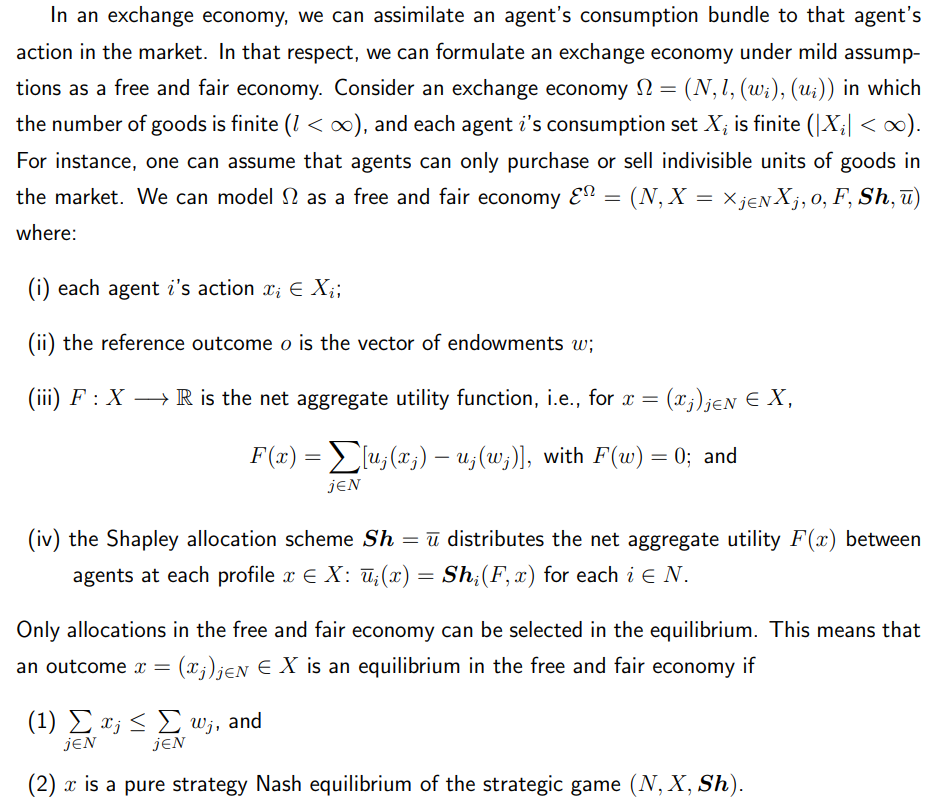
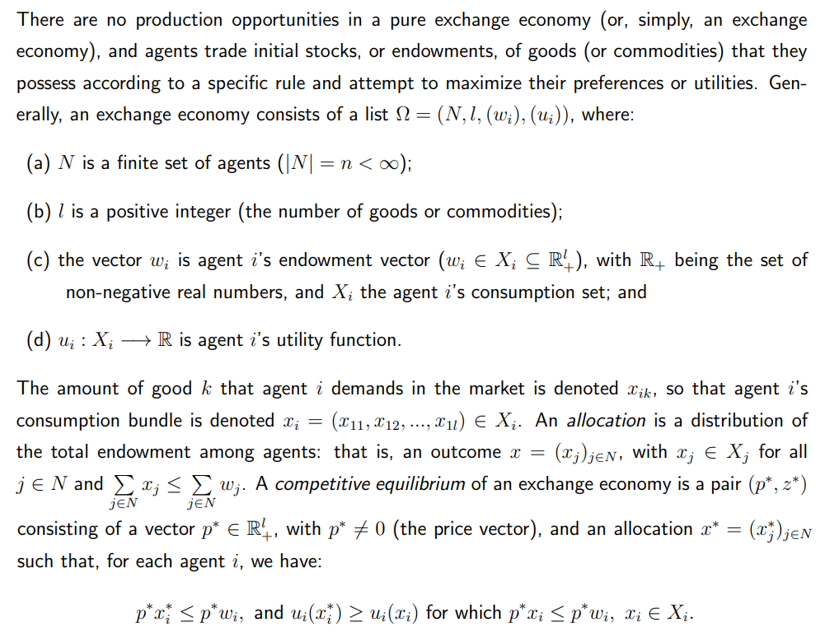
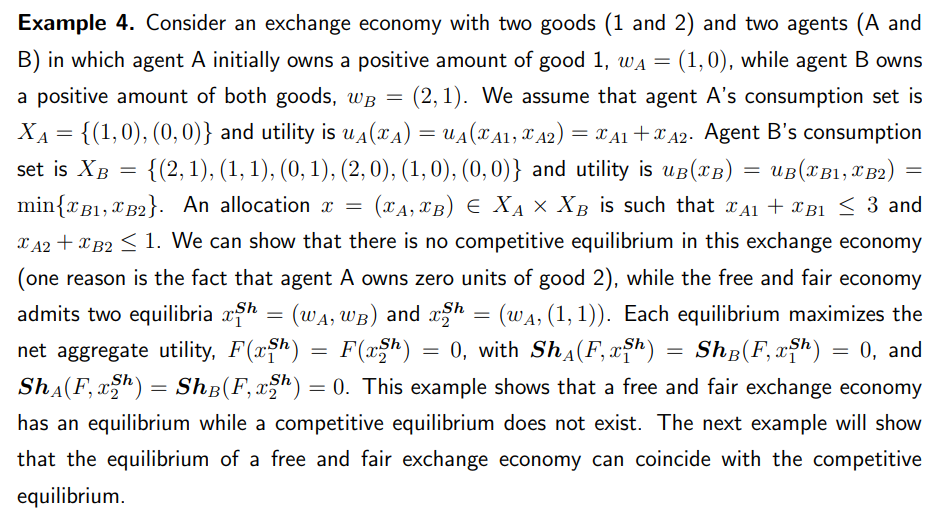
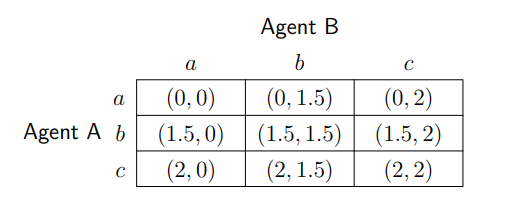
\ Our model differs from the exchange economy in at least two important respects. First, the incentive mechanism is different. Second, the equilibrium prediction from free exchanges between agents in both economies is different in general. A competitive equilibrium exists in an exchange economy when some assumptions exist on agents’ utilities and endowments. For instance, when utilities are continuous, strictly increasing, and quasi-concave and each agent initially owns a positive amount of each good in the market, a competitive equilibrium exists, and many equilibria might arise. However, under such assumptions on agents’ utilities, the net aggregate utility function F is strictly increasing, and thanks to Theorem 2, the free and fair economy admits a unique equilibrium. Additionally, it is not necessary to impose any assumptions on utilities and endowments to guarantee the existence of an equilibrium in a free and fair economy. We illustrate these points in the following examples.

\
\
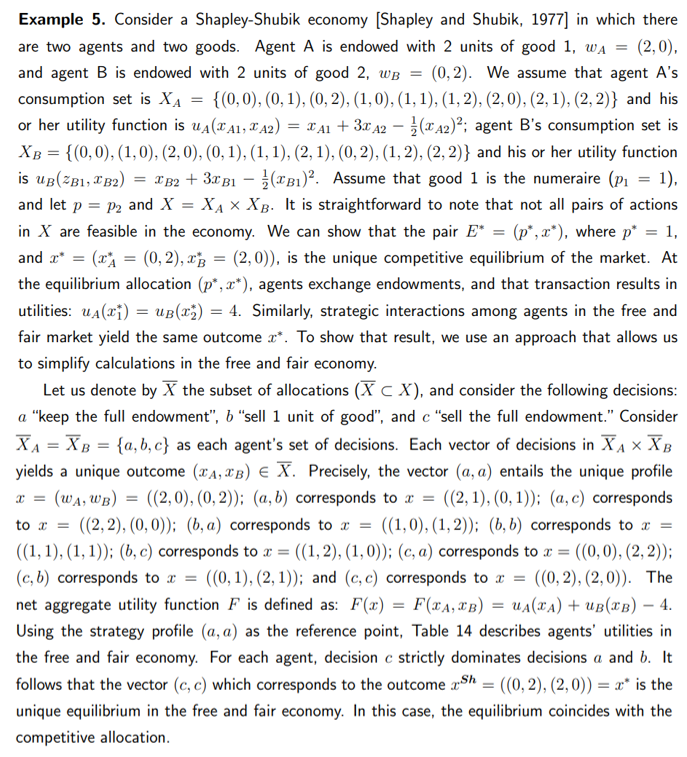
\ Table 14: Utilities in the free and fair economy
\ 6.4.2 Markets with transferable payoff

\
\
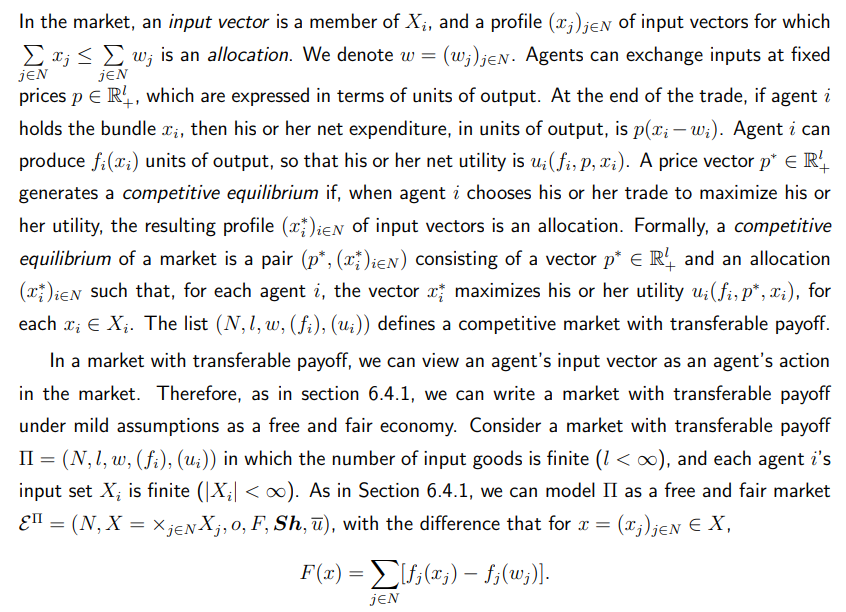
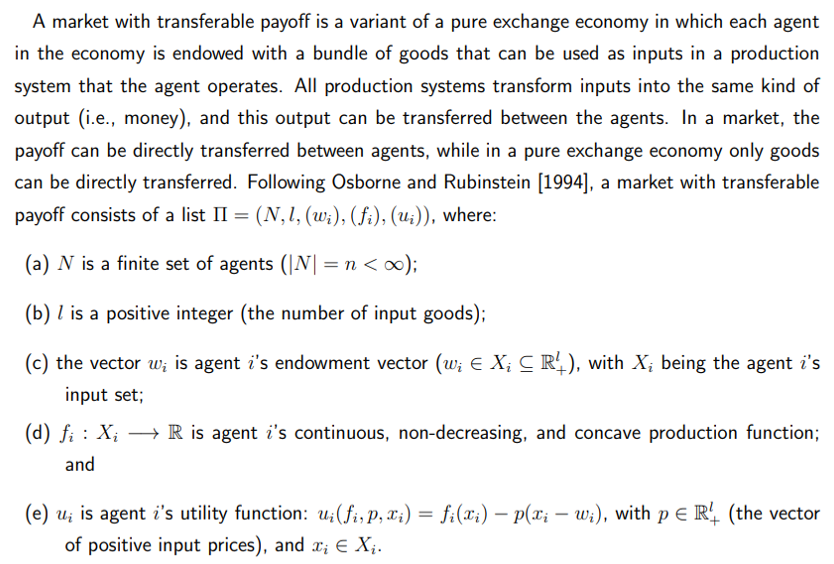
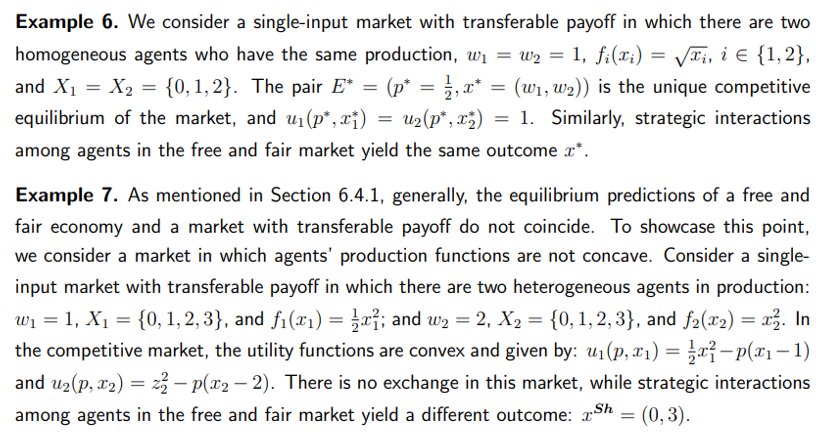
\ As in the analysis in section 6.4.1 below, we provide examples that show similarities (Example 6) and differences (Example 7) between the predictions of free and fair markets and markets with transferable payoff.

\
\

:::info Authors:

(1) Ghislain H. Demeze-Jouatsa, Center for Mathematical Economics, University of Bielefeld (demeze [email protected]);

(2) Roland Pongou, Department of Economics, University of Ottawa ([email protected]);

(3) Jean-Baptiste Tondji, Department of Economics and Finance, The University of Texas Rio Grande Valley ([email protected]).

:::


:::info This paper is available on arxiv under CC BY 4.0 DEED license.

:::

\

Disclaimer: The articles reposted on this site are sourced from public platforms and are provided for informational purposes only. They do not necessarily reflect the views of MEXC. All rights remain with the original authors. If you believe any content infringes on third-party rights, please contact [email protected] for removal. MEXC makes no guarantees regarding the accuracy, completeness, or timeliness of the content and is not responsible for any actions taken based on the information provided. The content does not constitute financial, legal, or other professional advice, nor should it be considered a recommendation or endorsement by MEXC.

You May Also Like

UNI Price Prediction: Critical Support Test at $5.37 – Next Target $7.88 by January 2025

UNI Price Prediction: Critical Support Test at $5.37 – Next Target $7.88 by January 2025

The post UNI Price Prediction: Critical Support Test at $5.37 – Next Target $7.88 by January 2025 appeared on BitcoinEthereumNews.com. Peter Zhang Dec 06, 2025 06:55 UNI price prediction shows critical support test at $5.37 with potential rebound to $7.88 target. Technical analysis reveals oversold conditions setting up recovery. Uniswap (UNI) is trading at a critical juncture as the token tests key support levels following a sharp 7.39% decline in the past 24 hours. With UNI currently priced at $5.51, our comprehensive technical analysis reveals both immediate risks and potential opportunities for the leading decentralized exchange token. UNI Price Prediction Summary • UNI short-term target (1 week): $6.20-$6.50 (+12-18%) • Uniswap medium-term forecast (1 month): $7.50-$8.35 range• Key level to break for bullish continuation: $5.98 (24h high) • Critical support if bearish: $5.37 (immediate support) Recent Uniswap Price Predictions from Analysts Recent analyst predictions show a mixed but cautiously optimistic outlook for UNI. Altpricer’s UNI price prediction targets $7.81 in the short term, citing slight upward momentum despite current volatility. Meanwhile, CoinCodex maintains a more conservative Uniswap forecast with an $8.35 target, though their analysis acknowledges bearish sentiment with key support levels identified at $9.02, $8.69, and $8.43. The consensus among analysts suggests that while immediate pressure exists, the UNI price target range of $7.81-$8.35 represents realistic upside potential once current support levels hold. However, confidence levels remain moderate due to broader market uncertainty and DeFi sector headwinds. UNI Technical Analysis: Setting Up for Potential Recovery The current Uniswap technical analysis reveals several compelling signals that support a cautiously bullish outlook. With UNI trading at $5.51, the token sits precariously close to its immediate support at $5.37, just 2.5% below current levels. The RSI reading of 39.09 indicates UNI is approaching oversold territory without being deeply oversold, suggesting limited downside momentum. More importantly, the Bollinger Bands analysis shows UNI at a %B…
Share
BitcoinEthereumNews2025/12/07 04:31