

The Evolution of Digital Asset Infrastructure for Crypto
Cryptsy
Cryptsy - Best Sweepstakes Casinos & Fish Table Games — Legal in All 50 States
The first time a Bitcoin/fiat pair hit a major retail exchange, execution happened on repurposed web servers, and the settlement layer depended on a single employee holding private keys on a USB drive. That era now feels primitive compared to today’s Digital Asset Infrastructure, where institutional-grade systems dominate.
By 2026, Tier-1 buy-side desks expect the same uptime, ultra-low latency, and counterparty protections in crypto as they do in equities, FX, and futures, supported by rapidly maturing Digital Asset Infrastructure platforms that emphasize security, scalability, and regulated custody.
This article walks through the most important building blocks that have matured custody, connectivity, liquidity aggregation, and risk tooling, and shows how they have reshaped the playing field for professional traders.
What Is Digital Asset Infrastructure?
Digital Asset Infrastructure refers to the underlying systems, technologies, and platforms that enable the creation, storage, transfer, trading, and management of digital assets like cryptocurrencies and tokenized assets. It includes core components such as custody solutions, blockchain networks, trading exchanges, payment rails, compliance tools, and settlement systems that allow digital assets to function securely and efficiently at scale.
In 2026, Digital Asset Infrastructure is increasingly institutional-grade, meaning it supports high-speed trading, regulated custody, real-time settlement, and integration with traditional financial systems. Companies like Coinbase, Fireblocks, and Chainalysis help power this ecosystem by providing secure custody, transaction infrastructure, and blockchain analytics.
What Are Digital Assets Used For?
Digital assets are used for a wide range of financial, technological, and business purposes across the modern digital economy. They are commonly used for payments and transfers, allowing users to send value globally without traditional banking delays. In finance, digital assets are widely used for trading and investment, including cryptocurrencies, tokenized stocks, and other blockchain-based instruments. Businesses also use them for raising capital through tokenization and fundraising models such as ICOs and tokenized equity.
Beyond finance, digital assets support decentralized applications (DeFi and Web3 services), enabling lending, borrowing, and yield generation without intermediaries. They are also used for digital ownership and storage of value, including NFTs, intellectual property, and tokenized real-world assets like real estate or commodities.
Why Do Digital Assets Matter?
Digital assets matter because they are reshaping how value is created, stored, and transferred in the global economy. They enable faster and cheaper transactions, especially for cross-border payments, by reducing reliance on traditional intermediaries like banks. They also improve financial inclusion, allowing anyone with internet access to participate in global financial systems.
From an investment perspective, digital assets provide new opportunities for diversification, including cryptocurrencies, tokenized real-world assets, and decentralized finance products. For businesses, they unlock new funding models and liquidity options through tokenization and blockchain-based fundraising.
Digital Asset Infrastructure Companies
Here are key Digital Asset Infrastructure companies:
- Coinbase — custody, exchange, institutional trading
- Fireblocks — secure crypto transfer and custody infrastructure
- Anchorage Digital — regulated digital asset bank and custody
- Kraken — trading infrastructure and exchange services
- Binance — global liquidity and institutional trading
- Chainalysis — blockchain analytics and compliance
- Consensys — Ethereum infrastructure tools
- Polygon — scaling infrastructure for blockchain networks
From Retail-Dominated Venues to Institutional-Grade Rails
The story of the market structure begins with who is trading. The initial crypto exchanges were bootstrapped by retail users, but the strength of this force changed as compliance-oriented venues, prime brokers, and OTC desks joined the game. According to multiple exchange transparency reports, institutional players accounted for roughly 46% of total Bitcoin trading volume in 2025, up from less than a quarter five years earlier. That shift forced service providers to rebuild everything from order-routing logic to capital-efficiency models.
For professional desks, the arrival of institutional liquidity meant tighter spreads and deeper books, yet it also raised the bar for due diligence. Unlike retail accounts, a hedge fund needs segregated sub-accounts, cross-margining across spot and derivatives, and robust service-level agreements. Exchanges that could not deliver were sidelined, while those that invested in bank-grade infrastructure, think redundant data centers, SOC 2 audits, and 24/7 support captured a disproportionate share of the flow. Even traditional Forex brokers with ETH pairs are evolving to meet these expectations, bridging the gap between conventional currency markets and crypto-native liquidity solutions.
Custody: Cold Wallets Were Yesterday’s News
Cold storage was the default response to counterparty risk during the early ICO era. It kept keys offline, but at the expense of capital velocity. When hedge funds started running intra-day arbitrage, the latency introduced by manual withdrawals became an unacceptable drag on performance.
Modern digital-asset custody solves that trade-off with multi-party computation (MPC) and hardware enclaves. Instead of one device storing the entire private key, MPC splits key shards across multiple geographically dispersed servers. A transaction requires a threshold of shards to sign, so no single physical breach can compromise the wallet. The result is a custody layer that is simultaneously air-gapped and “hot” enough for millisecond withdrawals.
In parallel, institutional settlement networks such as Fireblocks’ Network or Copper’s ClearLoop emerged. They enable off-exchange settlement, meaning assets remain in custody until the trade is matched. Credit risk plummets, and capital tied up in pre-funding can be redeployed across venues or strategies.
From a technology standpoint, the next frontier is composable custody: the ability to wrap DeFi protocols, tokenized securities, and even carbon credits inside the same MPC framework, letting a treasury desk manage everything through one interface. The idea is no longer exotic; multiple pilots are live with regulated entities in Singapore and Switzerland, but widespread adoption will depend on regulatory harmonization.
Liquidity Aggregation and Smart Order Routing
Professional traders rarely interact with a single venue. Depth, spread, and latency vary by exchange and pair, so execution quality hinges on the ability to aggregate. Early “universal APIs” were little more than wrappers that fanned orders to five or six exchanges. Today’s routing engines ingest market data from dozens of centralized and decentralized pools, normalize it in nanosecond time frames, and calculate the true best bid/offer net of fees, rebates, and slippage.
Advanced routers treat fragmented liquidity the way traditional FX algorithms treat fragmented ECNs. They slice large parent orders into child blocks, route each child to the venue with the best micro-price, and adapt in real time as market impact unfolds. Some even employ dynamic hedging, simultaneously selling perpetual swaps on one exchange while buying the underlying spot asset on another to neutralize directional exposure during execution.
The payoff can be quantified: internal back-tests at several prime brokers show that institutional clients executing via smart order routing reduce effective trading costs by 8–15 basis points compared with static, single-venue execution. That sounds modest until you annualize the savings across a billion-dollar book.
Low-Latency Connectivity: The New Battlefield
For systematic funds, latency is not an abstract metric; it is a P&L driver. In 2023, Kraken reported that it had cut round-trip order latency on its fastest API to approximately 2.5 milliseconds, a threefold improvement over its previous architecture. Numbers like that move the needle for market makers whose edge lives in the sub-ten-millisecond realm.
Co-location, Microwave Links, and the Race to Zero
High-frequency equities desks learned years ago that shaving microseconds can unlock arbitrage windows invisible to slower counterparts. The same logic is now surfacing in digital assets. Leading exchanges offer co-location racks inside their data centers, allowing clients to place bare-metal servers literally meters from the matching engine. That alone can eliminate 30-40 milliseconds of Internet jitter.
Some firms go further, leasing private microwave links between financial hubs. While fiber carries packets at about two-thirds the speed of light in a vacuum, microwaves travel through air and shave off a few microseconds per 100 kilometers. In cross-asset strategies, say, hedging a BTC/USD perpetual on Chicago’s CME against spot liquidity in New Jersey, those microseconds decide whether the hedge fills at the quoted price or slips into the next tick.
Latency efforts also extend to software. Kernel-bypass networking libraries such as SolarFlare’s Onload and Intel’s DPDK let trading engines write and read packets directly from the NIC, bypassing the OS stack. In aggregate, modern digital-asset pipes now rival the latency profiles of mature asset classes, demolishing the “crypto is slow” refrain of yesteryear.

Risk, Compliance, and the Rise of On-Chain Data Analytics
Building rock-solid pipes is only half the equation; the other half is trust. Institutional allocators require transparent risk frameworks, and regulators want end-to-end traceability across fiat and on-chain domains.
The toolbox has matured along three vectors:
Real-time Position and Margin Engines
The modern primes compute cross-asset margin in seconds and consider spot, perpetuals, and options in a single risk pool. Automatic liquidation ladders activate when volatility surges with respect to portfolio Greeks instead of crude notional thresholds, alleviating cascades in the system.
On-Chain Forensics
Millions of wallet addresses are ingested by blockchain analytics platforms and labeled with behavioral signatures, mixing, hacking, and sanction risk. Inbound deposits of suspicious lineage can now be flagged by compliance teams to be added to omnibus wallets, similar to the surveillance rigor of SWIFT or ACH.
Programmable Limits via APIs
An operations desk can cap a trader’s daily loss limit or restrict access to specific pairs through an API call, mirroring controls seen on equities OMS/EMS systems. The goal is to unite governance and trade workflow so that policy does not slow execution.
These capabilities matter because institutional managers are fiduciaries; any gap in risk tooling invites either regulatory pushback or LP redemption. By aligning infrastructure with Basel-style controls, service providers make digital assets palatable to pension funds and insurance companies that were previously sidelined.
Conclusion: What Professional Desks Should Do Next
The textbooks tell us that markets evolve toward efficiency, but the speed at which digital-asset infrastructure has professionalized is still startling. In under ten years, the ecosystem progressed from amateur matching engines to globally distributed, ultra-low-latency networks that can satisfy the most demanding prime-brokerage RFP.
In short, the infrastructure game isn’t over; it’s merely shifting from raw survival to refinement. The winners will be the firms that blend the ruthlessness of high-frequency trading with the discipline of institutional risk management, all while embracing the programmability that makes digital assets unique. The rails are ready now; it’s up to the trading community to decide how far and how fast to run on them.
The post The Evolution of Digital Asset Infrastructure for Crypto first appeared on Cryptsy and is written by Ethan Blackburn


You May Also Like
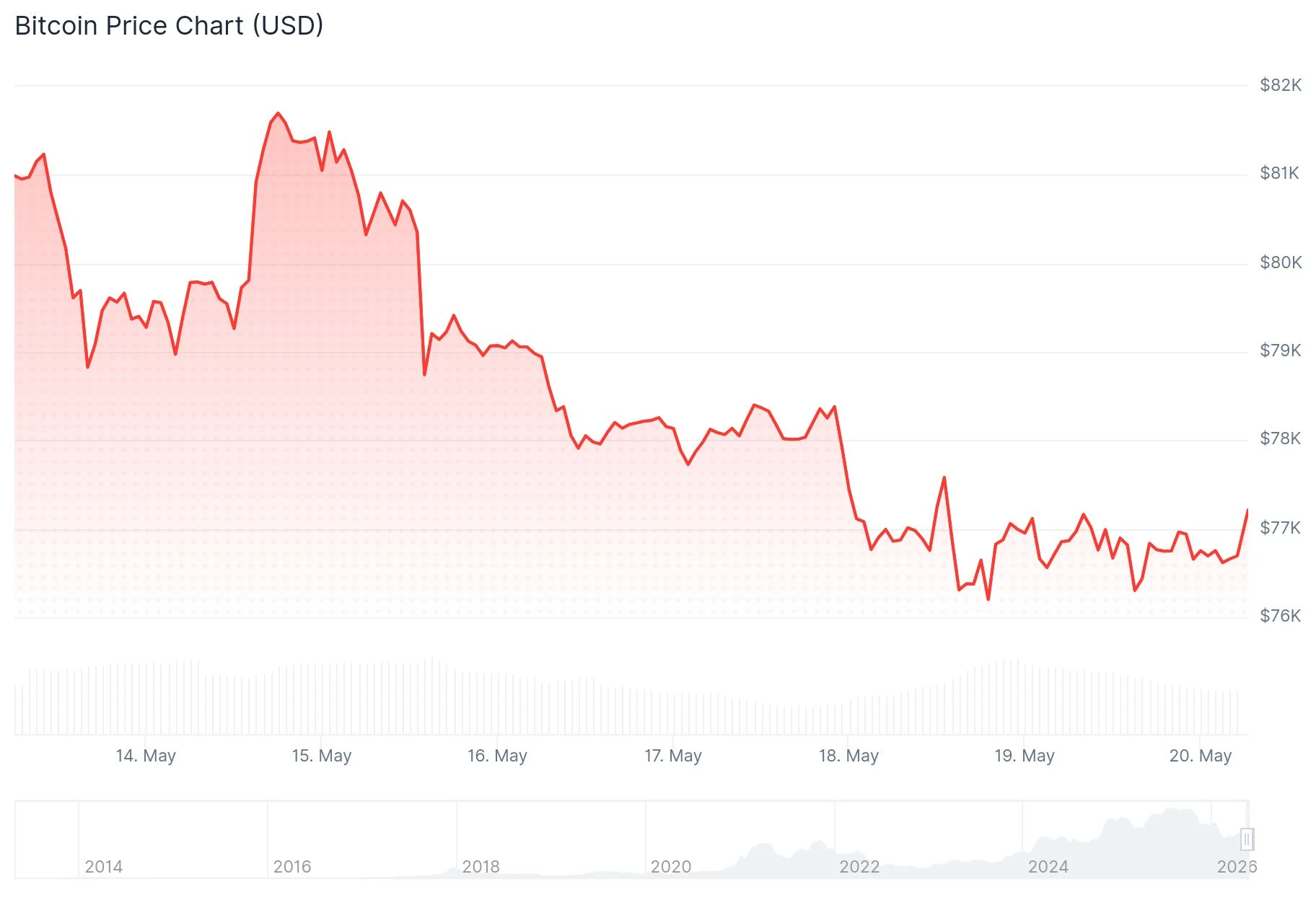
Bitcoin (BTC) Hovers Above $77K Amid Iran Diplomacy and Rising Treasury Yields

Beyond Cleaning: What Else You Must Check Before Moving Out




