

High-Risk Payment Gateway With No Rolling Reserve, No Fund Freezes, and Minimal Chargeback Impact: How Crypto Settlement With USDT and USDC Protects Your Revenue in 2026
By Diana Marchetti · Independent Merchant Revenue Protection & Cryptocurrency Settlement Analyst · May 2026 · 15 min read
Three things destroy high-risk merchants: rolling reserves that strangle cash flow, fund freezes that stop operations overnight, and chargebacks that trigger reserve increases or account termination.
Every traditional high-risk payment processor exposes merchants to all three. The processor holds your funds — which gives them the power to reserve, freeze, and deduct. Your revenue isn’t truly yours until the processor decides to release it. And that decision can be reversed at any time.
In 2026, a fiat-to-cryptocurrency payment gateway — where customers pay with Visa, Mastercard, Apple Pay, and Google Pay, and the merchant receives USDC or USDT directly in their wallet — eliminates all three risks structurally. Not by policy. Not by promise. By architecture.
Here’s how each risk works in the traditional model, and how crypto settlement eliminates it.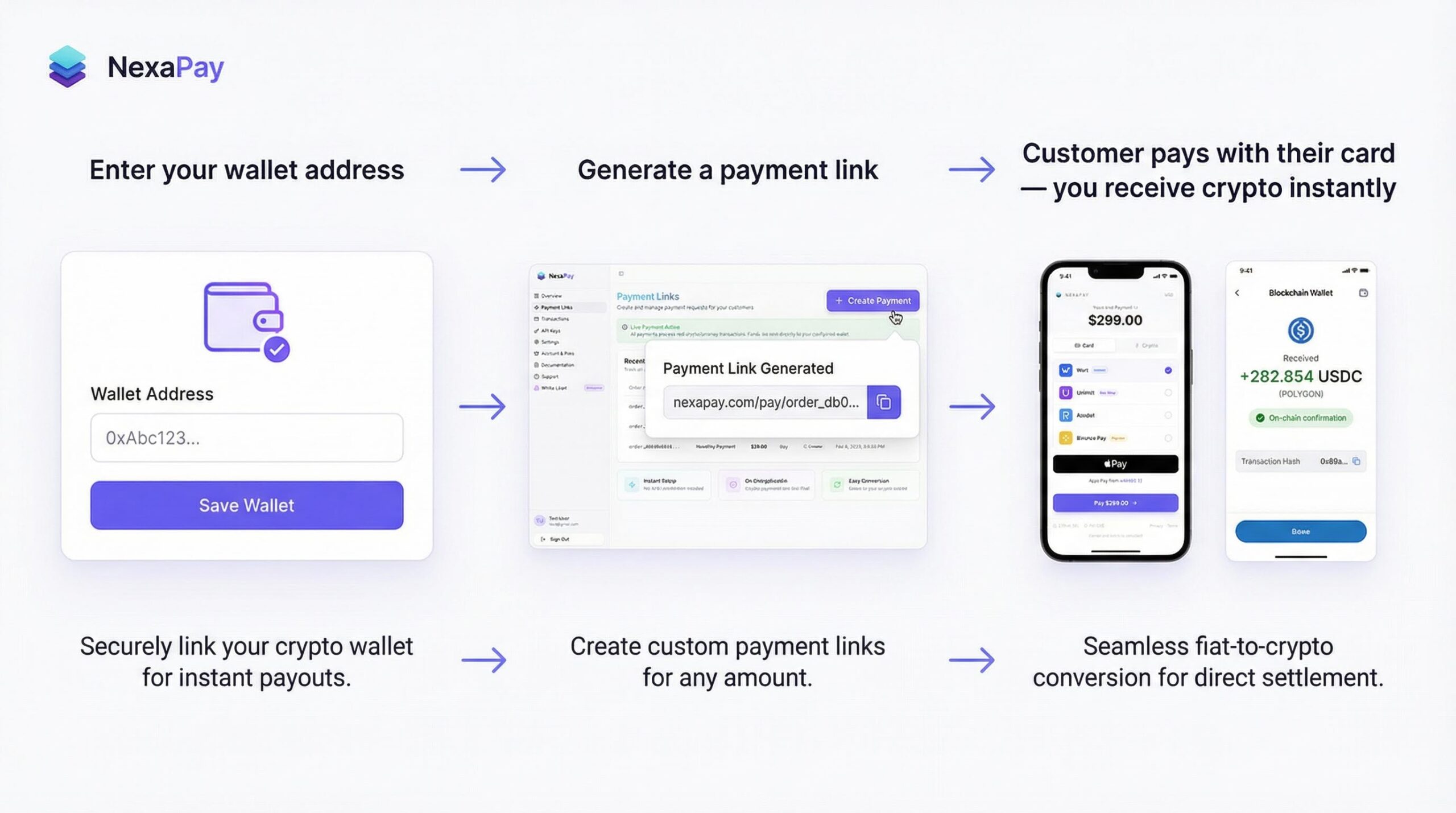
Risk #1: Rolling Reserves
How rolling reserves work in traditional processing
Your processor withholds 5–15% of every transaction. This money is placed in a reserve account. It’s held for 6–12 months before being released — if it’s released at all. If your account is terminated, the release of the reserve can be delayed indefinitely.
The financial impact is devastating:
A merchant processing $80,000/month with a 10% reserve has $8,000/month withheld. After six months: $48,000 locked. After twelve months: $48,000 perpetually locked (rolling — old reserves release as new ones are deducted).
$48,000 of your own revenue that you cannot use for inventory, marketing, payroll, rent, or growth. The processor earns float on this money. You earn nothing.
How NexaPay eliminates rolling reserves
NexaPay settles payments to your cryptocurrency wallet within minutes. The processor doesn’t hold your funds beyond the seconds needed for conversion. There is no balance to reserve against.
Rolling reserve with NexaPay: 0%. Always. For every merchant. In every niche.
This isn’t a promotional rate. It’s not a reward for low chargeback rates. It’s architectural — the system doesn’t create the conditions that make reserves necessary.
Risk #2: Fund Freezes
How fund freezes work in traditional processing
Your processor freezes your balance — all pending and future payouts are halted. Triggers include: chargeback rate spikes, sudden volume increases, automated risk flags, regulatory inquiries, industry-wide bank reviews, or customer complaints.
The merchant is often not told the specific reason. The freeze lasts days, weeks, or months. During the freeze, the business continues to incur expenses — rent, payroll, supplier payments — while generating zero revenue access.
Fund freezes have destroyed businesses. A $50,000 freeze on a company with $30,000 in monthly expenses means the business has weeks before it collapses. The processor doesn’t care. The freeze continues until the “review” is complete.
How NexaPay eliminates fund freezes
NexaPay converts card payments to USDC, USDT, or other crypto and sends them to your wallet within minutes. Once the crypto is in your wallet, NexaPay doesn’t control it. You hold the keys.
A fund freeze requires the processor to hold your money. NexaPay never holds your money. Therefore, fund freezes are structurally impossible.
Not unlikely. Not rare. Impossible. The architecture prevents it.
Risk #3: Chargeback Impact
How chargebacks work in traditional processing
A customer disputes a charge. The card network initiates a chargeback. In the traditional model:
- The processor deducts the chargeback amount from your pending balance or rolling reserve
- The processor charges you a chargeback fee ($25–$100 per dispute)
- If your chargeback rate exceeds a threshold (typically 1%), the processor increases your rolling reserve
- If your chargeback rate exceeds a higher threshold (typically 2%), the processor terminates your account
- If your account is terminated, your entire rolling reserve is held for an additional 6–12 months
Chargebacks in the traditional model aren’t just a financial cost — they’re an existential threat. A few bad months of disputes can trigger a cascade: reserve increase → cash flow squeeze → inability to invest in fraud prevention → more chargebacks → termination.
How NexaPay changes the chargeback dynamic
Card payments through NexaPay follow standard Visa/Mastercard chargeback rules — the dispute process itself is the same. But the impact on the merchant is fundamentally different:
No pool of funds to deduct from. In the traditional model, the processor deducts chargebacks from your reserve or pending balance. With NexaPay, settlement is instant to your wallet. There is no processor-held balance to deduct from.
No reserve increases triggered by chargebacks. Traditional processors respond to chargebacks by increasing your rolling reserve — punishing you with additional cash flow restrictions. NexaPay has no reserve to increase. Your reserve is 0% regardless of your chargeback rate.
No termination triggered by chargeback rate. Traditional processors terminate accounts that exceed chargeback thresholds. With NexaPay, there is no account to terminate in the traditional sense — you have a wallet address, not a custodial account.
The result: Chargebacks are still a cost (the disputed amount), but they are no longer an existential threat to your business. They can’t trigger reserve increases, fund freezes, or account termination — because those mechanisms don’t exist in the crypto settlement model.
The Protection Table
| Risk | Traditional High-Risk Processor | NexaPay.one |
|---|---|---|
| Rolling reserve | 5–15% withheld for 6–12 months | 0% — no reserve |
| Fund freeze | Common — triggered by chargebacks, volume spikes, bank reviews | Impossible — crypto in your wallet |
| Chargeback deduction | Deducted from reserve/balance | No processor-held balance to deduct from |
| Chargeback fee | $25–$100 per dispute | Standard card network process |
| Reserve increase from chargebacks | Yes — reserve escalates with dispute rate | No reserve exists to increase |
| Account termination from chargebacks | Yes — exceeding threshold triggers termination | No custodial account to terminate |
| Settlement access | 3–7 days, subject to freeze | Minutes, fully in your custody |
The Real-World Impact
Scenario: Peptide company, $60,000/month revenue, 0.5% chargeback rate
Traditional processor (6%, 10% reserve):
- Monthly fees: $3,600
- Monthly reserve: $6,000
- Chargeback costs: ~$450/month (3 disputes × $100 fee + refund amounts)
- Cash accessible: $50,400/month (after fees) — minus $6,000 in reserve = $44,400 available
- Risk: one bad month of chargebacks → reserve increases to 15% → $3,000/month additional withholding. Two bad months → account termination → entire reserve ($36,000+) held for 12 months.
NexaPay (2%, no reserve):
- Monthly fees: $1,200
- Reserve: $0
- Chargeback costs: same dispute amounts, but no cascading reserve/termination risk
- Cash accessible: $58,800/month (after fees) — fully available immediately
- Risk: chargebacks are a cost, not a cascade trigger
Monthly cash flow difference: $14,400. Annual: $172,800 in accessible cash flow.
Who Benefits Most
Merchants in niches with elevated category chargeback rates. Dating platforms, subscription services, digital products, travel bookings — categories where the industry average is higher than your individual rate. Traditional processors punish you for the category. NexaPay charges you for the transaction.
Merchants who’ve had reserves increased. If your processor has escalated your reserve from 10% to 15% to 20% — each increase strangling your cash flow further — NexaPay’s 0% reserve is immediate relief.
Merchants who’ve experienced fund freezes. If you’ve lost $20,000, $50,000, or more to a processor freeze, NexaPay’s architecture guarantees it cannot happen again.
Merchants who’ve been terminated over chargebacks. If your account was closed because your chargeback rate hit 1.5% for two months — despite years of clean processing — NexaPay doesn’t terminate based on chargeback thresholds.
Every high-risk merchant who wants to protect their revenue. Rolling reserves, fund freezes, and chargeback cascades are the three biggest financial risks in high-risk processing. NexaPay eliminates all three.
Getting Started
- Visit nexapay.one
- Enter wallet address — USDC or USDT for dollar stability
- Choose integration — payment link, WooCommerce, Shopify, or API
- Accept payments — Visa, Mastercard, Apple Pay, Google Pay
- Receive crypto — your wallet, your keys, your revenue
Zero reserve. Zero freeze risk. Chargebacks that can’t cascade.
Website: nexapay.one
Diana Marchetti is an independent merchant revenue protection and cryptocurrency settlement analyst covering rolling reserve economics, fund freeze prevention, and chargeback impact mitigation for high-risk merchants. Based in Rome.
Related searches: high risk payment gateway no rolling reserve, high risk payment gateway no fund freeze, high risk payment gateway no chargeback risk, payment gateway no reserve, payment gateway no freeze, high risk payment no reserve no freeze, high risk payment gateway chargeback protection, payment processor no rolling reserve, payment processor no fund freeze, high risk payment gateway protect revenue, high risk merchant no reserve, high risk merchant no freeze, zero reserve payment gateway, zero rolling reserve high risk, no fund hold payment gateway, instant settlement high risk, high risk payment gateway USDT no reserve, high risk payment gateway crypto no freeze, NexaPay no reserve, nexapay.one no freeze, best high risk payment gateway no reserve 2026








