

Crude Markets Tumble Over 3% Amid U.S.-Iran Diplomatic Efforts and Military Tensions
Key Highlights
- Brent crude declined 3.2% to settle at $96.41 per barrel while WTI tumbled 4.2% to $89.88 on Wednesday’s trading session
- Diplomatic efforts between Washington and Tehran persist even after recent military confrontations
- Potential agreement to reopen the Strait of Hormuz waterway could bring back approximately 20% of worldwide oil flows
- Tehran launched counterattacks on U.S. drone and aircraft following American strikes targeting Iranian missile facilities and naval vessels
- Financial analysts from Deutsche Bank indicate diplomatic discussions seem to be progressing despite limited concrete developments
Crude oil benchmarks experienced significant declines Wednesday as market participants assessed the balance between active diplomatic negotiations and recent military confrontations involving the United States and Iran near the strategically vital Strait of Hormuz.
Brent crude contracts for July delivery declined 3.2% to reach $96.41 per barrel. Meanwhile, U.S. West Texas Intermediate futures tumbled 4.2% to close at $89.88 per barrel.
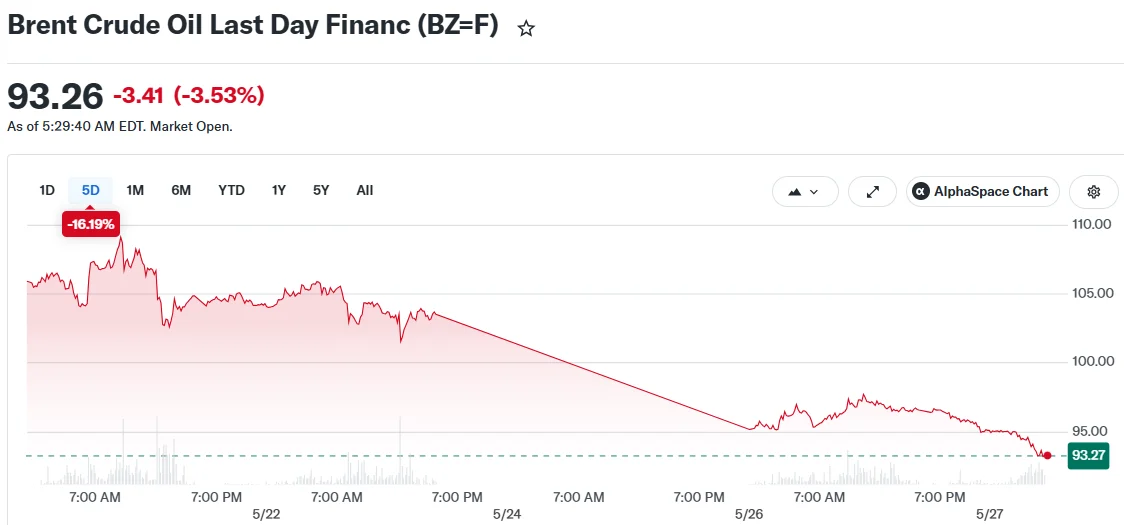 Brent Crude Oil Last Day Financ (BZ=F)
The downward movement followed a previous trading session where both crude benchmarks had surged over 3.5%. That rally was triggered by reports of U.S. military operations against Iranian installations.
Recent Military Confrontations Create Market Volatility
According to statements from the U.S. military, American forces conducted operations against Iranian missile launching facilities and vessels involved in deploying naval mines in southern Iranian territory. Officials characterized these operations as “defensive measures.”
Tehran’s media outlets confirmed that Iranian forces responded by engaging an American unmanned aerial vehicle and a fighter aircraft. Iranian authorities issued warnings of additional countermeasures should Washington breach existing ceasefire arrangements.
Despite these military exchanges, U.S. defense officials confirmed that the ceasefire agreement with Iran continues to hold. Both nations appear committed to maintaining diplomatic channels even as regional tensions remain elevated.
According to Al Jazeera’s reporting, indirect diplomatic communications between the two capitals are actively continuing. Nevertheless, the outlet noted that achieving a comprehensive peace agreement appears challenging following this week’s military incidents.
Washington officials indicated Tuesday that a potential agreement could materialize within days. The proposed diplomatic framework encompasses extending the ceasefire duration and facilitating the reopening of the Strait of Hormuz.
The prospective deal would additionally bring Tehran into discussions regarding its nuclear development activities. However, Iran has consistently refused American demands to relinquish its accumulated enriched uranium reserves.
Strategic Waterway Blockage Disrupts Worldwide Energy Flows
The Strait of Hormuz has been substantially blocked since the commencement of military tensions involving the United States, Israel, and Iran. This closure has eliminated approximately one-fifth of worldwide oil transportation.
Petroleum transit through this critical waterway continues to operate significantly below pre-conflict volumes. The disruption has maintained consistent upward pressure on international energy commodity markets.
Some market optimism developed this week following reports that a limited number of tankers successfully navigated through the strait. Energy traders interpreted this development as a potential indicator that full reopening might be approaching.
Financial markets are maintaining close surveillance of the negotiation progress. Any verified agreement or collapse of talks would likely trigger substantial price movements in either direction.
Petroleum flows through the Hormuz passage remain constrained at present, and the ultimate resolution of diplomatic efforts remains undetermined.
The post Crude Markets Tumble Over 3% Amid U.S.-Iran Diplomatic Efforts and Military Tensions appeared first on Blockonomi.


You May Also Like

5 Features Every AI Trading Agent Will Expect From DeFi
Iran threatens retaliation as Trump vows to “hit hard,” crypto market under stress
Terra Luna Classic Bulls Refuse to Give Up: Another LUNC Rally Seems Close



