

What Happens If You Send Crypto to Your Own Wallet Address?
BitcoinWorld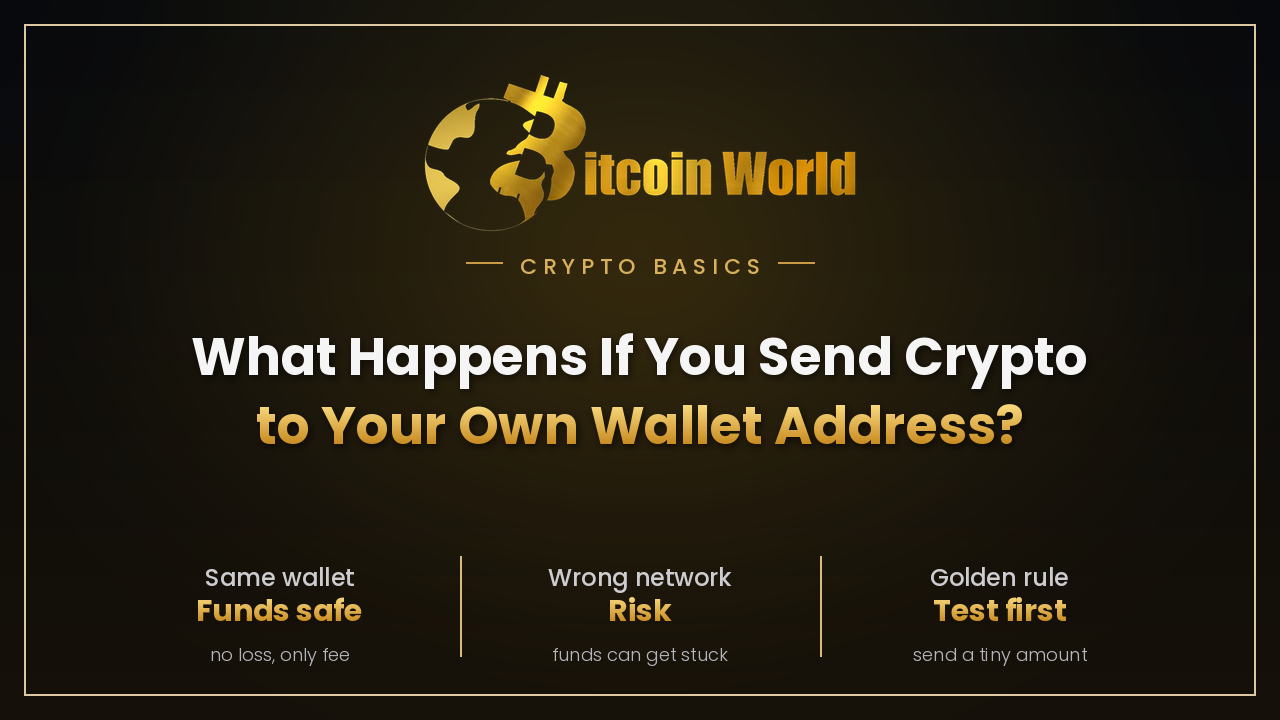
What Happens If You Send Crypto to Your Own Wallet Address?
What Happens If You Send Crypto to Your Own Wallet Address?
Sending crypto to your own wallet address is one of the most common things beginners panic about, but in the vast majority of cases nothing bad happens at all – the coins simply stay under your control. The confusion comes from not understanding that a wallet doesn’t “hold” coins the way a purse holds cash; it holds the keys that prove ownership on the blockchain. This article explains exactly what happens when you self-send, the one scenario that can actually cost you money, why people do it on purpose, and what Indian users should double-check first.
What Happens If You Send Crypto to Your Own Wallet Address?
When you send crypto to your own wallet address, the funds move from one address you control to another address you also control, so you never lose ownership. The blockchain simply records a transaction, and you remain the holder at the destination.
- Same wallet, same network: The coins arrive in your own address. You only pay the – standard network/gas fee – nothing is lost.
- Bitcoin (UTXO model): Sending to your own address creates a normal transaction; the BTC lands at the chosen address and you still hold the private keys.
- Ethereum and similar (account model): Your balance stays the same minus a small gas fee, since the value never left your control.
- Net effect: A self-transfer is essentially a no-op for ownership – you’ve just paid a tiny fee to move value between addresses you own.
Why Is Sending Crypto to Yourself Sometimes Risky?
The danger is never the self-send itself – it’s a network or asset mismatch. Problems arise when the address looks like yours but the coins land on a chain or in a wallet where you can’t actually access them.
- Wrong network: Sending a token on a network your destination wallet doesn’t support can leave funds stuck until you import your keys into a compatible wallet.
- Address you don’t truly control: Copy-paste errors or malware can swap the address for one you don’t hold the private key to, which is unrecoverable.
- Token contract addresses: Sending tokens to a coin’s contract address (instead of a wallet) can permanently lose them.
- The golden rule: Always send a small test amount first, confirm it arrives, then move the rest.
When Would Someone Send Crypto to Their Own Address on Purpose?
Self-transfers are routine and often smart. Most experienced users move crypto between their own wallets regularly for security and organization.
- Moving to self-custody: Shifting coins off an exchange into a hardware or non-custodial wallet you fully control.
- Consolidating funds: Combining small balances scattered across addresses into one.
- Privacy: Using a fresh receiving address each time, which many wallets generate automatically.
- Testing: Sending a tiny amount to confirm a new wallet or address works before a large transfer.
What Should Indian Users Check Before Sending Crypto to Themselves?
For users in India, the mechanics are identical, but a few local habits reduce risk and keep your records clean.
- Match the network: Indian users often use TRC-20 for cheap transfers; make sure both your sending and receiving wallets support the same chain.
- Keep records: Moving crypto between your own wallets is not the same as selling, so it generally isn’t a taxable sale – but keep clear proof both wallets are yours.
- Mind exchange rules: Some Indian exchanges apply checks or TDS on certain on-platform transfers; review the network and fees shown before confirming.
- Note on tax: Indian crypto tax rules change often, so confirm specifics with a qualified tax professional rather than relying on general guidance.
Frequently Asked Questions
What happens if someone accidentally sends Bitcoin to their own address twice?
Nothing is lost – the Bitcoin simply remains at an address you control after each transaction. Sending crypto to your own wallet address only costs you the small network fee each time, and your ownership never changes. The only real cost of repeating it is the cumulative transaction fees.
Is it safe to transfer crypto from an exchange to your own wallet in India?
Yes – transferring crypto to your own self-custody wallet is widely considered safer than leaving it on an exchange, since you control the private keys. Indian users should match the network (such as ERC-20 or TRC-20), send a small test amount first, and keep records that both wallets belong to them. Just account for any withdrawal fee or TDS the exchange may apply.
Can you lose crypto by sending it to your own wallet address?
Only if there’s a mismatch – you generally cannot lose crypto by sending it to your own address on the correct network. Loss happens when the asset lands on a chain your wallet doesn’t support or at an address you don’t actually hold the private key for. Sending a test amount first is the simplest way to avoid this.
Conclusion: Why Understanding Self-Transfers Matters
Knowing what happens when you send crypto to your own wallet address removes one of the biggest sources of beginner anxiety and unlocks safer habits like moving funds into self-custody. The takeaway is reassuring: on the correct network, a self-send never costs you anything but a tiny fee, while the only real risk – network or address mismatch – is entirely preventable with a quick test transfer. As more Indians move from exchanges to personal wallets, mastering this basic skill now is the foundation of protecting your crypto for the long run.
This post What Happens If You Send Crypto to Your Own Wallet Address? first appeared on BitcoinWorld.


You May Also Like

Nick Begich’s Strategic Bitcoin Reserve Bill Goes Public

Americans are on the brink of losing it all — and good people know it

ETH Enters High-Stakes Decision Zone


Trending News
More24/7 Live News
MoreQuick Reads
More
