Pi Network has taken another step in its cautious but calculated journey toward mainstream adoption. The project recently introduced a decentralized exchange (DEX) and automated market maker (AMM) on its testnet, a move that allows its vast community to interact with decentralized finance features in a controlled environment. The development, paired with new support for token creation on testnet, has sparked conversations about whether Pi is finally ready to pivot from a community-building experiment to a serious contender in the DeFi space. Pi Network Brings DeFi Tools to Testnet The rollout enables developers and Pioneers to experiment with liquidity pools, swaps, and token issuance, hallmarks of DeFi ecosystems. By keeping these functions on testnet, Pi Network reduces risk while encouraging community participation. Dr. Chengdiao Fan, Pi’s cofounder, emphasized during the TOKEN2049 event that “features like DEX and AMM will remain in testnet until governance, security, and utility measures are fully tested.” This careful approach mirrors strategies seen in traditional finance, where pilot projects often precede full-scale deployment. For Pi, which claims tens of millions of engaged users, the testnet launch is less about short-term hype and more about laying the foundation for real utility. Balancing Utility and Speculation One of the strongest criticisms Pi has faced is the lack of genuine utility beyond its mobile mining app. The launch of a testnet DEX and AMM directly addresses this by offering tangible tools for users and developers. Analysts note that while Pi has not yet bridged to major trading venues, these experiments can help the ecosystem grow organically. Community reactions have been divided. Some Pioneers see this as proof that the project is moving toward substance. Others remain cautious, pointing out that testnet success doesn’t always translate to mainnet traction. Source: X On X, one community developer wrote, “DEX is fun to test, but the real impact comes only when Pi tokens are live in mainnet liquidity pools.” The statement reflects both optimism and realism, a balance the project must manage carefully. Market Implications and Early Indicators Price watchers link the announcement to recent stability in PI Network’s market behavior. Trading data shows the token hovering near $0.27, holding a support zone despite broader market volatility. If Pi leverages its DeFi tools successfully, analysts suggest it could drive sustained demand rather than fleeting speculation. At the same time, risks remain. Token concentration among a small number of wallets, potential supply shocks from future unlocks, and uncertainty about regulatory positioning create hurdles. However, compared with meme-driven projects that often implode under scrutiny, Pi network appears intent on building layer by layer. A Slow but Strategic Road Ahead The introduction of DEX and AMM on testnet underscores Pi’s philosophy: move slowly, involve the community, and test before scaling. If Pi can convert testnet lessons into mainnet resilience, it may emerge as a unique hybrid, part grassroots social experiment, part serious DeFi contender. As one industry analyst remarked, “The DeFi space doesn’t need another flashy token; it needs projects that can scale utility safely. Pi’s testnet launch is a step in that direction.” Conclusion Pi Network’s decision to release DeFi tools on testnet is more than a technical milestone, it’s a statement of intent. By offering token creation, swaps, and liquidity pools in a safe environment, Pi shows it is serious about utility and community engagement. Whether this step translates into real adoption depends on how well the project handles governance, demand, and eventual mainnet integration. For now, the experiment is underway, and all eyes are on Pi to see if it can transform hype into lasting impact. FAQs Q1: What did Pi Network recently launch?Pi Network introduced a decentralized exchange (DEX) and automated market maker (AMM) on its testnet, along with token creation support. Q2: Why is this launch significant?It moves Pi closer to real-world utility, allowing developers and users to engage with DeFi features before they roll out on mainnet. Q3: How has the community reacted?Reactions are mixed. Some praise the move as progress, while others argue the real test will come with mainnet implementation. Q4: What risks should investors consider?Risks include token concentration in large wallets, regulatory challenges, and uncertainty about whether testnet experiments will scale. Glossary of Key Terms DEX (Decentralized Exchange): A platform for peer-to-peer crypto trading without intermediaries. AMM (Automated Market Maker): A system that uses liquidity pools instead of traditional order books to enable trading. Testnet: A blockchain environment for testing features without risking real assets. Liquidity Pool: A pool of crypto tokens locked in a smart contract to facilitate trading. Token Unlock: The release of previously restricted tokens into circulation, often creating price pressure. Mainnet: The fully launched blockchain network where real transactions and tokens exist. Read More: Will Pi’s New DEX and AMM Finally Silence the Critics?">Will Pi’s New DEX and AMM Finally Silence the Critics?Pi Network has taken another step in its cautious but calculated journey toward mainstream adoption. The project recently introduced a decentralized exchange (DEX) and automated market maker (AMM) on its testnet, a move that allows its vast community to interact with decentralized finance features in a controlled environment. The development, paired with new support for token creation on testnet, has sparked conversations about whether Pi is finally ready to pivot from a community-building experiment to a serious contender in the DeFi space. Pi Network Brings DeFi Tools to Testnet The rollout enables developers and Pioneers to experiment with liquidity pools, swaps, and token issuance, hallmarks of DeFi ecosystems. By keeping these functions on testnet, Pi Network reduces risk while encouraging community participation. Dr. Chengdiao Fan, Pi’s cofounder, emphasized during the TOKEN2049 event that “features like DEX and AMM will remain in testnet until governance, security, and utility measures are fully tested.” This careful approach mirrors strategies seen in traditional finance, where pilot projects often precede full-scale deployment. For Pi, which claims tens of millions of engaged users, the testnet launch is less about short-term hype and more about laying the foundation for real utility. Balancing Utility and Speculation One of the strongest criticisms Pi has faced is the lack of genuine utility beyond its mobile mining app. The launch of a testnet DEX and AMM directly addresses this by offering tangible tools for users and developers. Analysts note that while Pi has not yet bridged to major trading venues, these experiments can help the ecosystem grow organically. Community reactions have been divided. Some Pioneers see this as proof that the project is moving toward substance. Others remain cautious, pointing out that testnet success doesn’t always translate to mainnet traction. Source: X On X, one community developer wrote, “DEX is fun to test, but the real impact comes only when Pi tokens are live in mainnet liquidity pools.” The statement reflects both optimism and realism, a balance the project must manage carefully. Market Implications and Early Indicators Price watchers link the announcement to recent stability in PI Network’s market behavior. Trading data shows the token hovering near $0.27, holding a support zone despite broader market volatility. If Pi leverages its DeFi tools successfully, analysts suggest it could drive sustained demand rather than fleeting speculation. At the same time, risks remain. Token concentration among a small number of wallets, potential supply shocks from future unlocks, and uncertainty about regulatory positioning create hurdles. However, compared with meme-driven projects that often implode under scrutiny, Pi network appears intent on building layer by layer. A Slow but Strategic Road Ahead The introduction of DEX and AMM on testnet underscores Pi’s philosophy: move slowly, involve the community, and test before scaling. If Pi can convert testnet lessons into mainnet resilience, it may emerge as a unique hybrid, part grassroots social experiment, part serious DeFi contender. As one industry analyst remarked, “The DeFi space doesn’t need another flashy token; it needs projects that can scale utility safely. Pi’s testnet launch is a step in that direction.” Conclusion Pi Network’s decision to release DeFi tools on testnet is more than a technical milestone, it’s a statement of intent. By offering token creation, swaps, and liquidity pools in a safe environment, Pi shows it is serious about utility and community engagement. Whether this step translates into real adoption depends on how well the project handles governance, demand, and eventual mainnet integration. For now, the experiment is underway, and all eyes are on Pi to see if it can transform hype into lasting impact. FAQs Q1: What did Pi Network recently launch?Pi Network introduced a decentralized exchange (DEX) and automated market maker (AMM) on its testnet, along with token creation support. Q2: Why is this launch significant?It moves Pi closer to real-world utility, allowing developers and users to engage with DeFi features before they roll out on mainnet. Q3: How has the community reacted?Reactions are mixed. Some praise the move as progress, while others argue the real test will come with mainnet implementation. Q4: What risks should investors consider?Risks include token concentration in large wallets, regulatory challenges, and uncertainty about whether testnet experiments will scale. Glossary of Key Terms DEX (Decentralized Exchange): A platform for peer-to-peer crypto trading without intermediaries. AMM (Automated Market Maker): A system that uses liquidity pools instead of traditional order books to enable trading. Testnet: A blockchain environment for testing features without risking real assets. Liquidity Pool: A pool of crypto tokens locked in a smart contract to facilitate trading. Token Unlock: The release of previously restricted tokens into circulation, often creating price pressure. Mainnet: The fully launched blockchain network where real transactions and tokens exist. Read More: Will Pi’s New DEX and AMM Finally Silence the Critics?">Will Pi’s New DEX and AMM Finally Silence the Critics?

Will Pi’s New DEX and AMM Finally Silence the Critics?

5 min read

Pi Network has taken another step in its cautious but calculated journey toward mainstream adoption. The project recently introduced a decentralized exchange (DEX) and automated market maker (AMM) on its testnet, a move that allows its vast community to interact with decentralized finance features in a controlled environment.

The development, paired with new support for token creation on testnet, has sparked conversations about whether Pi is finally ready to pivot from a community-building experiment to a serious contender in the DeFi space.

Pi Network Brings DeFi Tools to Testnet

The rollout enables developers and Pioneers to experiment with liquidity pools, swaps, and token issuance, hallmarks of DeFi ecosystems. By keeping these functions on testnet, Pi Network reduces risk while encouraging community participation. Dr. Chengdiao Fan, Pi’s cofounder, emphasized during the TOKEN2049 event that “features like DEX and AMM will remain in testnet until governance, security, and utility measures are fully tested.”

This careful approach mirrors strategies seen in traditional finance, where pilot projects often precede full-scale deployment. For Pi, which claims tens of millions of engaged users, the testnet launch is less about short-term hype and more about laying the foundation for real utility.

Balancing Utility and Speculation

One of the strongest criticisms Pi has faced is the lack of genuine utility beyond its mobile mining app. The launch of a testnet DEX and AMM directly addresses this by offering tangible tools for users and developers. Analysts note that while Pi has not yet bridged to major trading venues, these experiments can help the ecosystem grow organically.

Community reactions have been divided. Some Pioneers see this as proof that the project is moving toward substance. Others remain cautious, pointing out that testnet success doesn’t always translate to mainnet traction.
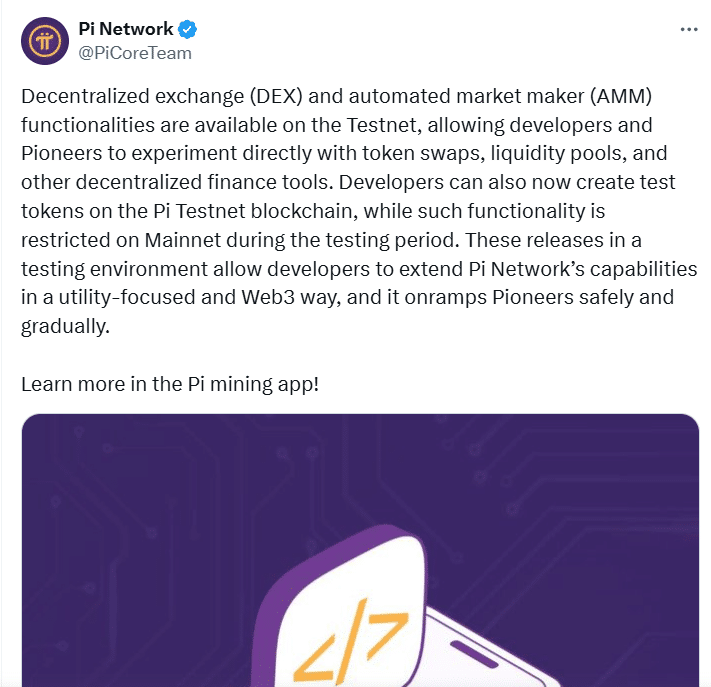
Pi network DEX and AMMSource: X

On X, one community developer wrote, “DEX is fun to test, but the real impact comes only when Pi tokens are live in mainnet liquidity pools.” The statement reflects both optimism and realism, a balance the project must manage carefully.

Market Implications and Early Indicators

Price watchers link the announcement to recent stability in PI Network’s market behavior. Trading data shows the token hovering near $0.27, holding a support zone despite broader market volatility. If Pi leverages its DeFi tools successfully, analysts suggest it could drive sustained demand rather than fleeting speculation.

At the same time, risks remain. Token concentration among a small number of wallets, potential supply shocks from future unlocks, and uncertainty about regulatory positioning create hurdles. However, compared with meme-driven projects that often implode under scrutiny, Pi network appears intent on building layer by layer.

A Slow but Strategic Road Ahead

The introduction of DEX and AMM on testnet underscores Pi’s philosophy: move slowly, involve the community, and test before scaling. If Pi can convert testnet lessons into mainnet resilience, it may emerge as a unique hybrid, part grassroots social experiment, part serious DeFi contender.

As one industry analyst remarked, “The DeFi space doesn’t need another flashy token; it needs projects that can scale utility safely. Pi’s testnet launch is a step in that direction.”

Conclusion

Pi Network’s decision to release DeFi tools on testnet is more than a technical milestone, it’s a statement of intent. By offering token creation, swaps, and liquidity pools in a safe environment, Pi shows it is serious about utility and community engagement.

Whether this step translates into real adoption depends on how well the project handles governance, demand, and eventual mainnet integration. For now, the experiment is underway, and all eyes are on Pi to see if it can transform hype into lasting impact.

FAQs

Q1: What did Pi Network recently launch?
Pi Network introduced a decentralized exchange (DEX) and automated market maker (AMM) on its testnet, along with token creation support.

Q2: Why is this launch significant?
It moves Pi closer to real-world utility, allowing developers and users to engage with DeFi features before they roll out on mainnet.

Q3: How has the community reacted?
Reactions are mixed. Some praise the move as progress, while others argue the real test will come with mainnet implementation.

Q4: What risks should investors consider?
Risks include token concentration in large wallets, regulatory challenges, and uncertainty about whether testnet experiments will scale.

Glossary of Key Terms

DEX (Decentralized Exchange): A platform for peer-to-peer crypto trading without intermediaries.

AMM (Automated Market Maker): A system that uses liquidity pools instead of traditional order books to enable trading.

Testnet: A blockchain environment for testing features without risking real assets.

Liquidity Pool: A pool of crypto tokens locked in a smart contract to facilitate trading.

Token Unlock: The release of previously restricted tokens into circulation, often creating price pressure.

Mainnet: The fully launched blockchain network where real transactions and tokens exist.

Read More: Will Pi’s New DEX and AMM Finally Silence the Critics?">Will Pi’s New DEX and AMM Finally Silence the Critics?

Disclaimer: The articles reposted on this site are sourced from public platforms and are provided for informational purposes only. They do not necessarily reflect the views of MEXC. All rights remain with the original authors. If you believe any content infringes on third-party rights, please contact [email protected] for removal. MEXC makes no guarantees regarding the accuracy, completeness, or timeliness of the content and is not responsible for any actions taken based on the information provided. The content does not constitute financial, legal, or other professional advice, nor should it be considered a recommendation or endorsement by MEXC.

You May Also Like

Cashing In On University Patents Means Giving Up On Our Innovation Future

Cashing In On University Patents Means Giving Up On Our Innovation Future

The post Cashing In On University Patents Means Giving Up On Our Innovation Future appeared on BitcoinEthereumNews.com. “It’s a raid on American innovation that would deliver pennies to the Treasury while kneecapping the very engine of our economic and medical progress,” writes Pipes. Getty Images Washington is addicted to taxing success. Now, Commerce Secretary Howard Lutnick is floating a plan to skim half the patent earnings from inventions developed at universities with federal funding. It’s being sold as a way to shore up programs like Social Security. In reality, it’s a raid on American innovation that would deliver pennies to the Treasury while kneecapping the very engine of our economic and medical progress. Yes, taxpayer dollars support early-stage research. But the real payoff comes later—in the jobs created, cures discovered, and industries launched when universities and private industry turn those discoveries into real products. By comparison, the sums at stake in patent licensing are trivial. Universities collectively earn only about $3.6 billion annually in patent income—less than the federal government spends on Social Security in a single day. Even confiscating half would barely register against a $6 trillion federal budget. And yet the damage from such a policy would be anything but trivial. The true return on taxpayer investment isn’t in licensing checks sent to Washington, but in the downstream economic activity that federally supported research unleashes. Thanks to the bipartisan Bayh-Dole Act of 1980, universities and private industry have powerful incentives to translate early-stage discoveries into real-world products. Before Bayh-Dole, the government hoarded patents from federally funded research, and fewer than 5% were ever licensed. Once universities could own and license their own inventions, innovation exploded. The result has been one of the best returns on investment in government history. Since 1996, university research has added nearly $2 trillion to U.S. industrial output, supported 6.5 million jobs, and launched more than 19,000 startups. Those companies pay…
Share
BitcoinEthereumNews2025/09/18 03:26
VectorUSA Achieves Fortinet’s Engage Preferred Services Partner Designation

VectorUSA Achieves Fortinet’s Engage Preferred Services Partner Designation

TORRANCE, Calif., Feb. 3, 2026 /PRNewswire/ — VectorUSA, a trusted technology solutions provider, specializes in delivering integrated IT, security, and infrastructure
Share
AI Journal2026/02/05 00:02
Top Solana Treasury Firm Forward Industries Unveils $4 Billion Capital Raise To Buy More SOL ⋆ ZyCrypto

Top Solana Treasury Firm Forward Industries Unveils $4 Billion Capital Raise To Buy More SOL ⋆ ZyCrypto

The post Top Solana Treasury Firm Forward Industries Unveils $4 Billion Capital Raise To Buy More SOL ⋆ ZyCrypto appeared on BitcoinEthereumNews.com. Advertisement &nbsp &nbsp Forward Industries, the largest publicly traded Solana treasury company, has filed a $4 billion at-the-market (ATM) equity offering program with the U.S. SEC  to raise more capital for additional SOL accumulation. Forward Strategies Doubles Down On Solana Strategy In a Wednesday press release, Forward Industries revealed that the 4 billion ATM equity offering program will allow the company to issue and sell common stock via Cantor Fitzgerald under a sales agreement dated Sept. 16, 2025. Forward said proceeds will go toward “general corporate purposes,” including the pursuit of its Solana balance sheet and purchases of income-generating assets. The sales of the shares are covered by an automatic shelf registration statement filed with the US Securities and Exchange Commission that is already effective – meaning the shares will be tradable once they’re sold. An automatic shelf registration allows certain publicly listed companies to raise capital with flexibility swiftly.  Kyle Samani, Forward’s chairman, astutely described the ATM offering as “a flexible and efficient mechanism” to raise and deploy capital for the company’s Solana strategy and bolster its balance sheet.  Advertisement &nbsp Though the maximum amount is listed as $4 billion, the firm indicated that sales may or may not occur depending on existing market conditions. “The ATM Program enhances our ability to continue scaling that position, strengthen our balance sheet, and pursue growth initiatives in alignment with our long-term vision,” Samani said. Forward Industries kicked off its Solana treasury strategy on Sept. 8. The Wednesday S-3 form follows Forward’s $1.65 billion private investment in public equity that closed last week, led by crypto heavyweights like Galaxy Digital, Jump Crypto, and Multicoin Capital. The company started deploying that capital this week, announcing it snatched up 6.8 million SOL for approximately $1.58 billion at an average price of $232…
Share
BitcoinEthereumNews2025/09/18 03:42