

Bitcoin Breaks Above $62K as Weak US Jobs Data Boosts Risk Appetite
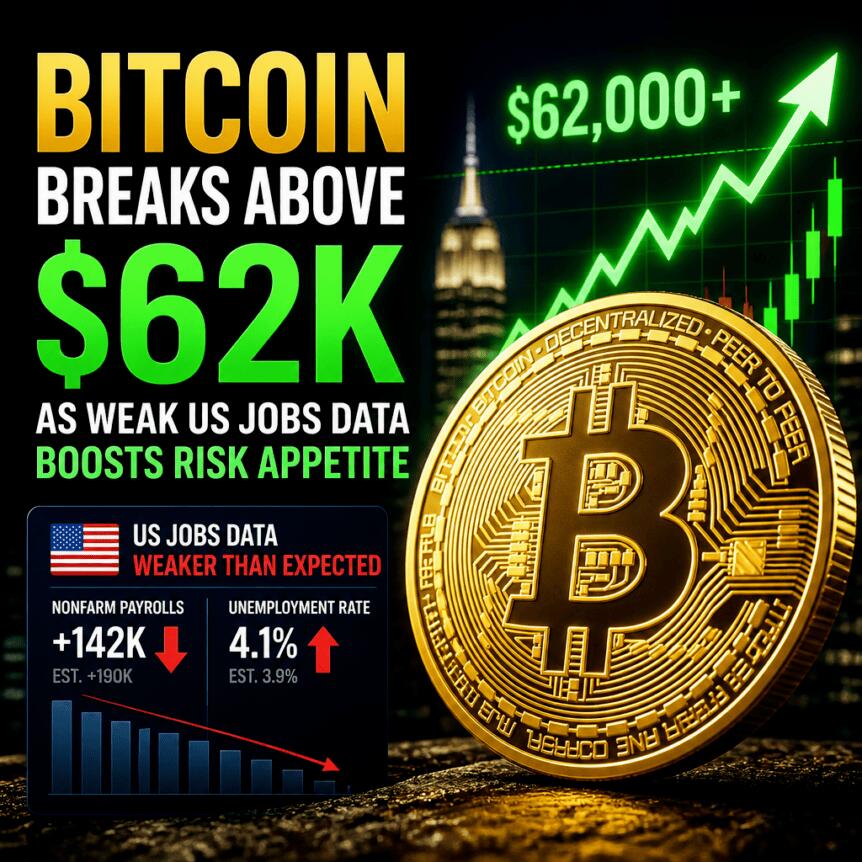
Bitcoin pushed through the $62,000 level at the start of Thursday’s Wall Street session, gaining as traders digested softer-than-expected US employment data. The move came alongside renewed optimism that inflation pressures may continue to cool—an outlook that typically supports risk assets, including crypto.
According to TradingView data cited in the market coverage, BTC/USD rose to a new July high of $62,137 on Bitstamp, up nearly 4% on the day. While the rally remains sensitive to macro headlines, crypto traders also pointed to a visible short squeeze beginning for “green July.”
Key takeaways
- US June nonfarm payrolls came in well below expectations, with 57,000 jobs added versus 114,000 forecast, helping lift Bitcoin.
- BLS data showed the unemployment rate held at 4.2% and the number of unemployed people was largely unchanged at 7.1 million.
- Traders highlighted an unwind of short positions, with CoinGlass reporting nearly $450 million in crypto short liquidations over 24 hours at the time of writing.
- Some analysts framed the move as buyers returning via exchange order-book dynamics, even as they caution the broader trend may still be choppy.
US jobs data shifts the macro tone for crypto
The immediate catalyst was the Bureau of Labor Statistics (BLS) nonfarm payrolls release for June. The report indicated that the US economy added far fewer jobs than expected—57,000 compared with the 114,000 consensus forecast.
The BLS also said the unemployment rate remained at 4.2% and the number of unemployed people changed little, staying around 7.1 million. In market terms, the combination of weaker job growth without a sharp deterioration in unemployment can be read as less immediate pressure on inflation—at least in the short run.
That interpretation is important for Bitcoin because expectations around Federal Reserve policy often drive rates-sensitive flows. A softer labor print can revive speculation that financial conditions may ease, benefiting assets that trade like a high-beta alternative to traditional markets.
Still, the data also carried a reminder that the labor narrative remains unstable. One trading-focused commentary, the Kobeissi Letter, noted that May’s jobs figure was revised down by 43,000 jobs, suggesting the picture is still being recalibrated in official statistics.
Analysts see “signals” for markets, but watch $65,000
As Bitcoin and broader altcoins moved higher, at least one widely followed trader argued that the macro setup is improving. Crypto analyst Michaël van de Poppe pointed to falling inflation expectations alongside the job-market trend, adding that unemployment is at its lowest level in close to a year.
In an X post, he said these are “strong, public signals about the direction of the markets,” while also setting a technical condition for his outlook. He stated that he does not expect another drop in Bitcoin “if Bitcoin can clearly break through $65,000 from here.”
For traders, that framing matters because it ties the macro tailwind to a specific market level. If price fails to clear resistance, the relief rally can fade quickly—even when macro data is supportive.
Short liquidations and exchange order books fuel the rally
Alongside macro drivers, crypto-specific positioning appeared to worsen for short sellers. CoinGlass data—referenced in the coverage—showed nearly $450 million in 24-hour crypto short liquidations at the time of writing.
Liquidations are often a catalyst for sharp intraday swings: when leveraged short positions are forced out as price rises, buying pressure can accelerate through automated and discretionary rebalancing. While liquidations do not guarantee a sustained trend, they can help explain why Bitcoin climbed quickly through key psychological levels during the session.
Market participants also cited order-book dynamics on major venues. Commentator Exitpump said “price drilling through large asks on Binance perps orderbook is actually sign of strength,” arguing that “chasing bids” were supporting aggressive buyers as BTC moved higher.
This kind of exchange liquidity reading is closely watched by day traders because it can reveal whether buy pressure is broad and persistent or simply the result of a short-lived burst of market orders.
Rekt Capital’s “green July” view: relief rally possible, but trend risk remains
Beyond the immediate squeeze, longer-cycle chart commentary continued to shape how investors interpret the rally. Trader and analyst Rekt Capital echoed the “green July” idea, referencing a view that Bitcoin may experience a relief move before bearish momentum resumes later.
The prior market framing cited in the coverage suggested a pattern where relief rallies occur in summer months, followed by a return of downtrend pressure into August. In additional commentary, Rekt Capital highlighted that Bitcoin could face headwinds once it flips key moving averages into resistance—specifically pointing to the 50-month exponential moving average (EMA) after a relief advance.
For investors, the practical takeaway is that the rally’s durability may hinge on whether buyers can keep pushing without triggering the reversal that longer-term chart followers expect. In other words, the macro surprise may be acting as the spark, but the technical path will determine whether it becomes a sustained trend or a tactical bounce.
As July begins, traders will likely keep watching both sides of the equation: further labor and inflation signals that can move expectations for Fed policy, and BTC’s ability to hold above resistance areas such as the $65,000 level referenced by van de Poppe. The combination of ongoing liquidation dynamics and moving-average behavior could decide whether this “green July” starts as a short squeeze—or develops into something more enduring.
This article was originally published as Bitcoin Breaks Above $62K as Weak US Jobs Data Boosts Risk Appetite on Crypto Breaking News – your trusted source for crypto news, Bitcoin news, and blockchain updates.


You May Also Like

Lovable AI’s Astonishing Rise: Anton Osika Reveals Startup Secrets at Bitcoin World Disrupt 2025
Conservative slams Dems for not riding Trump's corruption harder


