

Nvidia (NVDA) Stock: Bullish Analysts vs. Bearish Price Action
Key Takeaways
- Nvidia maintains a $4.71 trillion market cap with just 4.5% gains year-to-date, while Apple surges 14% to reach $4.51 trillion
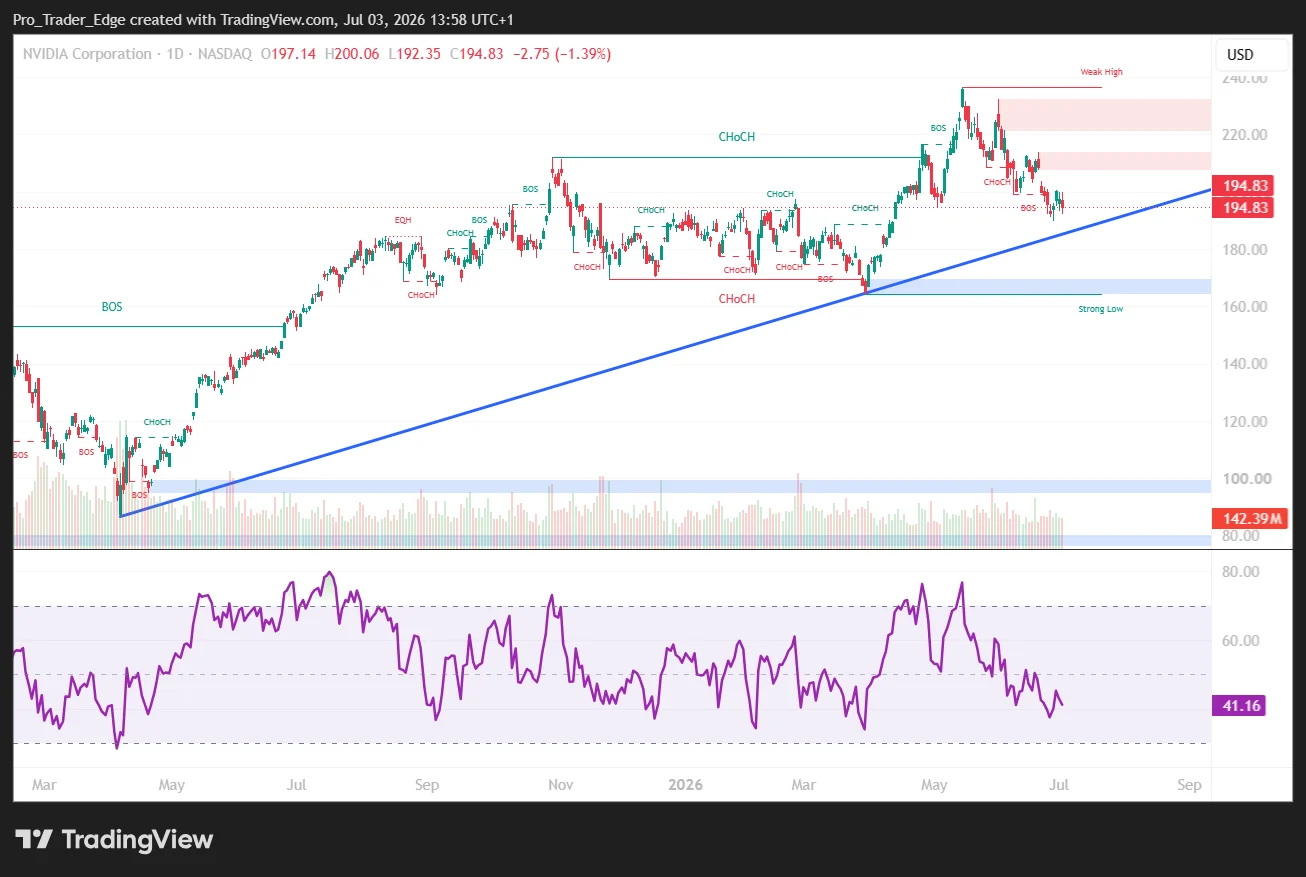
- Shares opened Friday at $194.83, declining 1.4% and positioned beneath the 50-day moving average of $210.37
- The chipmaker commits to distributing 50% of free cash flow through dividends and buybacks, supported by $80 billion repurchase program
- Large institutions hold 65.27% of shares with recent position increases, though directors offloaded more than $189 million in June
- Analyst community maintains Buy consensus with $303.84 mean price target, including Goldman Sachs at $285
Nvidia (NVDA) stock kicked off Friday trading at $194.83, sliding 1.4%, as the semiconductor giant defending its position as the world’s most valuable company encounters mounting pressure from Apple.
NVIDIA Corporation, NVDA
Apple has posted impressive 14% gains in 2025, pushing its valuation to $4.51 trillion. Meanwhile, Nvidia has managed only 4.5% growth during the same timeframe, standing at $4.71 trillion. The distance between them continues shrinking.
The chipmaker has defended the number-one ranking for 258 straight days since regaining it from Microsoft in late June 2024. While this marks the seventh-longest streak since 2000, Apple’s track record includes a dominant 1,344-day reign.
 Source: TradingView
The critical question facing investors: can Nvidia develop the sustained dominance that Apple has demonstrated? Achieving this goal might require adopting strategies from Apple’s proven blueprint.
Apple’s winning combination includes tightly integrated hardware-software ecosystems, aggressive share buybacks, and an exceptionally loyal user base. Nvidia is pursuing similar strategies across these areas, though results remain mixed.
Capital Allocation Strategy
Regarding shareholder returns, Nvidia shows positive momentum but hasn’t matched Apple’s benchmark. While Apple distributes virtually all free cash flow to investors, Nvidia targets 50% distribution through buybacks and dividends, with plans for future expansion.
The company’s $80 billion buyback program unveiled in May demonstrates serious commitment. Management also increased the quarterly dividend to $0.25 per share from the previous $0.01 — translating to $1.00 annually with a 0.5% yield.
Nvidia’s latest quarterly results exceeded expectations, delivering $1.87 earnings per share against the $1.76 consensus forecast. Revenue reached $81.61 billion, representing 85.2% year-over-year growth and surpassing the $78.42 billion analyst projection.
Software Ecosystem and Competition
Nvidia’s CUDA platform has historically functioned as the sticky layer keeping customers tied to its hardware ecosystem. This strategy proved highly effective throughout AI’s training phase. The crucial challenge ahead: maintaining that advantage during the inference stage — when AI models operate in live production environments.
Competitors including Cerebras Systems tout superior inference performance from their chip architectures. Simultaneously, Alphabet and Amazon are engineering proprietary silicon solutions, despite remaining major Nvidia customers.
This paradox — where largest buyers simultaneously develop competing products — represents the primary threat overhanging the company’s valuation.
Institutional investment patterns generally reflect confidence. Generali Investments expanded its NVDA holdings by 8.6% during Q1 to 59,500 shares valued at $10.4 million, making it their second-largest allocation. Brighton Jones increased exposure by 12.4%. Hudson Value Partners boosted its stake by 30.7%.
However, significant insider selling occurred in June. Director Stephen C. Neal liquidated 15,500 shares at $215.73 each. Director Mark A. Stevens sold 885,000 shares at $210.17, totaling approximately $186 million. Total insider dispositions reached $410.6 million last quarter.
The stock’s 52-week trading range extends from $157.34 to $236.54. Current pricing sits below the 50-day moving average of $210.37, while remaining above the 200-day moving average of $193.50.
Wall Street maintains a Buy rating consensus with a mean price objective of $303.84. Goldman Sachs projects a $285 target, while Rothschild & Co Redburn recently upgraded its forecast to $300.
The post Nvidia (NVDA) Stock: Bullish Analysts vs. Bearish Price Action appeared first on Blockonomi.


You May Also Like

OpenAI Reportedly Proposes 5% Equity Stake for U.S. Government


