The post Bored Ape NFTs Cleared of Securities Status by Court appeared on BitcoinEthereumNews.com. Court rules Bored Ape NFTs not securities, ending Yuga Labs class-action case. Judge finds no common enterprise for NFTs sold on third-party platforms like OpenSea. Royalties show Yuga’s profits independent of holder gains, weakening the SEC’s argument. A federal court in California has ruled that Bored Ape Yacht Club (BAYC) NFTs are not securities, closing a class-action lawsuit that had challenged the legal status of one of the most well-known digital collectible projects. The decision ends years of uncertainty surrounding Yuga Labs’ compliance with U.S. securities law and marks one of the simplest judicial statements yet on non-fungible tokens’ (NFTs) regulatory classification. A U.S. federal judge in California has dismissed an investor lawsuit against Yuga Labs, ruling that its Bored Ape Yacht Club (BAYC) NFTs and ApeCoin do not constitute securities. The court stated that the plaintiffs failed to prove the three prongs of the Howey test, affirming… — Wu Blockchain (@WuBlockchain) October 4, 2025 Judge Fernando M. Olguin of the U.S. District Court for the Central District of California dismissed the lawsuit against Yuga Labs, concluding that Bored Ape NFTs do not satisfy the legal requirements of a security under the Howey test. The ruling, issued Thursday, found no “common enterprise” linking NFT holders’ financial success to Yuga Labs’ operations. The court stated that the NFTs were purchased through third-party marketplaces such as OpenSea and Coinbase, rather than an exchange operated by Yuga Labs. This difference distinguishes BAYC from prior cases, such as Dapper Labs’ NBA Top Shot NFTs and DraftKings NFTs, where courts found closer operational ties between issuers and secondary market activity. Related: U.S. Court Mandates Ryder Ripps to Pay Yuga Labs $9 Million in Final Judgment Royalties Undermine Common Financial Interest Olguin’s ruling also noted that Yuga Labs’ receipt of royalties from secondary NFT sales further… The post Bored Ape NFTs Cleared of Securities Status by Court appeared on BitcoinEthereumNews.com. Court rules Bored Ape NFTs not securities, ending Yuga Labs class-action case. Judge finds no common enterprise for NFTs sold on third-party platforms like OpenSea. Royalties show Yuga’s profits independent of holder gains, weakening the SEC’s argument. A federal court in California has ruled that Bored Ape Yacht Club (BAYC) NFTs are not securities, closing a class-action lawsuit that had challenged the legal status of one of the most well-known digital collectible projects. The decision ends years of uncertainty surrounding Yuga Labs’ compliance with U.S. securities law and marks one of the simplest judicial statements yet on non-fungible tokens’ (NFTs) regulatory classification. A U.S. federal judge in California has dismissed an investor lawsuit against Yuga Labs, ruling that its Bored Ape Yacht Club (BAYC) NFTs and ApeCoin do not constitute securities. The court stated that the plaintiffs failed to prove the three prongs of the Howey test, affirming… — Wu Blockchain (@WuBlockchain) October 4, 2025 Judge Fernando M. Olguin of the U.S. District Court for the Central District of California dismissed the lawsuit against Yuga Labs, concluding that Bored Ape NFTs do not satisfy the legal requirements of a security under the Howey test. The ruling, issued Thursday, found no “common enterprise” linking NFT holders’ financial success to Yuga Labs’ operations. The court stated that the NFTs were purchased through third-party marketplaces such as OpenSea and Coinbase, rather than an exchange operated by Yuga Labs. This difference distinguishes BAYC from prior cases, such as Dapper Labs’ NBA Top Shot NFTs and DraftKings NFTs, where courts found closer operational ties between issuers and secondary market activity. Related: U.S. Court Mandates Ryder Ripps to Pay Yuga Labs $9 Million in Final Judgment Royalties Undermine Common Financial Interest Olguin’s ruling also noted that Yuga Labs’ receipt of royalties from secondary NFT sales further…

Bored Ape NFTs Cleared of Securities Status by Court

3 min read
  • Court rules Bored Ape NFTs not securities, ending Yuga Labs class-action case.
  • Judge finds no common enterprise for NFTs sold on third-party platforms like OpenSea.
  • Royalties show Yuga’s profits independent of holder gains, weakening the SEC’s argument.

A federal court in California has ruled that Bored Ape Yacht Club (BAYC) NFTs are not securities, closing a class-action lawsuit that had challenged the legal status of one of the most well-known digital collectible projects. The decision ends years of uncertainty surrounding Yuga Labs’ compliance with U.S. securities law and marks one of the simplest judicial statements yet on non-fungible tokens’ (NFTs) regulatory classification.

Judge Fernando M. Olguin of the U.S. District Court for the Central District of California dismissed the lawsuit against Yuga Labs, concluding that Bored Ape NFTs do not satisfy the legal requirements of a security under the Howey test. The ruling, issued Thursday, found no “common enterprise” linking NFT holders’ financial success to Yuga Labs’ operations.

The court stated that the NFTs were purchased through third-party marketplaces such as OpenSea and Coinbase, rather than an exchange operated by Yuga Labs. This difference distinguishes BAYC from prior cases, such as Dapper Labs’ NBA Top Shot NFTs and DraftKings NFTs, where courts found closer operational ties between issuers and secondary market activity.

Related: U.S. Court Mandates Ryder Ripps to Pay Yuga Labs $9 Million in Final Judgment

Royalties Undermine Common Financial Interest

Olguin’s ruling also noted that Yuga Labs’ receipt of royalties from secondary NFT sales further weakens any alleged shared financial structure. The company earned a fixed fee each time a Bored Ape changed hands, regardless of whether the buyer made a profit or incurred a loss. This arrangement, the judge stated, “decoupled” the financial interests of NFT holders and the company.

Creator royalties, which can reach up to 10% of each resale, have been a standard feature across NFT markets. In this case, the court found that such royalties pointed away from the existence of an investment contract since Yuga Labs benefited from sales activity without relying on holders’ speculative gains.

The decision follows multiple investigations into NFT projects by U.S. regulators. Earlier this year, the Securities and Exchange Commission (SEC) closed inquiries into both Yuga Labs and OpenSea, signaling a shift toward limited enforcement in the NFT sector.

Related:Bored Ape Yacht Club NFT Floor Price Hit Historic Low, Down 92%

Disclaimer: The information presented in this article is for informational and educational purposes only. The article does not constitute financial advice or advice of any kind. Coin Edition is not responsible for any losses incurred as a result of the utilization of content, products, or services mentioned. Readers are advised to exercise caution before taking any action related to the company.

Source: https://coinedition.com/bored-ape-nfts-not-securities-federal-judge-rules-in-key-yuga-labs-case/

Market Opportunity
ApeCoin Logo
ApeCoin Price(APE)
$0.1237
$0.1237$0.1237
-5.13%
USD
ApeCoin (APE) Live Price Chart
Disclaimer: The articles reposted on this site are sourced from public platforms and are provided for informational purposes only. They do not necessarily reflect the views of MEXC. All rights remain with the original authors. If you believe any content infringes on third-party rights, please contact [email protected] for removal. MEXC makes no guarantees regarding the accuracy, completeness, or timeliness of the content and is not responsible for any actions taken based on the information provided. The content does not constitute financial, legal, or other professional advice, nor should it be considered a recommendation or endorsement by MEXC.

You May Also Like

Strategy Defines Its Bitcoin Stress Point After Q4 Volatility

Strategy Defines Its Bitcoin Stress Point After Q4 Volatility

During Strategy’s Q4 2025 earnings call on February 5, management addressed concerns around a $17.4 billion unrealized Bitcoin loss by reframing risk around time
Share
Ethnews2026/02/06 16:16
Bubblemaps: The top five traders in STBL token trading volume are interconnected and have made profits exceeding $10 million

Bubblemaps: The top five traders in STBL token trading volume are interconnected and have made profits exceeding $10 million

PANews reported on September 18th that blockchain analytics platform Bubblemaps published an article on the X platform claiming that Tether co-founder Reeve Collins had just launched a new token, STBL. However, the top five traders are suspiciously interconnected and have profited over $10 million. Collins launched STBL yesterday, a new stablecoin system built around three tokens: USST (stablecoin), YLD (yield token supporting USST), and STBL (governance token). An analysis of the top five traders by STBL trading volume revealed that these five profit-makers received capital injections at the same time. Tracing the source of their funds revealed a clear connection: the funds all came from the same source (injected via Tornado Cash); bots were used to borrow USDC from the Venus Protocol; and the total profit exceeded $10 million. However, there is no evidence that these traders are connected to the core team. In fact, this group of bots has a history of extracting value from other tokens, not just STBL.
Share
PANews2025/09/18 10:09
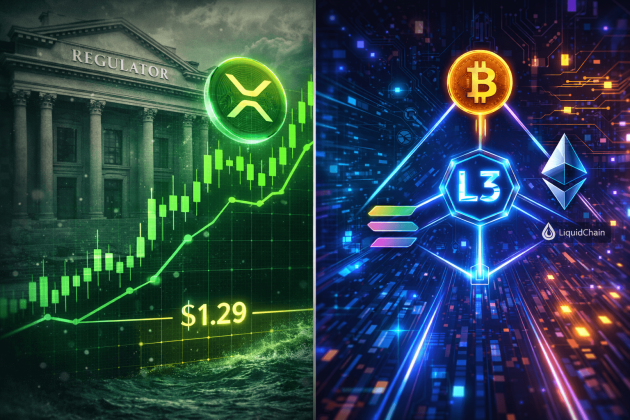
XRP Retests $1.29 Support: Is $2 Still in Play or Will LiquidChain Capture the Momentum?

XRP Retests $1.29 Support: Is $2 Still in Play or Will LiquidChain Capture the Momentum?

Quick Facts: ➡️ XRP’s dip to $1.29 is a technical retest of support; holding here is key for a potential run toward $2.00. ➡️ Regulatory clarity (post-SEC changes
Share
Bitcoinist2026/02/06 16:33