

How Tokcoin Network Scarcity Shapes the $TOK Price Prediction Outlook
Tokcoin Network is suddenly showing up in more crypto watchlists, and it is not because of another delayed date on a roadmap.
This time the conversation has shifted toward something more structural, the supply itself, and why a fixed cap combined with a mining-only distribution model could make TOK behave very differently once trading actually opens.
What Is Pulling Fresh Attention Toward This Project Right Now?
Every project eventually gets judged less on promises and more on mechanics.
This one has had its share of missed dates already, so traders have started looking past the calendar and asking a sharper question, what happens to price once the token is actually tradable?
That is where the scarcity angle enters. The Tokcoin network was built with a hard cap, and unlike tokens that unlock through presale allocations or team vesting, this entire supply has come from mining.
That single detail changes how the market is likely to react at launch.
How Does The Fixed Supply Model Behind TOK Actually Work?
Total supply is capped at 8 million TOK, and all of it is mining-distributed rather than pre-sold or reserved for insiders.
No presale allocation, no early investor unlock schedule sitting in the background waiting to hit the market.
Because the entire float has been earned through mining activity over time, ownership is already spread across a wide base of participants rather than concentrated in a few wallets.
That distribution pattern tends to reduce one specific kind of risk, coordinated dumping right after listing, though it does not remove volatility altogether.
Why Could Scarcity Trigger Sharp Price Discovery At Listing?
Thin order books are the part traders should actually be watching. When total supply is capped this low and spread across many small holders, the order book on any exchange is unlikely to be deep on day one.
Thin books mean even moderate buy or sell orders can move the $TOK price by a wide margin, in either direction.
This is not unique to this project; low-float listings across crypto history have shown similar patterns, but the effect tends to be sharper here given the mining-only origin of supply.
Traders who assume a low market cap automatically means an easy entry often get caught off guard by how fast a price can swing once liquidity providers start testing the range.
What Role Does The KYC Deadline Play In Tokcoin Network's Timeline?
Before any of the scarcity dynamics matter, Tokcoin Network still has to clear its KYC verification window, which currently runs through the end of July 2026.
This step exists to confirm wallet ownership before the Token Generation Event converts mined balances into tradable TOK on a 1:1 basis.
Skipping ahead to price talk without this step would be premature, since TGE itself cannot begin until KYC closes. Holders who have not completed verification risk being locked out of their converted balance when trading eventually starts.
When Could TOK Actually List On An Exchange?
The project has pointed to a September to October 2026 window for listing, though this is being framed as a target range rather than a locked commitment, understandably so given that the original roadmap already slipped by roughly ten months.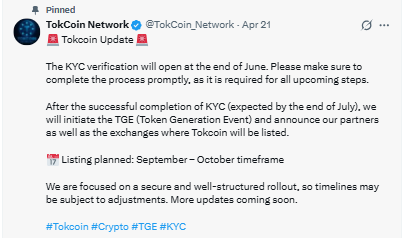
No exchange partner has been officially confirmed yet, and any name circulating in community channels right now should be treated as speculation until an official announcement is made.
Is a major exchange already lined up, or is the market simply hoping one is? That question will only be answered once TGE is complete.
Does EU MiCA Compliance Explain Part Of The Delay?
Regulatory alignment under the EU's MiCA framework has been cited as one reason for the slower rollout.
Compliance-first sequencing—verify wallets, close KYC, then move to TGE—is a slower path but arguably a safer one for a token entering under tighter regulatory scrutiny than earlier cycles allowed.
It also means further short delays inside this window would not be surprising.
What Could This Scarcity Mean For Tokcoin Network Price Prediction?
Putting a number on Tokcoin Network price prediction this early is difficult, and any figure without a live trading market backing it should be treated with caution.
What can be said is that a capped, mining-distributed supply of this size historically creates conditions for outsized moves in both directions right after listing.
Momentum traders may see opportunity in that volatility, while longer-term holders may prefer to wait for the first few sessions to settle before treating any price level as meaningful support or resistance.
The base case for TOK hinges on smooth TGE execution and orderly early trading, while a bull case would need strong demand meeting that thin order book, and a bear case would involve early holders exiting quickly once liquidity appears.
Expert Opinion
Analysts tracking Tokcoin Network note that the KYC-before-listing sequencing is best read as a risk management decision rather than a sign of weakness.
Sell pressure from unverified or inactive wallets tends to be one of the biggest drags on new listings, and filtering that out beforehand can support a cleaner price discovery process for TOK.
The mining-only distribution also removes the typical overhang from early investor unlocks that has hurt many low-cap tokens in their first weeks of trading.
Disclaimer: This article is for informational purposes only and should not be considered financial advice. Cryptocurrency markets are highly volatile, and prices can change rapidly. Readers should conduct their own research before making any investment decisions.


You May Also Like

DataZapp: Smarter Marketing Data Strategies for Insurance Agencies Looking to Reduce Acquisition Costs

Saudi Arabia considers expansion of Red Sea oil pipeline

Pico and ITRS Partner to Bring Network-Derived Observability to Indian Financial Markets



