Issuer-Sponsored Tokenized Securities: Do Rights Follow?
Overview
Bullish and Equiniti have formed the Issuer Sponsored Token Coalition with Alpaca, Apex Fintech Solutions and DriveWealth among its initial participants, bringing together firms spanning trading, brokerage and shareholder infrastructure to address one of the largest unresolved questions in tokenized equities: whether owning a stock-linked token should carry the same legal and economic rights as owning the underlying share.
Announced on September 24, 2026, the coalition plans to develop technical standards, market infrastructure and operating frameworks for issuer-sponsored tokenized securities. Its central premise is that blockchain modernization should preserve the relationship between public companies and their shareholders. Under this model, a tokenized security can be connected directly to an issuer’s authoritative shareholder register, helping maintain voting rights, corporate-action entitlements and investor protections while allowing the asset to interact with blockchain-based market infrastructure.
The initiative is an industry working group rather than a regulator, and participation is non-binding. It has not established a mandatory tokenization standard or required companies to issue blockchain shares. Its significance lies elsewhere: as tokenized stock trading grows, the industry is beginning to address the legal ownership layer that sits behind the token. The next stage of tokenization may therefore depend less on whether a share can move onchain and more on whether shareholder rights can move with it.
Key Takeaways
- Bullish and Equiniti launched the Issuer Sponsored Token Coalition on September 24.
- Alpaca, Apex Fintech Solutions and DriveWealth are among its first participants.
- The coalition focuses on issuer-sponsored tokenized securities linked to authoritative shareholder records.
- Its goal is to preserve ownership rights, corporate actions and investor protections while modernizing market infrastructure.
- The group is voluntary and does not have regulatory authority.
Why Was the Issuer Sponsored Token Coalition Created?
Tokenized Equity Has an Ownership Problem
The rapid development of tokenized stocks has exposed a fundamental weakness in some existing models: a digital asset can track a company’s share price without making the token holder a shareholder of that company. Synthetic products, collateralized debt structures and other indirect representations can deliver useful economic exposure, but they do not necessarily transfer voting rights, formal ownership or direct corporate-action entitlements.
The Issuer Sponsored Token Coalition is built around the view that tokenized public securities should preserve the traditional issuer-shareholder relationship rather than replace it with an unrelated contractual claim. In an issuer-sponsored model, the blockchain representation is connected to recognized ownership infrastructure, including the authoritative shareholder register. The technology changes how the security can be represented and transferred, while the legal relationship between company and investor remains intact.
This distinction becomes increasingly important as tokenized equity trading volumes grow. When stock-linked tokens were small experimental products, price exposure was often the dominant consideration. If tokenized securities are to become part of mainstream capital markets, however, investors and issuers need to know who legally owns the security, who receives a dividend, who can vote and how ownership changes are reflected when tokens move between wallets.
The coalition is therefore addressing a problem deeper than blockchain throughput or trading hours. It is attempting to align digital possession with recognized securities ownership.
What Are Issuer-Sponsored Tokenized Securities?
The Token Is Connected to the Issuer Rather Than Merely Tracking the Share
Issuer-sponsored tokenized securities are intended to represent shares through a model recognized by the issuer and connected to official ownership records. The objective is not simply to create an ERC-20 token whose price follows a listed stock; it is to ensure that the digital representation remains part of the company’s shareholder infrastructure.
That creates a fundamental difference from synthetic equity exposure. A synthetic token can reference Tesla or Nvidia while the investor’s legal claim ultimately sits against an intermediary or product issuer. An issuer-sponsored tokenized share can instead be designed so that ownership remains connected to the actual issuer and shareholder register.
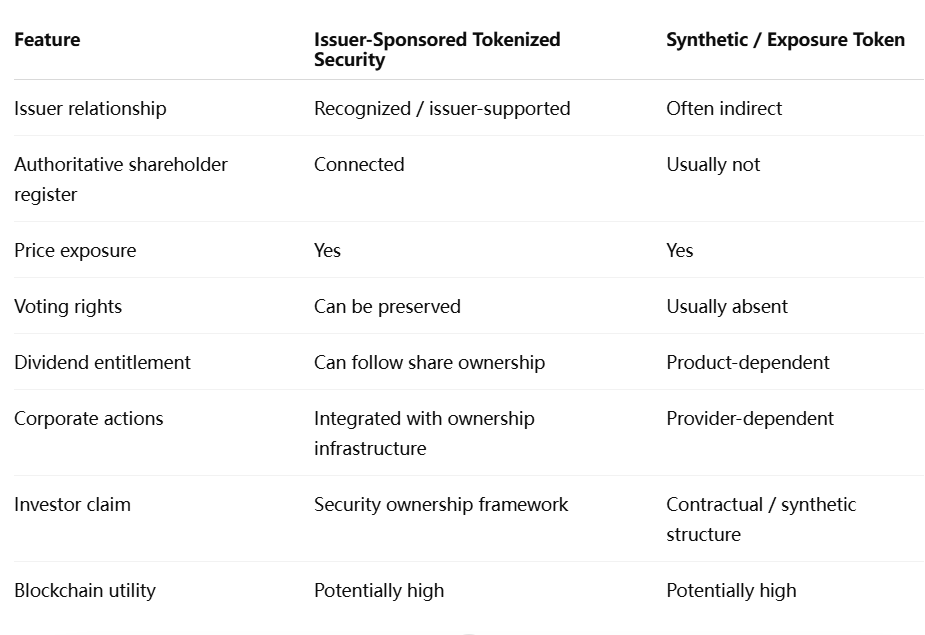
The crucial phrase is can be preserved. Tokenization itself does not automatically produce voting or dividend rights. Those rights result from the security’s legal structure and the connection between blockchain records and authoritative ownership records.
This is why the coalition’s focus on market infrastructure matters. A smart contract can prove who controls a blockchain address, but securities law and corporate records determine whether that address holder is recognized as a shareholder.
Does Owning a Stock Token Automatically Mean Owning the Stock?
Blockchain Ownership and Legal Ownership Are Separate Layers
No. Possession of a token does not by itself establish direct ownership of the referenced public company. The token contract can record ownership of the digital asset with mathematical certainty while saying relatively little about the legal relationship between that asset and the company whose ticker appears on the screen.
This distinction becomes clearer during events that have nothing to do with day-to-day trading. Consider a shareholder vote, cash dividend, tender offer or merger. A synthetic product can compensate investors economically for some of those events, but the token holder may still lack the legal right to vote or communicate directly with the issuer. In an issuer-sponsored structure connected to the official register, these rights can potentially follow the tokenized security more directly.
That difference also affects insolvency and intermediary risk. An indirect token may depend on a platform continuing to hold or manage underlying shares correctly. A properly structured issuer-sponsored model aims to reduce the gap between the blockchain representation and recognized ownership itself.
This is the coalition’s strongest strategic argument: tokenized equity should modernize the ownership rail, not merely create another derivative layer on top of the existing stock.
Why Does the Shareholder Register Matter?
Capital Markets Depend on More Than Trade Execution
The shareholder register is an authoritative record used to identify recognized holders and administer ownership-related processes. This infrastructure may appear mundane compared with blockchain trading, but it underpins dividends, shareholder communications, proxy voting and corporate actions.
A blockchain can make an asset transferable 24/7, but a public company still needs to know who is entitled to participate in those events. If a token changes wallets while the authoritative record does not change, the two systems can diverge. Solving that synchronization problem is necessary before onchain shares can replicate the full functionality of traditional ownership.
Equiniti’s role is therefore important. As a transfer-agent and shareholder-services provider, it operates in precisely the part of the market responsible for ownership records and corporate actions. Its tokenization model explicitly describes the shareholder register as the legal record of ownership, while blockchain functions as an automation and representation layer.
This architecture is deliberately more conservative than the idea of replacing every traditional record with a permissionless blockchain. Instead, the model attempts to connect programmable assets to existing legal infrastructure and allow the two systems to evolve together.
Corporate Actions Are a Harder Problem Than Trading
Much of the tokenization debate focuses on faster settlement and 24/7 trading because those benefits are easy to demonstrate. Corporate actions are considerably harder. A stock split changes the number of securities outstanding, a merger can alter or cancel existing shares, a tender offer requires communication with eligible holders, and a dividend must reach the correct investors based on record dates.
For issuer-sponsored tokenized securities to function at institutional scale, those events need to propagate accurately across both traditional and blockchain records. The challenge is not only technical synchronization; the system must also satisfy securities law, tax reporting, identity requirements and investor communications.
This is why tokenization cannot be evaluated purely through transaction speed. A market can execute a token swap in seconds while still lacking the infrastructure required to administer a public security over its full lifecycle.
Why Are Bullish, Equiniti, Alpaca, Apex and DriveWealth Relevant?
The Coalition Brings Together Different Parts of the Securities Lifecycle
The participant mix is more important than the number of companies involved. Bullish contributes digital-asset trading infrastructure, while Equiniti represents transfer-agent and shareholder-record expertise. Alpaca, Apex Fintech Solutions and DriveWealth operate across brokerage, custody and market infrastructure, giving the group exposure to many of the functions that sit between an issuer and an investor.
This reflects the reality that tokenized securities cannot scale through a blockchain protocol alone. Issuance, ownership records, custody, trading, settlement, compliance and liquidity are distinct functions, and each has existing legal and operational requirements.
The coalition initially plans to focus on preserving issuer and shareholder rights, building interoperability, developing adoption infrastructure and creating a broader market ecosystem. It also expects to evaluate smart-contract architectures, interoperability standards, regulatory requirements and product pilots. Those are exploratory goals rather than completed standards.
That distinction should remain clear. The coalition has not yet created a universal technical specification for tokenized stocks, and joining it does not obligate a participant to issue, list or provide liquidity for any security.
Why Is the Coalition Forming Now?
SEC Policy Has Shifted the Industry From Theory Toward Implementation
The timing is significant. The coalition launched one week after the SEC introduced its five-year Innovation Exemption for limited onchain trading of eligible tokenized NMS stocks. The SEC framework requires qualifying tokenized stocks to preserve the same rights and privileges as corresponding traditional shares, bringing legal equivalence closer to the center of the U.S. tokenization debate.
The coalition should not be described as an official arm of that SEC program. It is an independent industry initiative. However, the regulatory and industry developments clearly address related structural questions: if regulated securities begin trading through blockchain infrastructure, the market must determine how ownership rights remain attached to those assets.
This creates a natural progression in the U.S. tokenization market. Earlier development focused on proving that securities could be issued digitally. Newer DEX and brokerage products demonstrated that equity-linked tokens could trade. Regulation and industry infrastructure are now turning toward the harder problem of preserving shareholder rights as those securities move between traditional and blockchain systems.
That sequence suggests tokenization is entering a more mature phase in which legal architecture becomes as important as technical architecture.
Interoperability May Be the Hardest Technical Problem
Tokenized and Traditional Shares Need to Remain Economically Synchronized
Issuer-sponsored tokenization does not mean conventional securities infrastructure disappears overnight. The more realistic near-term structure is coexistence: traditional shares remain in established systems while tokenized representations circulate through blockchain networks.
That creates an interoperability requirement. If an investor moves a security from conventional custody into a tokenized format—or reverses the process—the total ownership record must remain accurate and double issuance cannot occur. Corporate actions also need to reach both forms consistently.
The coalition explicitly identifies interoperability across traditional clearing and settlement infrastructure, blockchain networks, wrapped-token models and emerging entitlement-token frameworks as a priority. Solving this problem is essential because fragmented representations of the same share could create reconciliation risk rather than reduce it.
The strongest tokenization architecture may therefore be the one that makes movement between legacy and blockchain systems reliable, rather than the one that attempts to eliminate legacy infrastructure immediately.
What Could Slow Issuer-Sponsored Tokenization?
Issuer Participation May Be a Larger Constraint Than Blockchain Capacity
Issuer-sponsored models require public companies to participate or at least recognize the structure. That can improve legal clarity but may slow asset coverage compared with third-party platforms capable of creating synthetic exposure to hundreds of securities quickly.
Public companies also have little incentive to adopt tokenization merely because the technology exists. They need measurable benefits such as broader investor access, lower servicing costs, improved ownership visibility or more efficient capital raising. If tokenization introduces additional operational complexity without delivering those benefits, adoption may remain limited.
Transfer-agent integration, custody rules and cross-chain standards create additional challenges. A tokenized share that works only on one network may fragment liquidity, while bridging the same security across multiple networks introduces synchronization and security risks.
The market therefore faces a trade-off between speed and legal robustness. Synthetic products can scale quickly; issuer-sponsored securities may scale more slowly but potentially offer a stronger foundation for institutional adoption.
MEXC View: Tokenized Equities Need Legal Composability
Crypto markets have demonstrated technical composability: assets can move between wallets, DEXs, lending markets and smart contracts without each application rebuilding the asset from scratch. Tokenized equities now face the more difficult challenge of legal composability.
A security needs to remain recognizable through dividends, voting, record dates and corporate actions even as it moves across programmable financial applications. If blockchain ownership can travel but shareholder rights cannot, tokenization creates a technically efficient asset with an incomplete legal framework.
Issuer-sponsored tokenized securities attempt to close that gap by connecting blockchain representations to official ownership infrastructure. Whether this becomes the dominant model remains uncertain, but it addresses a problem that trading volume alone cannot solve.
For the tokenized equity market, the next competitive advantage may therefore be neither faster blockchains nor more listed tickers. It may be the ability to make liquidity, programmability and formal ownership work together.
Tokenized Stocks Become More Credible When Rights Follow the Token
The Issuer Sponsored Token Coalition represents an important shift in the tokenized equity debate. Bullish, Equiniti, Alpaca, Apex Fintech Solutions and DriveWealth are not merely trying to make securities easier to trade onchain; they are exploring infrastructure intended to preserve the relationship between public companies and the investors who own their shares.
That distinction is increasingly important as tokenized stock markets gain liquidity. A token can deliver excellent price exposure and 24/7 transferability while still leaving the investor with fundamentally different rights from a conventional shareholder. Issuer-sponsored tokenization attempts to make digital ownership compatible with authoritative shareholder registers, corporate actions and investor protections.
The model still faces significant obstacles. Public companies must see sufficient value to participate, transfer-agent infrastructure must integrate with blockchain networks and tokenized and traditional markets must remain synchronized. The coalition itself is a voluntary working group rather than a regulatory authority, so its standards will gain importance only if issuers and market participants actually adopt them.
Nevertheless, the direction is significant. The first phase of tokenized equities proved that stock exposure can move onchain. The next phase will determine whether actual shareholder ownership can move with it. If issuer-sponsored tokenized securities can solve that problem, tokenization may evolve from a new trading format into a genuine modernization of securities ownership infrastructure.
Sources
https://equiniti.com/us/public/transfer-agent-services/equiniti-x-tokenization/
https://equiniti.com/us/insights/eq-views/tokenization-an-issuer-s-primer/
https://equiniti.com/us/insights/eq-views/tokenized-shares-vs-synthetic-tokens/
Risk Disclaimer: This article is for reference only and does not constitute investment advice. The cryptocurrency market is highly volatile. Please make decisions cautiously based on your individual circumstances.
You May Also Like

Tokenized Stock Trading Hits $20.9B: Why Uniswap Leads

Stablecoin Adoption: Why Bank-Level Protection Matters