Sky Protocol Moody's Rating: Why B3 Matters for DeFi
Overview
Sky Protocol has become an important test case for whether traditional credit-analysis frameworks can meaningfully evaluate decentralized financial infrastructure. On October 6, 2026, Moody’s Ratings assigned Sky Protocol a B3 counterparty risk rating, bringing a familiar institutional risk language into a sector that has historically been assessed through collateral ratios, smart-contract audits, governance analysis and onchain liquidity metrics.
The Sky Protocol Moody's rating should not be interpreted as a B3 rating on USDS itself, nor as a judgment that the stablecoin is expected to lose its peg. Moody’s action applies to the protocol’s counterparty risk, which is a broader assessment of its capacity to meet financial obligations. B3 also sits in speculative-grade territory, meaning the rating carries materially higher credit risk than investment-grade categories even though it is not equivalent to a forecast of default.
The more important development is methodological. Stablecoin protocols increasingly resemble financial balance sheets: they hold collateral, manage liquidity, create liabilities, absorb losses and operate under governance frameworks that can alter risk parameters. A conventional rating agency assessing that structure could make decentralized finance easier for banks, funds and treasury teams to compare with other forms of credit exposure. The rating therefore matters less as a symbolic endorsement of DeFi and more as evidence that stablecoin risk is becoming legible to institutional credit systems.
Key Takeaways
- Moody’s assigned Sky Protocol a B3 counterparty risk rating on October 6, 2026.
- The rating applies to Sky Protocol, not directly to USDS as a standalone stablecoin.
- B3 is speculative grade and should not be interpreted as a guarantee of stability or a prediction of default.
- Traditional credit analysis could give institutions a standardized way to assess stablecoin protocols alongside other financial counterparties.
- Smart-contract, governance, liquidity and collateral risks remain relevant even when an external rating is available.
What Does the Sky Protocol Moody's Rating Actually Mean?
Moody's Is Assessing Counterparty Risk, Not the USDS Peg
The most important distinction is the object being rated. Moody’s lists the action as a B3 counterparty risk rating for Sky Protocol. It is therefore inaccurate to describe the announcement as Moody’s assigning USDS a B3 stablecoin rating or deciding that USDS itself has B3-quality reserves. A counterparty risk rating addresses a broader question: how exposed a creditor or other counterparty may be to the entity or protocol failing to meet financial obligations.
That distinction matters because stablecoin risk is multidimensional. Whether USDS trades near its target value is only one observable outcome. The resilience of the broader system also depends on what assets support liabilities, how quickly collateral can be liquidated, how governance can alter parameters, where losses are absorbed and whether liquidity remains available during market stress. A protocol can maintain a stable market price for long periods while still carrying meaningful structural credit risk.
B3 also needs context. Within Moody’s long-term rating scale, B ratings are below investment grade and indicate material credit risk. That does not mean Sky Protocol is being declared insolvent or that a failure is imminent. Ratings are relative assessments designed to help investors compare credit risk across issuers and counterparties, and they can be upgraded or downgraded as conditions change.
For additional context on the rating event and the wider stablecoin market, see the MEXC On-Chain Daily Report: Sky Protocol Receives Moody’s First Stablecoin Protocol Rating.
Why Does a Stablecoin Protocol Need Credit Analysis?
DeFi Protocols Increasingly Resemble Financial Balance Sheets
Stablecoin protocols were initially discussed mainly through crypto-native metrics such as total value locked, collateralization ratios and token supply. Those metrics remain useful, but they do not fully answer the questions an institutional risk committee would ask before approving material exposure.
A stablecoin system effectively manages assets and liabilities. It holds or obtains economic exposure to collateral, issues liabilities against that asset base, manages liquidity and depends on rules governing how losses are distributed. For institutions, that creates a familiar analytical problem even if the underlying implementation uses smart contracts rather than a conventional corporate treasury system.
The quality of the asset side matters first. Highly liquid government securities behave differently from volatile crypto collateral, private credit or leveraged DeFi positions. Liquidity then determines whether assets can be converted quickly enough to meet redemptions or other obligations. Governance adds another layer because changes to collateral parameters, risk limits or protocol incentives can alter the financial profile after an institution has already taken exposure.
This is why the Sky Protocol Moody's rating is more consequential than a simple brand endorsement. It signals that stablecoin protocols can increasingly be assessed through frameworks that examine the same basic questions applied to financial counterparties: what supports the liabilities, how liquid are the assets, how are risks controlled and what happens when market conditions deteriorate?
How Should Institutions Evaluate Sky Protocol?
Collateral, Liquidity and Governance Need to Be Viewed Together
No single metric provides a complete assessment of a decentralized stablecoin protocol. A high collateral ratio can appear reassuring, for example, but may provide limited protection if the collateral is illiquid or highly correlated during stress. Similarly, deep liquidity during normal markets does not guarantee that redemption pathways remain robust during a rapid selloff.
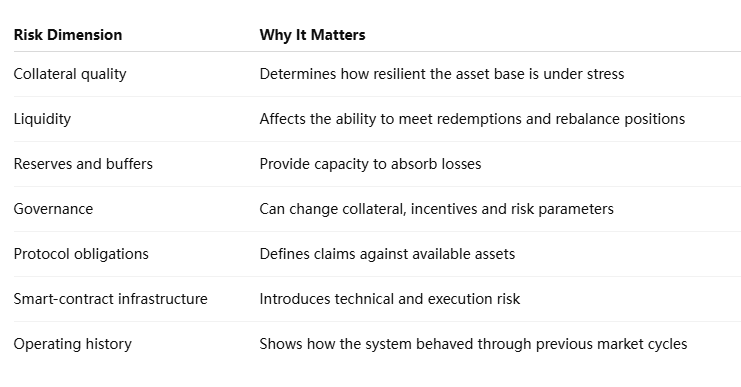
The interaction between these factors is what matters. A protocol with conservative collateral but weak governance controls can still take on more risk later. A highly diversified asset base may remain vulnerable if liquidity disappears during a crisis. Conversely, a protocol with strong risk controls may still face losses when correlated collateral moves sharply against outstanding liabilities.
For institutional users, the practical value of a third-party rating is that it can provide a standardized starting point for this analysis. It does not replace internal due diligence. A treasury or investment committee still needs to determine whether a B3-rated counterparty fits its own risk mandate, concentration limits and liquidity requirements.
Does a Moody's Rating Make DeFi Safer?
Standardized Analysis Reduces Information Friction, Not Underlying Risk
No. A credit rating can improve transparency and comparability, but it cannot remove the underlying sources of risk.
This distinction is especially important in DeFi because some risks can change faster than traditional corporate credit. Smart contracts can be upgraded, governance proposals can alter collateral parameters and new integrations can create exposures that did not exist when a previous assessment was made. Oracle failures or contract vulnerabilities can also create losses that do not map neatly onto conventional credit deterioration.
What a rating can do is reduce information friction. Traditional institutions already use rating scales to organize exposure limits, collateral policies and investment mandates. If stablecoin protocols can be translated into comparable credit categories, risk committees may find it easier to discuss whether an exposure belongs in a portfolio and how much capital should be allocated to it.
That could become particularly relevant for institutional stablecoin usage. A bank or fund deciding whether to hold stablecoins, lend against them or accept them as collateral needs more than a market-cap ranking. It needs a way to assess expected resilience under stress. External ratings could become one input alongside reserve disclosures, onchain analytics, audits and internal scenario analysis.
Why Could Stablecoin Ratings Matter Beyond Sky Protocol?
Credit Scores Could Influence Collateral and Treasury Decisions
If traditional rating frameworks become more common across stablecoin protocols, their impact could extend beyond investor perception. Ratings may eventually influence whether certain stablecoins or protocol exposures qualify for institutional treasury policies, how much collateral haircut is applied to them or how lenders price credit against them.
This could create a new layer of differentiation in the stablecoin market. Today, competition is often discussed in terms of market capitalization, exchange liquidity, chain support and yield. Institutional adoption introduces additional questions: which assets are acceptable for treasury reserves, what concentration limits should apply and how much capital should be held against counterparty exposure?
A standardized rating does not automatically answer those questions, but it can become part of the decision framework. An institution might combine an external rating with internal stress tests and onchain data to set different exposure limits for different protocols.
There is also a broader market-structure implication. As tokenized securities, stablecoin payments and onchain credit connect more deeply with traditional financial institutions, credit analysis must become interoperable too. Traditional firms are unlikely to abandon established risk frameworks simply because the underlying asset is blockchain-based. More likely, crypto-native information will be translated into forms that existing risk systems can ingest.
What Are the Limits of the Sky Protocol Moody's Rating?
A rating should not be confused with deposit insurance, a guarantee of redemption or an investment recommendation. Moody’s ratings can change as financial conditions, protocol design and governance evolve. They are assessments of relative credit risk, not promises that a counterparty will always perform as expected.
The decentralized structure also creates analytical challenges. Governance can change more quickly than management policies at some traditional institutions, while collateral composition may shift over time. Onchain transparency can provide real-time information, but transparency alone does not prevent poor risk decisions or unexpected correlations.
Another limitation is that credit analysis and technical security are not identical. A protocol could have adequate financial resources yet still experience losses from a smart-contract exploit. Conversely, strong technical security cannot compensate for structurally weak collateral or insufficient liquidity. Institutions need both forms of analysis.
This is why the emergence of external ratings should be viewed as an additional risk layer rather than a replacement for crypto-native due diligence.
MEXC View: Stablecoins Are Entering the Credit-Analysis Era
The significance of the Sky Protocol Moody's rating is that stablecoins are increasingly being evaluated not merely as crypto products, but as financial systems with assets, liabilities, liquidity and governance risk. This is a natural consequence of institutional adoption. Once stablecoins begin supporting corporate treasury, collateral, payments and credit markets, risk committees need a language that goes beyond market capitalization and peg history.
Traditional ratings can provide that language, while onchain data can make the underlying analysis more dynamic than conventional credit monitoring. The combination could eventually be more useful than either system alone: standardized ratings support institutional comparison, while blockchain transparency provides near-real-time evidence about collateral and liquidity.
The key metric to watch is therefore not whether every DeFi protocol obtains a rating. It is whether banks, funds and other professional investors begin using these assessments to determine real exposure limits, collateral haircuts and treasury allocations. That would mark the point at which crypto credit analysis becomes integrated with mainstream institutional risk management.
Sky Protocol's B3 Rating Makes DeFi Risk More Legible
The Sky Protocol Moody's rating should not be read as a simple endorsement of the protocol or a direct rating of the USDS peg. Moody’s has assigned Sky Protocol a B3 counterparty risk rating, placing it within a speculative-grade credit category and giving institutional investors another framework through which to assess the protocol’s ability to meet financial obligations.
What makes the development significant is the bridge between two risk cultures. DeFi has traditionally relied on real-time collateral data, code audits, governance monitoring and market liquidity. Traditional finance relies heavily on standardized credit categories, risk limits and committee-based approval processes. Bringing those approaches together could make decentralized financial infrastructure easier for institutional users to evaluate.
The limitations remain substantial. A rating cannot eliminate smart-contract, oracle or governance risk, and it can become outdated if a protocol’s financial structure changes quickly. Institutions should therefore treat ratings as one layer within a broader due-diligence process.
Even so, the direction is important. As stablecoin protocols become more deeply integrated with payments, lending and tokenized assets, the market will increasingly need tools that translate complex onchain risk into decision frameworks understood by professional capital allocators. Sky Protocol’s B3 rating is notable less because of the letter grade itself than because it suggests that DeFi is entering a phase where creditworthiness is becoming a formal part of institutional adoption.
Sources
https://ratings.moodys.com/
https://sky.money/
Risk Disclaimer: This article is for reference only and does not constitute investment advice. The cryptocurrency market is highly volatile. Please make decisions cautiously based on your individual circumstances.
You May Also Like

RWA Perpetuals Hit $1.4T: Why Trading Is Exploding

From Oil Prices to Your Wallet: How an Oil Price Shock Moves the Entire Market