- Quick Buy/SellBuy & sell with cards and mobile payments
- P2PTrade with local payments at best prices
- Fiat DepositDeposit in BRL, COP, EUR, and more
- Global Bank TransferBuy and sell via local banks
- MEXC CardSpend your crypto worldwide
- SpotBuy and sell crypto with ease
- RealStocksTrade top US equities directly with crypto
- ConvertSwap hot tokens instantly with 0 fees
- Pre-MarketGet in early before official listings
- MX ZoneUnlock exclusive perks with MX
- Spot DCASteady growth through ups and downs
- Spot GridBuy low and sell high 24/7
- Meme+Discover on-chain gems early
- On-ChainYour unified hub for discovering, trading, and managing on-chain assets
- USDT-MPerpetual Futures settled in USDT
- USDC-MPerpetual Futures settled in USDC
- USD1-MPerpetual Futures settled in USD1
- Coin-MPerpetual Futures settled in other cryptos
- Futures EarnEarn up to 20% APR on your Futures funds
- AI StrategyConvert ideas into strategic action
- Grid TradingCapture volatility with automated trading
- Copy Trade × AIFollow seasoned traders or strategize with AI
- Demo TradingSimulate Futures trading risk-free
- Futures OverviewExplore Futures tools, products, and features
- GOLD Futures24/7 access to top liquidity & leveraged power
- OIL Futures24/7 access to top liquidity & leveraged trading
- SILVER FuturesTrade with 0 fees, top liquidity, and flexible leverage.
- BTC FuturesMarket's lowest fees and high leverage
- ETH FuturesMarket's lowest fees and high leverage
- ZEC Futures SurgeEnjoy 0 fees, up to 150× leverage, and top position capacity at 21×+ leverage
- MEXC EarnEarn high APR on your crypto
- Hold and EarnHold assets and earn interest daily
- Futures EarnEarn on balance and unlock higher APR as you trade
- On-Chain EarnEasy staking. Real on-chain yield
- MEXC LoansBorrow instantly at competitive rates
- Rewards HubGet started with $10,000 in bonuses
- Event CenterHigher rewards, 0 fees
- Invite and EarnInvite friends and earn 140 USDT each
- $500K BTC CarnivalWin up to 1 BTC & more!
- LaunchpadAccess top tokens early or at a discount
- Airdrop+Deposit and trade to claim new airdrops
- KickstarterHold MX to earn new tokens
- 0 FeesTrade hot futures, enjoy limited 0 fees
- Futures M-DayTrade Futures and claim daily rewards
- Futures Loss Coverage PlanGet triple protection and win $5,000 in XAUT
- Referral ProgramInvite friends and unlock commissions from 40%
- Affiliate ProgramTop-tier affiliate commissions up to 70%
- MEXC VVIPM-Score into Wealth, 10+ Elite Benefits Upgrading
- MEXC × TradingViewConnect MEXC to trade directly on TradingView
- Crypto NewsFollow the latest crypto headlines
- AnnouncementsStay on top of every happening on MEXC
- LearnStrong crypto fundamentals for every beginner
- MEXC InstitutionalTailored solutions for institutional clients
Grayscale Republic: Are DeFi and AI Becoming Fund Sectors?
Overview
Grayscale is expanding distribution of several thematic crypto investment products through Republic, giving eligible investors a lower-ticket route into funds focused on decentralized finance, decentralized artificial intelligence and onchain data infrastructure. Announced on October 15, 2026, the Grayscale Republic partnership initially makes the Grayscale Decentralized Finance Fund, Grayscale Decentralized AI Fund and Grayscale Data Network Trust available through Republic, with minimum investments starting at $2,500.
The lower minimum does not mean the products have become ordinary retail ETFs. U.S. participation remains limited to verified accredited investors, and the securities are offered through private-placement structures. Grayscale warns that the shares are speculative, illiquid and subject to substantial transfer restrictions. Lower investment size does not create broader legal eligibility or ETF-like liquidity.
The more important development is how crypto investment categories are evolving. Investors are no longer being offered only individual BTC, ETH or altcoin exposure. Asset managers are increasingly packaging DeFi, decentralized AI and data infrastructure into defined sectors with dedicated products, portfolio methodologies and distribution channels.
Grayscale Republic therefore represents more than a new sales partnership. It tests whether crypto themes can mature into recognizable asset-management categories that investors can access through the same private-market infrastructure used for other alternative investments.
Key Takeaways
- Republic is distributing selected Grayscale DeFi, decentralized AI and data-network investment products.
- Minimum investments begin at $2,500, but U.S. investors must still be verified accredited investors.
- The products are private placements rather than ordinary retail ETFs.
- Current offerings provide exposure to assets including UNI, AAVE, ONDO, NEAR, RENDER, TAO, FIL and DATA.
- The larger trend is the transformation of crypto narratives into structured investment sectors.
What Does the Grayscale Republic Partnership Actually Change?
Grayscale already managed the investment products before the Republic partnership. What changes is distribution. Republic provides a digital investment platform through which eligible investors can complete onboarding and gain access to selected Grayscale products with minimum investments beginning at $2,500. Grayscale continues to manage the underlying investment vehicles and determine their portfolios according to the relevant product structures.
The arrangement therefore separates product manufacturing from distribution. Grayscale creates and manages the investment exposure, while Republic provides an investor-access layer that includes accredited-investor verification and private-market onboarding. This can make thematic crypto products easier to reach without turning them into unrestricted securities.
For background on the composition of Grayscale's DeFi strategy, see MEXC's coverage of Grayscale's 2026 DeFi Fund rebalancing, which details how the portfolio has evolved as the decentralized-finance sector changes.
Can Any Retail Investor Buy These Grayscale Funds?
No. The $2,500 minimum lowers the capital required to participate, but it does not remove the legal eligibility requirement.
Republic currently identifies the products as available to U.S. accredited investors. Grayscale's offering materials describe the relevant shares as private-placement securities, meaning they do not function like ordinary exchange-listed ETFs that any brokerage customer can buy throughout the trading day.
This is an important distinction because “expanded access” can refer to several different things. A product can become easier to discover, offer a lower minimum investment and simplify digital onboarding while still being legally restricted to a defined investor category.
The Grayscale Republic partnership primarily changes the first three. It does not convert private-placement securities into broadly available retail instruments.
Lower minimum ≠ broader legal eligibility.
Why Does a $2,500 Minimum Still Matter?
Even though the accredited-investor requirement remains, reducing the investment minimum can materially change who within that eligible population can build a position. Alternative and private-market products often require commitments large enough to make portfolio diversification difficult for smaller accredited investors. A $2,500 starting point makes it possible to allocate across several themes without committing a large amount to each product.
That may be especially relevant in crypto, where thematic portfolios can be volatile and concentrated. An investor interested in DeFi and decentralized AI may prefer separate smaller allocations instead of making a single large commitment to one sector. Lower minimums can make that approach operationally easier.
The significance is therefore not democratization in the full retail sense. It is fractionalization of access within an already eligible investor group. Digital distribution reduces some of the practical friction around private products while securities-law restrictions remain intact.
This distinction also helps explain why platforms such as Republic matter. Their value is not simply displaying investments on a website; they provide the onboarding and compliance infrastructure necessary to distribute restricted products to a larger pool of qualified investors.
What Are Investors Actually Buying?
The three products provide different forms of thematic crypto exposure. Republic's current product pages show the DeFi Fund holding a basket that includes UNI, AAVE, ONDO, ENA, CRV and LDO, while the Decentralized AI Fund includes NEAR, RENDER, TAO and FIL. The Data Network Trust provides concentrated exposure to DATA.
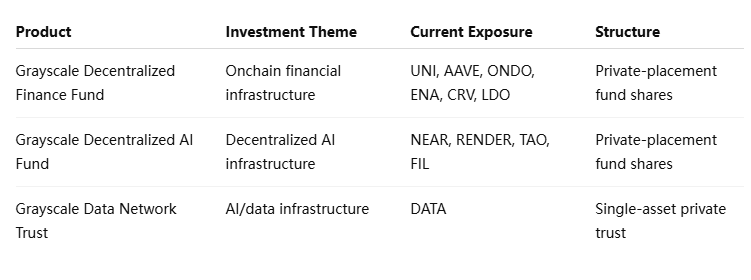
The portfolios are important because they show that Grayscale is not treating “crypto” as one homogeneous asset class. The DeFi product targets protocols associated with trading, borrowing, lending and other financial activity, while the AI product targets networks involved in compute, models, storage and decentralized AI infrastructure.
Investors should also recognize that fund holdings can change. Grayscale regularly rebalances thematic portfolios according to their methodologies, so a list of assets at one point in time should not be treated as a permanent composition.
Are DeFi and Decentralized AI Becoming Real Investment Sectors?
They are increasingly being treated that way, although the categories are still much younger and less standardized than traditional equity sectors.
A sector becomes more useful for asset management when investors can define which assets belong to it, compare businesses or protocols using related economic drivers, construct a repeatable portfolio and distribute that portfolio through an investable vehicle. Grayscale has been building precisely that framework around crypto. Its research separates digital assets into areas such as financials and artificial intelligence rather than treating every token as an interchangeable altcoin.
DeFi is the more mature example. Protocols such as Aave and Uniswap can be analyzed through activity such as lending, trading volume, fees and protocol economics. Decentralized AI is less mature, but Grayscale divides the sector into infrastructure involving compute, data, models and blockchain-enabled AI applications.
This progression matters because sectorization often precedes more systematic capital allocation. An institution may find it difficult to justify holding a collection of unrelated tokens, but a defined sector with investment methodology, benchmark logic and a fund structure is easier to incorporate into portfolio construction.
That does not make decentralized AI or DeFi low-risk. It makes them easier to analyze as categories.
Why Republic Matters More Than Another Fund Launch
The partnership is notable because the products themselves are not all new. What Republic adds is distribution infrastructure.
Republic says its broader platform serves more than three million members across more than 150 countries and has facilitated billions of dollars in capital deployment. For Grayscale, the value is access to an investor base already accustomed to private-market and alternative investments. For Republic, Grayscale brings established crypto products and asset-management expertise.
The combination reflects a broader convergence between crypto investment products and private-market platforms. Instead of requiring investors to open self-custody wallets and purchase a basket of tokens individually, a regulated product can hold the assets while the investor owns a security representing exposure to the fund.
That structure moves custody and portfolio management away from the end investor, but it also introduces fund-level fees, restrictions and counterparty dependencies. The convenience of the wrapper therefore comes with a different risk profile from directly holding the underlying assets.
The key change is that crypto sector exposure is being distributed through alternative-investment infrastructure rather than only through crypto exchanges.
Do These Products Trade Like ETFs?
No. This is the second major distinction investors need to understand.
ETFs generally offer exchange trading and continuous market access during trading hours. The Republic-distributed Grayscale products are private-placement securities. Grayscale explicitly warns that they are speculative and illiquid, and that investors can lose their entire investment. Shares are also subject to resale and transfer restrictions, while some Grayscale structures do not currently operate redemption programs.
A lower minimum investment does not change those characteristics.
This creates a meaningful gap between the value of the underlying crypto assets and the practical liquidity available to a fund investor. The underlying tokens may trade around the clock on liquid crypto markets, while the private security representing exposure to them can remain restricted.
Liquid underlying tokens do not guarantee liquid fund shares.
That inversion is important. In many traditional private funds, illiquidity comes from illiquid underlying assets. Here, some underlying crypto assets may be highly tradable, while the legal wrapper remains intentionally less liquid because it is a restricted security.
Why Decentralized AI Is an Important Test
DeFi already has several years of operating history and recognizable business models around exchanges, lending and other financial services. Decentralized AI is a newer investment narrative and therefore a more difficult test of whether a crypto theme can mature into a durable sector.
Grayscale's AI framework covers networks that distribute some combination of computing, data, models and economic coordination across independent participants. Instead of relying entirely on centralized hyperscalers, these protocols attempt to use token incentives and open networks to coordinate resources needed for AI development or operation.
The investment challenge is that these networks do not all generate value in the same way. Compute marketplaces, storage networks, model platforms and AI-agent infrastructure can have fundamentally different economics. Grouping them under “AI” can make portfolio construction easier while also hiding important differences.
That is why thematic funds need more than attractive narratives. Investors still need to evaluate token economics, network demand, fees, competitive positioning and whether value generated by the network actually accrues to the token held by the fund.
The Republic distribution deal can broaden access to the theme, but it does not solve the valuation problem.
MEXC View: Crypto Narratives Are Becoming Investable Sectors
The deeper significance of Grayscale Republic is not simply that investors can buy more crypto products. It is that categories such as DeFi and decentralized AI are being packaged into recognizable investment sectors with portfolio construction, professional custody and dedicated distribution.
Crypto asset management historically centered on individual assets—first Bitcoin, then Ethereum and a growing list of single-token trusts. Sector products introduce a different way of allocating capital. Investors can express a thesis on onchain finance or decentralized AI without selecting every protocol individually.
That shift could make crypto portfolio construction look more like traditional asset management, where investors distinguish technology, financials, energy and other industries instead of treating the entire equity market as one trade.
The important test is whether these categories develop durable economic characteristics that justify dedicated allocations. A fund wrapper can institutionalize access to a narrative, but only sustained network activity and token value accrual can turn that narrative into a durable investment sector.
Risks and Limitations
The partnership expands distribution, but the products remain high-risk private securities.
- Accredited-investor restriction: U.S. participation is not open to the general retail public.
- Illiquidity: the shares should not be assumed to trade like exchange-listed ETFs.
- Transfer restrictions: private-placement shares can face substantial resale limitations.
- No guaranteed redemption: applicable product structures may not provide an active redemption program.
- Thematic concentration: DeFi or decentralized AI funds can perform poorly if a specific crypto sector loses relevance.
- Portfolio changes: current holdings are not permanent and can be rebalanced.
- Underlying token volatility: even diversified funds remain exposed to highly volatile digital assets.
- Classification risk: decentralized AI remains an evolving category whose component projects can have very different economics.
The $2,500 minimum should therefore be interpreted as a lower entry amount, not evidence that the products have become lower-risk or more liquid.
Grayscale Republic Is Turning Crypto Themes Into Fund Categories
The Grayscale Republic partnership reflects a broader change in crypto investing. Digital assets are increasingly being organized into themes that resemble conventional investment sectors rather than being presented only as isolated tokens. DeFi, decentralized AI and data infrastructure now have dedicated investment vehicles, portfolio definitions and distribution channels.
Republic lowers the practical entry point for eligible investors, with investments starting at $2,500, but it does not remove the legal boundaries of the products. U.S. participants remain subject to accredited-investor requirements, and the shares remain private-placement securities with significant liquidity and transfer constraints. Expanded access is therefore not the same as retail ETF access.
The more durable implication lies in product design. Grayscale is translating crypto-native narratives into structures that alternative-investment investors already understand: professionally managed funds, defined themes and security-based ownership. Republic supplies the distribution and onboarding layer needed to place those products in front of a broader qualified audience.
Whether these products succeed will ultimately depend on more than distribution. DeFi needs to demonstrate sustainable economic activity, while decentralized AI needs to show that decentralized compute, data and model networks can generate durable value for their tokens. If those foundations strengthen, crypto sector funds may become a more important part of portfolio construction. The Grayscale Republic partnership is an early indication that the infrastructure for that transition is already being built.
Sources
Grayscale / Republic partnership announcement:
https://www.globenewswire.com/news-release/2026/10/15/3381705/0/en/grayscale-investments-partners-with-republic-to-expand-investor-access-to-investment-products.html
Republic — Grayscale investment products:
https://republic.com/grayscale-defi-fund-reg-d
Grayscale Institute — Understanding Crypto Sectors: Artificial Intelligence:
https://institute.grayscale.com/understanding-crypto-sectors-artificial-intelligence/
Grayscale Institute — Understanding Crypto Sectors: Financials:
https://institute.grayscale.com/understanding-crypto-sectors-financials/
Risk Disclaimer: This article is for reference only and does not constitute investment advice. The cryptocurrency market is highly volatile. Please make decisions cautiously based on your individual circumstances.
You May Also Like

USDC MiCA: Is Europe Raising the Bar for Stablecoins?
Netflix’s 6% Workforce Cut Puts Cost Discipline in Focus