

- Quick Buy/SellBuy & sell with cards and mobile payments
- P2PTrade with local payments at best prices
- Fiat DepositDeposit in BRL, COP, EUR, and more
- Global Bank TransferBuy and sell via local banks
- MEXC CardSpend your crypto worldwide
- SpotBuy and sell crypto with ease
- RealStocksTrade top US equities directly with crypto
- ConvertSwap hot tokens instantly with 0 fees
- Pre-MarketGet in early before official listings
- MX ZoneUnlock exclusive perks with MX
- Spot DCASteady growth through ups and downs
- Spot GridBuy low and sell high 24/7
- Meme+Discover on-chain gems early
- On-ChainYour unified hub for discovering, trading, and managing on-chain assets
- USDT-MPerpetual Futures settled in USDT
- USDC-MPerpetual Futures settled in USDC
- USD1-MPerpetual Futures settled in USD1
- Coin-MPerpetual Futures settled in other cryptos
- Futures EarnEarn up to 20% APR on your Futures funds
- AI StrategyConvert ideas into strategic action
- Grid TradingCapture volatility with automated trading
- Copy Trade × AIFollow seasoned traders or strategize with AI
- Demo TradingSimulate Futures trading risk-free
- Futures OverviewExplore Futures tools, products, and features
- GOLD Futures24/7 access to top liquidity & leveraged power
- OIL Futures24/7 access to top liquidity & leveraged trading
- SILVER FuturesTrade with 0 fees, top liquidity, and flexible leverage.
- BTC FuturesMarket's lowest fees and high leverage
- ETH FuturesMarket's lowest fees and high leverage
- ZEC Futures SurgeEnjoy 0 fees, up to 150× leverage, and top position capacity at 21×+ leverage
- MEXC EarnEarn high APR on your crypto
- Hold and EarnHold assets and earn interest daily
- Futures EarnEarn on balance and unlock higher APR as you trade
- On-Chain EarnEasy staking. Real on-chain yield
- MEXC LoansBorrow instantly at competitive rates
- Rewards HubGet started with $10,000 in bonuses
- Event CenterHigher rewards, 0 fees
- Invite and EarnInvite friends and earn 140 USDT each
- LaunchpadAccess top tokens early or at a discount
- $500K TSLA FeverWin TSLAX, TSLAON & more!
- Airdrop+Deposit and trade to claim new airdrops
- KickstarterHold MX to earn new tokens
- RealStocks PNL Rate LeaderboardTrade $100 to win up to $10,000 in stock rewards
- 0 FeesTrade hot futures, enjoy limited 0 fees
- Futures M-DayTrade Futures and claim daily rewards
- Futures Loss Coverage PlanGet triple protection and win $5,000 in XAUT
- Referral ProgramInvite friends and unlock commissions from 40%
- Affiliate ProgramTop-tier affiliate commissions up to 70%
- MEXC VVIPM-Score into Wealth, 10+ Elite Benefits Upgrading
- MEXC × TradingViewConnect MEXC to trade directly on TradingView
- Crypto NewsFollow the latest crypto headlines
- AnnouncementsStay on top of every happening on MEXC
- LearnStrong crypto fundamentals for every beginner
- MEXC InstitutionalTailored solutions for institutional clients
Kalshi CPI Futures: Can It Challenge Wall Street?
Kalshi is preparing to enter the institutional inflation derivatives market with proposed exchange-traded futures contracts linked to the U.S. Consumer Price Index (CPI). According to Bloomberg's October 23, 2026 report, the prediction-market operator is targeting a December launch for futures tracking both headline CPI and core CPI, which excludes food and energy. The company has engaged Michael Ashton, a former Barclays inflation trader known as the “Inflation Guy,” to help design the contracts and attract institutional interest from major banks and hedge funds.
The Kalshi CPI Futures initiative represents a potential expansion beyond the event-driven contracts that established Kalshi's position in prediction markets. Its existing inflation contracts allow traders to speculate on whether CPI will exceed particular thresholds, but institutional investors often require instruments with more continuous exposure to changes in economic data. Standardized inflation futures could potentially address that difference, provided their pricing, settlement, and liquidity characteristics meet professional trading requirements.
The planned contracts have not yet launched, and Kalshi has not formally confirmed a December listing date. Their eventual commercial significance will depend on more than regulatory status or product availability. The central question is whether a platform associated with prediction markets can establish the market depth, clearing arrangements, and sustained institutional participation necessary to compete within traditional macroeconomic derivatives trading.
Key Takeaways
- Kalshi is developing CPI-linked futures targeting a possible December 2026 launch, although the date remains unconfirmed.
- The proposed products would track headline and core U.S. inflation rather than simply settle individual CPI event predictions.
- Institutional adoption will depend on liquidity, standardized contract specifications, margin arrangements, and effective hedging performance.
- Existing CPI prediction contracts do not provide the same exposure as a conventional inflation futures instrument.
- The initiative could broaden Kalshi's role from event-based trading toward institutional macro risk management.
Kalshi CPI Futures: What Is Actually Planned?
Kalshi's proposed inflation futures mark an attempt to compete for a different type of financial transaction from those that dominate its existing prediction-market business. Bloomberg reported on October 23 that the company was presenting plans to banks and hedge funds for exchange-traded contracts linked directly to headline and core CPI. The proposed maturity structure would cover each of the following 12 reference months, followed by contracts associated with May and November over the subsequent four years. The company is reportedly considering trading from Sunday through Friday, with Kalshi Klear identified as the intended clearing entity. These details derive from reported marketing materials rather than finalized public contract specifications, meaning important elements of the product could change before launch. Kalshi confirmed that it was working on CPI futures but declined to provide a definitive introduction date.
The expansion builds on an existing market for inflation-related event contracts. Kalshi already offers products allowing participants to trade predictions concerning monthly CPI increases, annual inflation rates, and whether particular figures exceed specified thresholds. These markets can aggregate information about expected economic outcomes and allow traders to take positions on individual releases. However, professional macro investors frequently manage portfolios whose sensitivity to inflation is continuous rather than binary. Bond portfolios, inflation-linked securities, and interest-rate derivatives can change in value across a range of inflation outcomes, creating demand for contracts that more closely resemble traditional financial hedging instruments. Kalshi's proposed futures would attempt to address that demand by moving beyond a narrowly defined event outcome toward an instrument whose value could respond more directly to changes in the underlying inflation measure.
How Would Kalshi CPI Futures Work?
Kalshi CPI Futures are intended to provide standardized exposure to U.S. inflation measurements, although their final settlement methodology, tick size, contract multiplier, and margin requirements have not been publicly confirmed in the available announcement. A conventional CPI futures contract would typically reference an agreed inflation index or published measure and allow participants to buy or sell exposure to that value. Its profitability would depend on the contract's specific pricing and settlement rules rather than simply whether a published number crossed a single threshold. By comparison, a binary CPI event contract pays according to a particular condition, such as whether monthly inflation exceeds a stated percentage. That distinction can materially change how positions respond to inflation surprises and how effectively they offset risks in an existing investment portfolio.
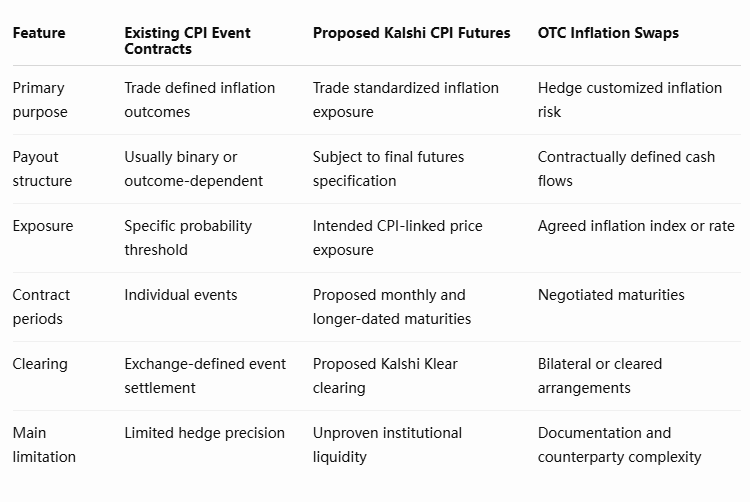
The proposed maturity schedule is potentially important because inflation exposure extends beyond the next economic release. Institutional investors may wish to manage risk associated with several months or years of inflation expectations, and a standardized contract curve could provide more flexibility than separate bets on individual announcements. Nevertheless, a longer maturity range would not automatically create usable liquidity across every contract. Trading activity often concentrates in nearby or benchmark maturities, leaving less frequently traded contracts with wider spreads and higher execution costs. Kalshi would need to support sufficiently consistent pricing and market-making activity for the proposed structure to become useful beyond the most immediate CPI releases.
Why Inflation Hedging Is Harder Than Predicting CPI
Predicting the direction of an inflation announcement and hedging the economic exposure created by inflation are fundamentally different activities. An investor can correctly anticipate that CPI will exceed a market consensus estimate without necessarily holding an instrument that offsets losses elsewhere in a portfolio. Inflation affects nominal bond yields, real interest rates, central bank expectations, corporate financing costs, and the valuation of financial assets through different channels. The relationship between a particular CPI release and the value of a bond or interest-rate futures position can therefore be unstable. A contract tied directly to CPI may offer a more targeted source of inflation exposure, but its ability to hedge a portfolio depends on the instrument's settlement design, its sensitivity to the relevant inflation measure, and the period covered by the underlying liability or investment.
Consider an investment manager holding assets exposed to unexpectedly persistent inflation. The manager may seek protection against inflation outcomes above an assumed baseline, but a binary contract focused on whether the next month's CPI exceeds a threshold can produce a discontinuous payoff. A small difference between the published result and the threshold may determine the entire settlement outcome, while the portfolio's inflation sensitivity could vary more gradually. A futures contract referencing the relevant CPI measure could potentially offer a closer relationship between the hedge and the economic variable being managed. Even then, important differences would remain between realized CPI, market expectations, and the pricing of inflation-sensitive assets. Effective hedging requires examining these relationships rather than assuming every inflation-linked contract provides interchangeable protection.
Liquidity is the second major challenge. Inflation derivatives are used by sophisticated market participants who often require sizable transactions, reliable two-sided quotes, and the ability to adjust positions without excessive market impact. A contract could be conceptually well suited to hedging yet remain commercially unattractive if traders cannot enter or exit positions efficiently. Market makers must also be able to hedge their own exposures, manage collateral, and price the instrument consistently against related markets. For Kalshi, establishing these connections may prove more difficult than introducing the contracts themselves. The proposed product's eventual credibility will depend on whether banks and funds are prepared not only to express interest but also to commit trading capital and provide repeated market participation.
Can Kalshi Compete With Traditional Futures Exchanges?
Kalshi's proposal enters a market historically dominated by established derivatives infrastructure rather than prediction-market platforms. Exchanges such as CME Group and Intercontinental Exchange support extensive activity in interest-rate, bond, and related macroeconomic derivatives, while institutional inflation exposure can also be obtained through inflation swaps, inflation-linked government securities, and other instruments. The proposed CPI futures would not necessarily compete with every one of these products on identical terms. A standardized contract directly linked to the inflation index could serve a narrower purpose, potentially attracting investors who want a more explicit relationship between a published CPI measure and their trading exposure. Bloomberg reported that CME had previously attempted CPI futures but does not currently offer them, illustrating that product differentiation alone does not ensure the creation of a sustainable market.
Kalshi's existing institutional and regulatory infrastructure may provide an entry point, but the requirements of a professional futures market differ from those of event-based speculation. Banks and hedge funds typically assess clearing reliability, collateral efficiency, position limits, market-maker participation, pricing transparency, and the availability of instruments used to hedge related exposures. They also consider whether adopting a new exchange creates operational expenses that outweigh the benefits of a specialized contract. Even where the proposed CPI futures have an attractive payoff design, they may struggle to attract institutional activity if traders can manage similar risks more efficiently through established instruments. Kalshi's challenge is to offer a sufficiently valuable form of inflation exposure while building the liquidity network required to make that exposure practical.
The proposed involvement of Michael Ashton provides relevant market expertise but should not be confused with evidence of future trading success. Product designers can improve contract specifications and establish relationships with potential participants, yet market depth ultimately emerges through repeated transactions between buyers, sellers, and liquidity providers. Institutions may initially test the futures with small positions before committing meaningful capital. The resulting market could grow gradually, concentrate around particular maturities, or remain limited if pricing differs substantially from related inflation instruments. These possibilities make realized trading volume and open interest more informative than the number of institutions approached during preliminary marketing.
What Would Institutional Adoption Actually Require?
The first meaningful indicator would be sustained two-sided liquidity across the contracts most relevant to institutional investors. Initial trading volume could be elevated by launch-related attention without demonstrating that the market supports routine risk management. A more durable measure would combine outstanding positions, bid-ask spreads, order-book depth, and the ability to execute larger transactions without significant price movement. Institutional traders would also need confidence that prices remain aligned with the underlying CPI reference and related inflation markets. Persistent pricing differences might create trading opportunities, but they could also discourage hedgers if they introduce uncertainty about the relationship between the futures contract and the exposure it is intended to manage.
Clearing and collateral requirements will influence adoption as well. Professional trading desks operate within established risk-management systems and evaluate how efficiently positions can be margined, financed, and settled. If the proposed products impose relatively high collateral requirements or cannot be integrated conveniently with existing risk processes, their usefulness may be limited despite attractive contract specifications. Conversely, an effective clearing model combined with reliable market-making could support adoption by institutions seeking more direct inflation exposure. These factors cannot be assessed fully until Kalshi publishes definitive contract rules, margin arrangements, and operational details. The current announcement establishes strategic intent rather than proven institutional market functionality.
MEXC View: Prediction Markets Need Institutional Market Structure
Kalshi's planned CPI futures illustrate a possible evolution in the relationship between prediction markets and traditional derivatives markets. Event contracts demonstrate that market prices can aggregate expectations about economic outcomes, but institutional financial markets require more than informative probabilities. They depend on products capable of transferring risk continuously, accommodating substantial positions, and maintaining executable prices across different market conditions. Kalshi is testing whether its existing exchange infrastructure and regulatory framework can support that more demanding function. Its earlier event-market model remains relevant, but the value proposition of CPI futures would be judged through hedge effectiveness and trading depth rather than predictive accuracy alone.
The distinction also affects how Kalshi should be compared with other prediction-market providers. As explained in MEXC's guide to Kalshi's regulated event contracts, the platform's existing products generally center on defined real-world outcomes. Inflation futures would move the business toward instruments designed for broader macroeconomic exposure. If the planned contracts attract sustained institutional participation, that development could demonstrate a path for prediction-market operators to expand into specialized derivatives infrastructure. If liquidity remains thin, the attempt would instead show why traditional futures exchanges retain advantages that cannot be replicated through contract innovation alone.
Kalshi Needs Liquidity, Not Just an Inflation Contract
Kalshi's proposed CPI futures represent a potentially significant expansion of its business model, but the most consequential development would not be the introduction of another inflation-linked product. It would be the creation of a market capable of supporting institutional transactions that existing event contracts cannot adequately accommodate. A platform built around defined economic outcomes may possess valuable experience in aggregating expectations, yet professional inflation risk management requires continuous pricing, reliable execution, sufficient collateral infrastructure, and instruments that correspond meaningfully to the risks investors need to manage.
The Kalshi CPI Futures initiative therefore poses a test of market structure rather than merely product innovation. Banks and hedge funds may have reasons to examine contracts directly tied to headline and core CPI, particularly when inflation uncertainty affects bond valuations, financing costs, and monetary policy expectations. However, a specialized exchange-traded contract will attract sustained use only if participants can enter, maintain, and close positions efficiently. The existence of a potential hedging need does not guarantee that an independently liquid market will develop around a newly introduced contract.
The next milestones are confirmation of the launch timetable, publication of final contract specifications, clarification of margin and clearing arrangements, and the participation of market makers. Once trading begins, open interest, executable spreads, market depth, and recurring institutional activity will provide a more reliable assessment of adoption than initial volume alone.
Kalshi's opportunity lies in bringing more direct inflation exposure to a standardized exchange environment, but its ability to compete with established derivatives infrastructure will depend on the liquidity and risk-transfer capacity it can build around that product. Until those conditions are demonstrated, the planned expansion remains a promising market-structure experiment rather than proof that prediction markets have successfully entered institutional macro derivatives trading.
Sources
Bloomberg — Kalshi Taps Inflation Guy to Break Into $8 Trillion Market, October 23, 2026:
https://news.bloomberglaw.com/banking-law/kalshi-taps-inflation-guy-to-break-into-8-trillion-market-1
Kalshi — Existing Inflation Prediction Markets:
https://kalshi.com/category/economics/inflation
Risk Disclaimer: This article is for reference only and does not constitute investment advice. The cryptocurrency market is highly volatile. Please make decisions cautiously based on your individual circumstances.
More Related News
Stay ahead of the curve with Trending News—your daily pulse on the crypto and traditional finance markets. We cut through the noise to bring you the most critical headlines, macro shifts, and market-moving events as they happen. From breaking regulatory updates to sudden price actions and institutional trends, this is where you'll find real-time insights to keep your trading strategy sharp and informed.
Comments
Only preset comments and emojis can be selected