Monad co-founder Keone Hon has issued a public warning after scammers infiltrated the project’s official Telegram channel with fake advertisements mimicking the network’s upcoming airdrop claim portal. The incident occurred just a few hours before the highly anticipated launch of the MON token, raising fresh concerns over phishing campaigns targeting crypto users ahead of token distributions. In a post on X, Hon cautioned users not to click on any advertisements appearing within Monad’s official Telegram announcement channel, noting that malicious actors had purchased Telegram ads that appeared inside the project’s verified space. “Crazy that Telegram will push content directly into a channel that otherwise only contains content from one party,” he wrote. Monad Tightens Security Ahead of MON Airdrop, Warns of Fake Claim Portals Hon confirmed that the team is working to have the fake ads removed and stressed that the only legitimate link for the airdrop claim is claim(.)monad(.)xyz. The Monad airdrop claim portal is scheduled to open at 1:00 pm UTC on Tuesday and will remain accessible for three weeks, according to the team. Hon urged users to exercise caution and avoid acting with urgency, emphasizing that there is no need to rush. “Do not act with urgency, and always triple-verify before doing anything,” he said. Monad Growth Lead Kevin McCordic reiterated the warning, reminding users to rely solely on official announcements and confirming that a detailed blog post will be published to explain the airdrop process. He noted that, unlike previous token distributions that required user verification, Monad’s airdrop will involve a specific time window during which users can complete tasks to claim their tokens. Despite the fraudulent ads, anticipation for the MON token remains high. The yet-to-launch token is already trading on Hyperliquid’s perpetual futures market at around $0.07, implying a fully diluted valuation (FDV) of about $7 billion, based on a total supply of 100 billion tokens.Source: Hyperliquid Monad, founded in 2022 by former Jump Crypto executive Keone Hon, has drawn considerable attention for its goal of creating a high-performance, EVM-compatible layer-1 blockchain. The network claims it can process up to 10,000 transactions per second (TPS) with near-instant finality through parallel execution and an optimized consensus layer. The project says it has overcome the so-called blockchain trilemma, balancing scalability, security, and decentralization. Monad has attracted considerable investor interest, raising $225 million in 2024 through a funding round led by crypto venture firm Paradigm. Its testnet, launched in February, has already built an active ecosystem spanning DeFi applications, NFTs, gaming, meme tokens, and prediction markets. Users have been experimenting with testnet MON tokens, though the team has not confirmed whether testnet activity will influence token allocations. Crypto Projects Face Growing Scam Threats as Telegram Fraud Soars in 2025 Telegram’s ad policy explicitly prohibits deceptive and phishing content, but the platform’s system allowed scammers to purchase ads directly targeted at Monad’s channel. The incident shows the growing risks facing crypto projects during major token events, as scammers attempt to exploit heightened community engagement and investor excitement. Crypto scams on Telegram have surged sharply in 2025, with blockchain security firms warning that social platforms are becoming the primary channel for sophisticated fraud. In September, THORChain co-founder JP lost $1.35 million in a Telegram-linked phishing attack believed to involve North Korean hackers. The incident combined a hijacked Telegram account, a deepfake Zoom call, and what JP suspects was a zero-day exploit. JP revealed that attackers may have accessed his encrypted iCloud Keychain, where old MetaMask keys were stored. He urged users to avoid cloud backups and adopt multi-signature wallets to reduce risks. The case adds to a growing list of Telegram-related thefts. Data from Crystal Intelligence shows that investors lost $2.2 billion to scams and wallet breaches in the first half of 2025 alone. Scam Sniffer reported that malware scams on Telegram have spiked 2,000% since November 2024, often spread through fake bots and phishing groups posing as trading or airdrop communities. Authorities are taking notice. The North American Securities Administrators Association recently labeled crypto and social media fraud as the top investor threats of 2025, citing the rise of AI-generated content and deepfakes that make scams harder to detect. Security researchers warn that Telegram remains a central hub for “scam-as-a-service” operations, a growing ecosystem fueling billions in crypto crime each yearMonad co-founder Keone Hon has issued a public warning after scammers infiltrated the project’s official Telegram channel with fake advertisements mimicking the network’s upcoming airdrop claim portal. The incident occurred just a few hours before the highly anticipated launch of the MON token, raising fresh concerns over phishing campaigns targeting crypto users ahead of token distributions. In a post on X, Hon cautioned users not to click on any advertisements appearing within Monad’s official Telegram announcement channel, noting that malicious actors had purchased Telegram ads that appeared inside the project’s verified space. “Crazy that Telegram will push content directly into a channel that otherwise only contains content from one party,” he wrote. Monad Tightens Security Ahead of MON Airdrop, Warns of Fake Claim Portals Hon confirmed that the team is working to have the fake ads removed and stressed that the only legitimate link for the airdrop claim is claim(.)monad(.)xyz. The Monad airdrop claim portal is scheduled to open at 1:00 pm UTC on Tuesday and will remain accessible for three weeks, according to the team. Hon urged users to exercise caution and avoid acting with urgency, emphasizing that there is no need to rush. “Do not act with urgency, and always triple-verify before doing anything,” he said. Monad Growth Lead Kevin McCordic reiterated the warning, reminding users to rely solely on official announcements and confirming that a detailed blog post will be published to explain the airdrop process. He noted that, unlike previous token distributions that required user verification, Monad’s airdrop will involve a specific time window during which users can complete tasks to claim their tokens. Despite the fraudulent ads, anticipation for the MON token remains high. The yet-to-launch token is already trading on Hyperliquid’s perpetual futures market at around $0.07, implying a fully diluted valuation (FDV) of about $7 billion, based on a total supply of 100 billion tokens.Source: Hyperliquid Monad, founded in 2022 by former Jump Crypto executive Keone Hon, has drawn considerable attention for its goal of creating a high-performance, EVM-compatible layer-1 blockchain. The network claims it can process up to 10,000 transactions per second (TPS) with near-instant finality through parallel execution and an optimized consensus layer. The project says it has overcome the so-called blockchain trilemma, balancing scalability, security, and decentralization. Monad has attracted considerable investor interest, raising $225 million in 2024 through a funding round led by crypto venture firm Paradigm. Its testnet, launched in February, has already built an active ecosystem spanning DeFi applications, NFTs, gaming, meme tokens, and prediction markets. Users have been experimenting with testnet MON tokens, though the team has not confirmed whether testnet activity will influence token allocations. Crypto Projects Face Growing Scam Threats as Telegram Fraud Soars in 2025 Telegram’s ad policy explicitly prohibits deceptive and phishing content, but the platform’s system allowed scammers to purchase ads directly targeted at Monad’s channel. The incident shows the growing risks facing crypto projects during major token events, as scammers attempt to exploit heightened community engagement and investor excitement. Crypto scams on Telegram have surged sharply in 2025, with blockchain security firms warning that social platforms are becoming the primary channel for sophisticated fraud. In September, THORChain co-founder JP lost $1.35 million in a Telegram-linked phishing attack believed to involve North Korean hackers. The incident combined a hijacked Telegram account, a deepfake Zoom call, and what JP suspects was a zero-day exploit. JP revealed that attackers may have accessed his encrypted iCloud Keychain, where old MetaMask keys were stored. He urged users to avoid cloud backups and adopt multi-signature wallets to reduce risks. The case adds to a growing list of Telegram-related thefts. Data from Crystal Intelligence shows that investors lost $2.2 billion to scams and wallet breaches in the first half of 2025 alone. Scam Sniffer reported that malware scams on Telegram have spiked 2,000% since November 2024, often spread through fake bots and phishing groups posing as trading or airdrop communities. Authorities are taking notice. The North American Securities Administrators Association recently labeled crypto and social media fraud as the top investor threats of 2025, citing the rise of AI-generated content and deepfakes that make scams harder to detect. Security researchers warn that Telegram remains a central hub for “scam-as-a-service” operations, a growing ecosystem fueling billions in crypto crime each year

Monad Co-Founder’s Urgent Warning: Scammers Infiltrate Official Telegram With Fake Airdrop Ads

2025/10/15 06:11
4 min read

Monad co-founder Keone Hon has issued a public warning after scammers infiltrated the project’s official Telegram channel with fake advertisements mimicking the network’s upcoming airdrop claim portal.

The incident occurred just a few hours before the highly anticipated launch of the MON token, raising fresh concerns over phishing campaigns targeting crypto users ahead of token distributions.

In a post on X, Hon cautioned users not to click on any advertisements appearing within

Monad’s official Telegram announcement channel, noting that malicious actors had purchased Telegram ads that appeared inside the project’s verified space.

“Crazy that Telegram will push content directly into a channel that otherwise only contains content from one party,” he wrote.

Monad Tightens Security Ahead of MON Airdrop, Warns of Fake Claim Portals

Hon confirmed that the team is working to have the fake ads removed and stressed that the only legitimate link for the airdrop claim is claim(.)monad(.)xyz.

The Monad airdrop claim portal is scheduled to open at 1:00 pm UTC on Tuesday and will remain accessible for three weeks, according to the team.

Hon urged users to exercise caution and avoid acting with urgency, emphasizing that there is no need to rush. “Do not act with urgency, and always triple-verify before doing anything,” he said.

Monad Growth Lead Kevin McCordic reiterated the warning, reminding users to rely solely on official announcements and confirming that a detailed blog post will be published to explain the airdrop process.

He noted that, unlike previous token distributions that required user verification, Monad’s airdrop will involve a specific time window during which users can complete tasks to claim their tokens.

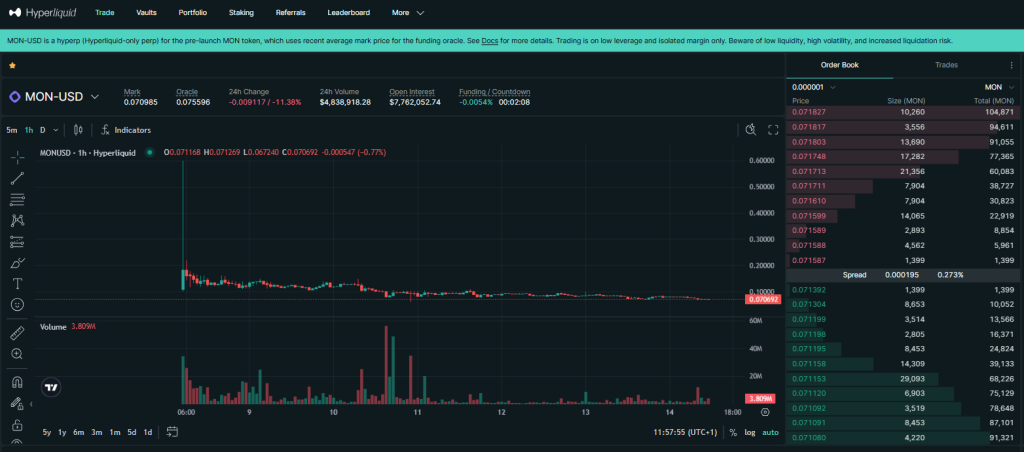
Despite the fraudulent ads, anticipation for the MON token remains high. The yet-to-launch token is already trading on Hyperliquid’s perpetual futures market at around $0.07, implying a fully diluted valuation (FDV) of about $7 billion, based on a total supply of 100 billion tokens.
Source: Hyperliquid

Monad, founded in 2022 by former Jump Crypto executive Keone Hon, has drawn considerable attention for its goal of creating a high-performance, EVM-compatible layer-1 blockchain.

The network claims it can process up to 10,000 transactions per second (TPS) with near-instant finality through parallel execution and an optimized consensus layer.

The project says it has overcome the so-called blockchain trilemma, balancing scalability, security, and decentralization.

Monad has attracted considerable investor interest, raising $225 million in 2024 through a funding round led by crypto venture firm Paradigm. Its testnet, launched in February, has already built an active ecosystem spanning DeFi applications, NFTs, gaming, meme tokens, and prediction markets.

Users have been experimenting with testnet MON tokens, though the team has not confirmed whether testnet activity will influence token allocations.

Crypto Projects Face Growing Scam Threats as Telegram Fraud Soars in 2025

Telegram’s ad policy explicitly prohibits deceptive and phishing content, but the platform’s system allowed scammers to purchase ads directly targeted at Monad’s channel.

The incident shows the growing risks facing crypto projects during major token events, as scammers attempt to exploit heightened community engagement and investor excitement.

Crypto scams on Telegram have surged sharply in 2025, with blockchain security firms warning that social platforms are becoming the primary channel for sophisticated fraud.

In September, THORChain co-founder JP lost $1.35 million in a Telegram-linked phishing attack believed to involve North Korean hackers. The incident combined a hijacked Telegram account, a deepfake Zoom call, and what JP suspects was a zero-day exploit.

JP revealed that attackers may have accessed his encrypted iCloud Keychain, where old MetaMask keys were stored. He urged users to avoid cloud backups and adopt multi-signature wallets to reduce risks.

The case adds to a growing list of Telegram-related thefts. Data from Crystal Intelligence shows that investors lost $2.2 billion to scams and wallet breaches in the first half of 2025 alone.

Scam Sniffer reported that malware scams on Telegram have spiked 2,000% since November 2024, often spread through fake bots and phishing groups posing as trading or airdrop communities.

Authorities are taking notice. The North American Securities Administrators Association recently labeled crypto and social media fraud as the top investor threats of 2025, citing the rise of AI-generated content and deepfakes that make scams harder to detect.

Security researchers warn that Telegram remains a central hub for “scam-as-a-service” operations, a growing ecosystem fueling billions in crypto crime each year.

Disclaimer: The articles reposted on this site are sourced from public platforms and are provided for informational purposes only. They do not necessarily reflect the views of MEXC. All rights remain with the original authors. If you believe any content infringes on third-party rights, please contact [email protected] for removal. MEXC makes no guarantees regarding the accuracy, completeness, or timeliness of the content and is not responsible for any actions taken based on the information provided. The content does not constitute financial, legal, or other professional advice, nor should it be considered a recommendation or endorsement by MEXC.

You May Also Like

MoneyGram launches stablecoin-powered app in Colombia

MoneyGram launches stablecoin-powered app in Colombia

The post MoneyGram launches stablecoin-powered app in Colombia appeared on BitcoinEthereumNews.com. MoneyGram has launched a new mobile application in Colombia that uses USD-pegged stablecoins to modernize cross-border remittances. According to an announcement on Wednesday, the app allows customers to receive money instantly into a US dollar balance backed by Circle’s USDC stablecoin, which can be stored, spent, or cashed out through MoneyGram’s global retail network. The rollout is designed to address the volatility of local currencies, particularly the Colombian peso. Built on the Stellar blockchain and supported by wallet infrastructure provider Crossmint, the app marks MoneyGram’s most significant move yet to integrate stablecoins into consumer-facing services. Colombia was selected as the first market due to its heavy reliance on inbound remittances—families in the country receive more than 22 times the amount they send abroad, according to Statista. The announcement said future expansions will target other remittance-heavy markets. MoneyGram, which has nearly 500,000 retail locations globally, has experimented with blockchain rails since partnering with the Stellar Development Foundation in 2021. It has since built cash on and off ramps for stablecoins, developed APIs for crypto integration, and incorporated stablecoins into its internal settlement processes. “This launch is the first step toward a world where every person, everywhere, has access to dollar stablecoins,” CEO Anthony Soohoo stated. The company emphasized compliance, citing decades of regulatory experience, though stablecoin oversight remains fluid. The US Congress passed the GENIUS Act earlier this year, establishing a framework for stablecoin regulation, which MoneyGram has pointed to as providing clearer guardrails. This is a developing story. This article was generated with the assistance of AI and reviewed by editor Jeffrey Albus before publication. Get the news in your inbox. Explore Blockworks newsletters: Source: https://blockworks.co/news/moneygram-stablecoin-app-colombia
Share
BitcoinEthereumNews2025/09/18 07:04
Pluvo Raises $5M Seed Round to Build the AI Decision Intelligence Platform for Modern Finance Teams

Pluvo Raises $5M Seed Round to Build the AI Decision Intelligence Platform for Modern Finance Teams

Backed by Andreessen Horowitz’s a16z speedrun, Pluvo is redefining how CFOs turn data into decisions with AI-powered financial analysis. OTTAWA, Ontario–(BUSINESS
Share
AI Journal2026/02/28 03:15
TMTG in talks with TAE and Texas Ventures III about spinning Truth Social and related businesses into SpinCo

TMTG in talks with TAE and Texas Ventures III about spinning Truth Social and related businesses into SpinCo

Truth Social sits at the center of a corporate plan that could separate Truth Media from the rest of Trump Media & Technology Group Corp. Trump Media & Technology
Share
Cryptopolitan2026/02/28 03:30