

BlockchainFX Surges Past $9.5m as Polkadot and Cardano Face Growth Crossroads After Market Crash Last Week

As they navigate scaling challenges and adoption plateaus, BlockchainFX ($BFX) is gaining renewed attention. With its presale price now at $0.028 and a promise of decentralised, multi-asset trading, staking incentives, and integrated utility, BFX is positioning itself as a serious contender in the evolving infrastructure landscape.
Presale Mechanics: BFX at $0.028 and Rising
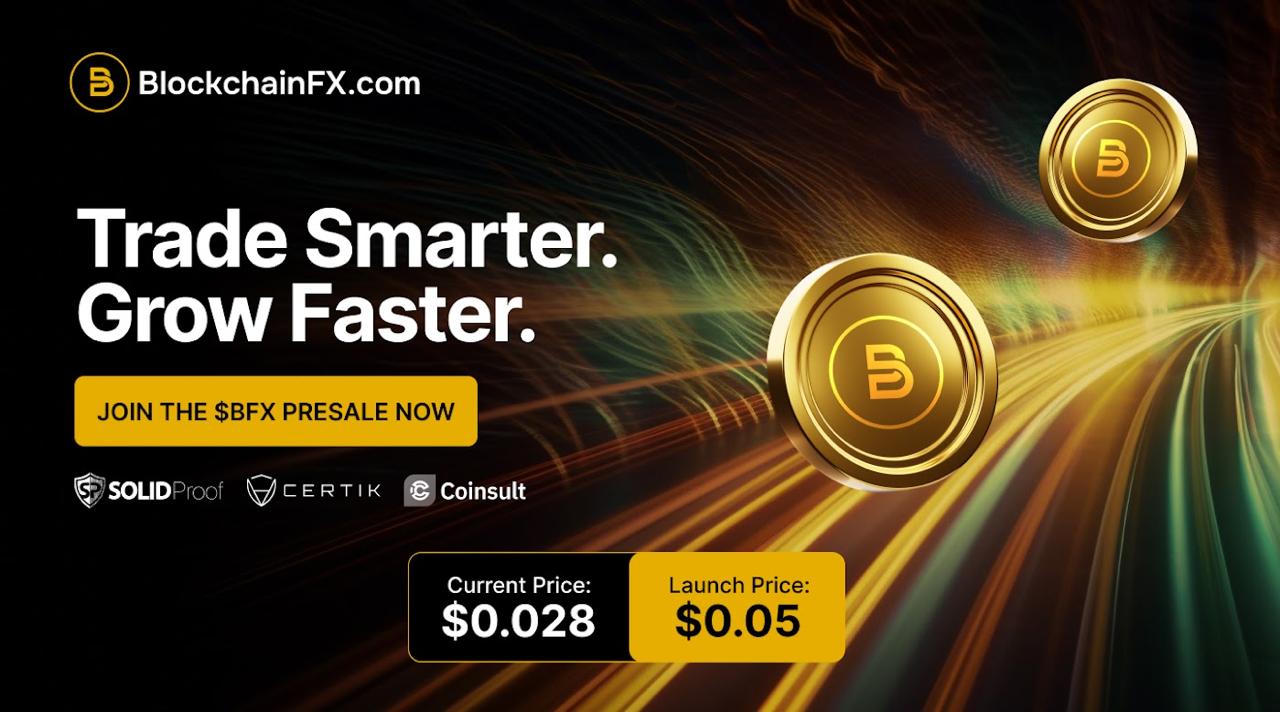
BlockchainFX’s presale is designed to reward early entrants. At present, the token is priced at $0.028, with the market launch target set at $0.05. Each presale tier completion increases the price, motivating earlier participation. A 30 % bonus via the BLOCK30 code further amplifies early demand. The structure aims to build momentum and align early investors with the platform’s growth trajectory.
Polkadot’s Interoperability Promise and Current Stagnation
Polkadot, trading around $4.19, continues to position itself as a powerful interoperability protocol. Its parachain model and cross-chain ambitions are foundational to its long-term vision. However, the complexity of parachain auctions, liquidity fragmentation, and a slow developer onboarding curve have constrained some of its momentum.
Furthermore, as new infrastructure platforms emerge, Polkadot’s reliance on other chains to deliver user-facing applications limits how directly it can capture value from decentralised finance and multi-asset innovation. In this context, BlockchainFX’s more integrated approach may seem more pragmatic to developers and users who prioritise accessibility over modular architecture.
Cardano’s Development Discipline and Growing Pressure
Cardano is currently trading near $0.82. It has earned respect for its methodical, peer-reviewed development, commitment to governance, and energy-efficient proof-of-stake design.
Yet, that precision has sometimes come at the cost of speed. Late rollouts of features and a smaller footprint of live dApps have frustrated parts of the community. The challenge for Cardano is translating its technical credibility into sustained user growth and cross-market utility. BlockchainFX’s design, which integrates staking, trading, and real-world payment use, may appeal more directly to users seeking everyday usability rather than long gestation periods.
Staking Design: Aligning Rewards with Platform Growth
BlockchainFX introduces a staking and fee redistribution system as a central pillar of its economy. From every trade, 70 % of fees are allocated to staking rewards, buybacks, and token burns. Half of those fees go directly to token stakers; 20 % support daily token buybacks; and half of repurchased tokens are burned permanently.
Staking rewards are capped at $25,000 USDT per day to maintain balance and guard against inflationary dilution. The design is intended to reward participation while slowly reducing circulating supply — a contrast with some legacy systems where staking dynamics are less directly tied to utility and growth.
Compared with Polkadot and Cardano, which primarily allocate rewards for network security or protocol upgrades, BFX’s approach more tightly binds user incentives to the platform’s broader activity.
Multi-Asset Trading: Bridging Crypto and Traditional Finance
One of BlockchainFX’s hallmark ambitions is enabling users to trade across multiple asset classes — crypto, equities, forex, and ETFs — within a single decentralised environment. This cross-market integration is intended to reduce friction for users seeking portfolio diversity without managing multiple platforms.
Polkadot’s design focuses on blockchain infrastructure and interoperability, and Cardano centres on layered protocol development. Neither currently offers built-in access to traditional financial markets. For users who want flexibility beyond crypto, BFX’s approach could be compelling, especially in periods when cross-asset hedging and diversification matter.
To bridge digital and real-world usage, BlockchainFX plans a presale-exclusive Visa card (offered in metal or 18-karat gold). Users will be able to top up the card using BFX and over 20 cryptocurrencies, make transactions up to $100,000, and withdraw up to $10,000 per month from ATMs. Most notably, staking and trading rewards can be spent directly via the card.
This feature converts blockchain participation into immediate utility — a notable step beyond many token ecosystems, including those of Polkadot and Cardano, where utility remains mainly within the blockchain sphere.

Navigating Market Sentiment in 2025
Polkadot and Cardano have built reputational capital, but in 2025’s evolving climate, questions about agility, utility, and ecosystem adaptability are more important than ever. BlockchainFX’s presale momentum, integrated tokenomics, multi-asset vision, and real-world usability suggest a different direction — one focused on blending decentralised infrastructure with accessible financial functionality.
If users and developers increasingly favour platforms offering both technical depth and usability, BlockchainFX may well become one of the most closely watched names of this cycle.
Website: https://blockchainfx.com/
X: https://x.com/BlockchainFXcom
Telegram Chat: https://t.me/blockchainfx_chat
This publication is sponsored. Coindoo does not endorse or assume responsibility for the content, accuracy, quality, advertising, products, or any other materials on this page. Readers are encouraged to conduct their own research before engaging in any cryptocurrency-related actions. Coindoo will not be liable, directly or indirectly, for any damages or losses resulting from the use of or reliance on any content, goods, or services mentioned. Always do your own research.
The post BlockchainFX Surges Past $9.5m as Polkadot and Cardano Face Growth Crossroads After Market Crash Last Week appeared first on Coindoo.
You May Also Like

The Channel Factories We’ve Been Waiting For

Polygon Tops RWA Rankings With $1.1B in Tokenized Assets
