Balancer, one of the most established decentralized finance (DeFi) protocols with more than $700 million in total value locked (TVL), appears to have suffered a serious exploit, adding fresh stress to an industry still grappling with security concerns. Early on-chain evidence indicates that attackers drained assets across multiple chains, with losses now exceeding $98 million, making this one of the largest DeFi breaches of 2025 so far. Related Reading: Bitmine Buys 44,036 Ethereum Worth $166M During Market Dip – Details The attack appears to have targeted Balancer liquidity pools, siphoning high-value assets including wrapped ETH and liquid-staking derivatives through coordinated cross-chain movements. Initial wallet traces show funds rapidly routed through mixing services and bridge networks. This suggests a sophisticated operation designed to minimize traceability. This is not the first time Balancer has faced a security incident, and the scale of this exploit reignites conversations around protocol hardening, liquidity pool design risk, and cross-chain attack vectors. It also deals a blow to market confidence at a time when institutional interest in DeFi infrastructure has been slowly recovering. Over $98M in ETH-Based Assets Drained as Market Weakness Adds Pressure According to on-chain data compiled by Lookonchain, the Balancer exploit resulted in the loss of a significant amount of high-value Ethereum-based assets. Among the stolen funds were 6,587 WETH (worth approximately $24.46 million), 6,851 osETH (valued around $26.86 million), and 4,260 wstETH (roughly $19.27 million). These figures confirm that the attacker targeted core liquidity holdings, particularly liquid-staking assets and wrapped Ether. Assets commonly used in advanced DeFi strategies and institutional portfolios. The scale of outflows highlights the exploit’s severity and underscores persistent vulnerabilities in cross-chain and liquidity-pool architecture. More importantly, this incident has arrived at a sensitive moment for the market. Ethereum is already under selling pressure, struggling to reclaim key levels amid broader crypto market weakness. Risk appetite has thinned, liquidity has become more selective, and sentiment remains fragile following recent volatility. The Balancer breach adds another layer of stress to an ecosystem trying to regain its footing. Major exploits like this serve as a stark reminder that smart-contract risk remains one of the sector’s biggest challenges. With investors already cautious, the timing amplifies uncertainty — and the market’s reaction in the coming days will be a critical test for confidence across the Ethereum and DeFi landscape. Related Reading: Bitcoin Point Of Control Sits At $117K – Key Battle Zone For Bulls Balancer (BAL) Trades Near Cycle Lows as Sellers Maintain Control Balancer’s native token BAL continues to trade under heavy pressure, now sitting near $0.97 and hovering close to multi-year lows. The weekly chart reflects persistent weakness, with price trending steadily downward since mid-2024 and repeatedly failing to reclaim key moving averages. The 50-week and 100-week moving averages remain firmly above price and slope downward, reinforcing a long-term bearish structure and signaling that momentum remains with sellers. Recent attempts to rebound have been shallow and short-lived. Indicating limited buying interest and a reluctance from market participants to position aggressively following the latest exploit news. This weakness predates the incident. However, BAL has been in a consistent downtrend for months, struggling to sustain demand even during broader market relief phases. Related Reading: $780M Worth of Ethereum Pulled From Exchanges – Biggest Withdrawal Spike in Weeks With the token sitting near its post-listing lows, the market is in a “show-me” phase. Bulls need to reclaim at least the $1.20–$1.40 area and break above the 50-week moving average to challenge the prevailing downtrend. Failure to do so risks deeper price compression and potential price discovery lower. Featured image from ChatGPT, chart from TradingView.comBalancer, one of the most established decentralized finance (DeFi) protocols with more than $700 million in total value locked (TVL), appears to have suffered a serious exploit, adding fresh stress to an industry still grappling with security concerns. Early on-chain evidence indicates that attackers drained assets across multiple chains, with losses now exceeding $98 million, making this one of the largest DeFi breaches of 2025 so far. Related Reading: Bitmine Buys 44,036 Ethereum Worth $166M During Market Dip – Details The attack appears to have targeted Balancer liquidity pools, siphoning high-value assets including wrapped ETH and liquid-staking derivatives through coordinated cross-chain movements. Initial wallet traces show funds rapidly routed through mixing services and bridge networks. This suggests a sophisticated operation designed to minimize traceability. This is not the first time Balancer has faced a security incident, and the scale of this exploit reignites conversations around protocol hardening, liquidity pool design risk, and cross-chain attack vectors. It also deals a blow to market confidence at a time when institutional interest in DeFi infrastructure has been slowly recovering. Over $98M in ETH-Based Assets Drained as Market Weakness Adds Pressure According to on-chain data compiled by Lookonchain, the Balancer exploit resulted in the loss of a significant amount of high-value Ethereum-based assets. Among the stolen funds were 6,587 WETH (worth approximately $24.46 million), 6,851 osETH (valued around $26.86 million), and 4,260 wstETH (roughly $19.27 million). These figures confirm that the attacker targeted core liquidity holdings, particularly liquid-staking assets and wrapped Ether. Assets commonly used in advanced DeFi strategies and institutional portfolios. The scale of outflows highlights the exploit’s severity and underscores persistent vulnerabilities in cross-chain and liquidity-pool architecture. More importantly, this incident has arrived at a sensitive moment for the market. Ethereum is already under selling pressure, struggling to reclaim key levels amid broader crypto market weakness. Risk appetite has thinned, liquidity has become more selective, and sentiment remains fragile following recent volatility. The Balancer breach adds another layer of stress to an ecosystem trying to regain its footing. Major exploits like this serve as a stark reminder that smart-contract risk remains one of the sector’s biggest challenges. With investors already cautious, the timing amplifies uncertainty — and the market’s reaction in the coming days will be a critical test for confidence across the Ethereum and DeFi landscape. Related Reading: Bitcoin Point Of Control Sits At $117K – Key Battle Zone For Bulls Balancer (BAL) Trades Near Cycle Lows as Sellers Maintain Control Balancer’s native token BAL continues to trade under heavy pressure, now sitting near $0.97 and hovering close to multi-year lows. The weekly chart reflects persistent weakness, with price trending steadily downward since mid-2024 and repeatedly failing to reclaim key moving averages. The 50-week and 100-week moving averages remain firmly above price and slope downward, reinforcing a long-term bearish structure and signaling that momentum remains with sellers. Recent attempts to rebound have been shallow and short-lived. Indicating limited buying interest and a reluctance from market participants to position aggressively following the latest exploit news. This weakness predates the incident. However, BAL has been in a consistent downtrend for months, struggling to sustain demand even during broader market relief phases. Related Reading: $780M Worth of Ethereum Pulled From Exchanges – Biggest Withdrawal Spike in Weeks With the token sitting near its post-listing lows, the market is in a “show-me” phase. Bulls need to reclaim at least the $1.20–$1.40 area and break above the 50-week moving average to challenge the prevailing downtrend. Failure to do so risks deeper price compression and potential price discovery lower. Featured image from ChatGPT, chart from TradingView.com

Balancer Protocol Sees $70M Exit In Suspected Crypto Exploit

2025/11/04 02:00
3 min read

Balancer, one of the most established decentralized finance (DeFi) protocols with more than $700 million in total value locked (TVL), appears to have suffered a serious exploit, adding fresh stress to an industry still grappling with security concerns. Early on-chain evidence indicates that attackers drained assets across multiple chains, with losses now exceeding $98 million, making this one of the largest DeFi breaches of 2025 so far.

The attack appears to have targeted Balancer liquidity pools, siphoning high-value assets including wrapped ETH and liquid-staking derivatives through coordinated cross-chain movements. Initial wallet traces show funds rapidly routed through mixing services and bridge networks. This suggests a sophisticated operation designed to minimize traceability.

Balancer Hacker Portfolio | Source: Lookonchain

This is not the first time Balancer has faced a security incident, and the scale of this exploit reignites conversations around protocol hardening, liquidity pool design risk, and cross-chain attack vectors. It also deals a blow to market confidence at a time when institutional interest in DeFi infrastructure has been slowly recovering.

Over $98M in ETH-Based Assets Drained as Market Weakness Adds Pressure

According to on-chain data compiled by Lookonchain, the Balancer exploit resulted in the loss of a significant amount of high-value Ethereum-based assets. Among the stolen funds were 6,587 WETH (worth approximately $24.46 million), 6,851 osETH (valued around $26.86 million), and 4,260 wstETH (roughly $19.27 million). These figures confirm that the attacker targeted core liquidity holdings, particularly liquid-staking assets and wrapped Ether. Assets commonly used in advanced DeFi strategies and institutional portfolios.

Balancer Vault Transfers | Source: Etherescan

The scale of outflows highlights the exploit’s severity and underscores persistent vulnerabilities in cross-chain and liquidity-pool architecture. More importantly, this incident has arrived at a sensitive moment for the market. Ethereum is already under selling pressure, struggling to reclaim key levels amid broader crypto market weakness. Risk appetite has thinned, liquidity has become more selective, and sentiment remains fragile following recent volatility.

The Balancer breach adds another layer of stress to an ecosystem trying to regain its footing. Major exploits like this serve as a stark reminder that smart-contract risk remains one of the sector’s biggest challenges. With investors already cautious, the timing amplifies uncertainty — and the market’s reaction in the coming days will be a critical test for confidence across the Ethereum and DeFi landscape.

Balancer (BAL) Trades Near Cycle Lows as Sellers Maintain Control

Balancer’s native token BAL continues to trade under heavy pressure, now sitting near $0.97 and hovering close to multi-year lows. The weekly chart reflects persistent weakness, with price trending steadily downward since mid-2024 and repeatedly failing to reclaim key moving averages. The 50-week and 100-week moving averages remain firmly above price and slope downward, reinforcing a long-term bearish structure and signaling that momentum remains with sellers.
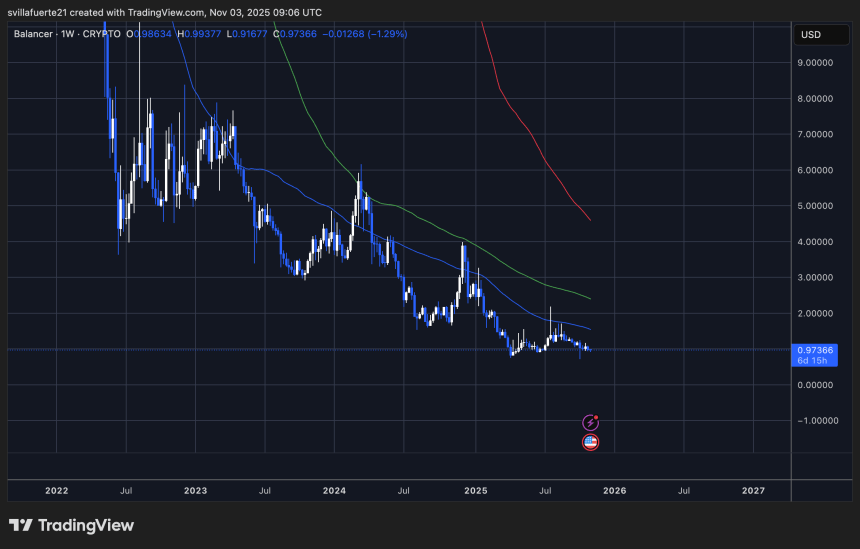
BAL price showing weakness | Source: BALUSDT chart on TradingView

Recent attempts to rebound have been shallow and short-lived. Indicating limited buying interest and a reluctance from market participants to position aggressively following the latest exploit news. This weakness predates the incident. However, BAL has been in a consistent downtrend for months, struggling to sustain demand even during broader market relief phases.

With the token sitting near its post-listing lows, the market is in a “show-me” phase. Bulls need to reclaim at least the $1.20–$1.40 area and break above the 50-week moving average to challenge the prevailing downtrend. Failure to do so risks deeper price compression and potential price discovery lower.

Featured image from ChatGPT, chart from TradingView.com

Market Opportunity
DeFi Logo
DeFi Price(DEFI)
$0,000345
$0,000345$0,000345
-%2,26
USD
DeFi (DEFI) Live Price Chart
Disclaimer: The articles reposted on this site are sourced from public platforms and are provided for informational purposes only. They do not necessarily reflect the views of MEXC. All rights remain with the original authors. If you believe any content infringes on third-party rights, please contact [email protected] for removal. MEXC makes no guarantees regarding the accuracy, completeness, or timeliness of the content and is not responsible for any actions taken based on the information provided. The content does not constitute financial, legal, or other professional advice, nor should it be considered a recommendation or endorsement by MEXC.

You May Also Like

Best Crypto to Buy as Saylor & Crypto Execs Meet in US Treasury Council

Best Crypto to Buy as Saylor & Crypto Execs Meet in US Treasury Council

The post Best Crypto to Buy as Saylor & Crypto Execs Meet in US Treasury Council appeared on BitcoinEthereumNews.com. Michael Saylor and a group of crypto executives met in Washington, D.C. yesterday to push for the Strategic Bitcoin Reserve Bill (the BITCOIN Act), which would see the U.S. acquire up to 1M $BTC over five years. With Bitcoin being positioned yet again as a cornerstone of national monetary policy, many investors are turning their eyes to projects that lean into this narrative – altcoins, meme coins, and presales that could ride on the same wave. Read on for three of the best crypto projects that seem especially well‐suited to benefit from this macro shift:  Bitcoin Hyper, Best Wallet Token, and Remittix. These projects stand out for having a strong use case and high adoption potential, especially given the push for a U.S. Bitcoin reserve.   Why the Bitcoin Reserve Bill Matters for Crypto Markets The strategic Bitcoin Reserve Bill could mark a turning point for the U.S. approach to digital assets. The proposal would see America build a long-term Bitcoin reserve by acquiring up to one million $BTC over five years. To make this happen, lawmakers are exploring creative funding methods such as revaluing old gold certificates. The plan also leans on confiscated Bitcoin already held by the government, worth an estimated $15–20B. This isn’t just a headline for policy wonks. It signals that Bitcoin is moving from the margins into the core of financial strategy. Industry figures like Michael Saylor, Senator Cynthia Lummis, and Marathon Digital’s Fred Thiel are all backing the bill. They see Bitcoin not just as an investment, but as a hedge against systemic risks. For the wider crypto market, this opens the door for projects tied to Bitcoin and the infrastructure that supports it. 1. Bitcoin Hyper ($HYPER) – Turning Bitcoin Into More Than Just Digital Gold The U.S. may soon treat Bitcoin as…
Share
BitcoinEthereumNews2025/09/18 00:27
BlackRock boosts AI and US equity exposure in $185 billion models

BlackRock boosts AI and US equity exposure in $185 billion models

The post BlackRock boosts AI and US equity exposure in $185 billion models appeared on BitcoinEthereumNews.com. BlackRock is steering $185 billion worth of model portfolios deeper into US stocks and artificial intelligence. The decision came this week as the asset manager adjusted its entire model suite, increasing its equity allocation and dumping exposure to international developed markets. The firm now sits 2% overweight on stocks, after money moved between several of its biggest exchange-traded funds. This wasn’t a slow shuffle. Billions flowed across multiple ETFs on Tuesday as BlackRock executed the realignment. The iShares S&P 100 ETF (OEF) alone brought in $3.4 billion, the largest single-day haul in its history. The iShares Core S&P 500 ETF (IVV) collected $2.3 billion, while the iShares US Equity Factor Rotation Active ETF (DYNF) added nearly $2 billion. The rebalancing triggered swift inflows and outflows that realigned investor exposure on the back of performance data and macroeconomic outlooks. BlackRock raises equities on strong US earnings The model updates come as BlackRock backs the rally in American stocks, fueled by strong earnings and optimism around rate cuts. In an investment letter obtained by Bloomberg, the firm said US companies have delivered 11% earnings growth since the third quarter of 2024. Meanwhile, earnings across other developed markets barely touched 2%. That gap helped push the decision to drop international holdings in favor of American ones. Michael Gates, lead portfolio manager for BlackRock’s Target Allocation ETF model portfolio suite, said the US market is the only one showing consistency in sales growth, profit delivery, and revisions in analyst forecasts. “The US equity market continues to stand alone in terms of earnings delivery, sales growth and sustainable trends in analyst estimates and revisions,” Michael wrote. He added that non-US developed markets lagged far behind, especially when it came to sales. This week’s changes reflect that position. The move was made ahead of the Federal…
Share
BitcoinEthereumNews2025/09/18 01:44
Trump Denies Involvement in $500M Abu Dhabi WLFI Stake

Trump Denies Involvement in $500M Abu Dhabi WLFI Stake

The post Trump Denies Involvement in $500M Abu Dhabi WLFI Stake appeared on BitcoinEthereumNews.com. US President Donald Trump has denied knowledge of a reported
Share
BitcoinEthereumNews2026/02/03 23:26