Top 5 Perpetual DEXs to Keep An Eye On
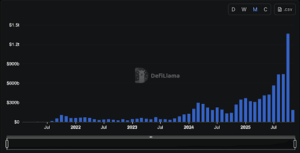
Decentralized perpetual exchanges (Perp DEXs) are emerging as one of DeFi’s fastest-growing verticals. According to DeFi Llama, their combined trading volume surpassed $1.3 trillion in October 2025, setting a new all-time high and signalling growing confidence in on-chain derivatives infrastructure.
This article provides an in-depth analysis of the evolving Perp DEX landscape. It will feature a comparison of the top 5 Perp DEXs to watch out for: they include Hyperliquid, Lighter, Grvt, dYdX and GMX. The listicle will go a step further to examine the LP vault strategies offered by these Perp DEXs, alongside other competitors like EdgeX, Paradex and Extended.
A Deep Dive into the Perp DEX Market
Two main types of architecture define the Perp DEX arena:
- Order book models – These are Perp DEXs that follow a similar order book model to the one implemented by centralized exchanges (CEXs). Out of the 5 projects featured in this analysis, 4 fall under this category: Grvt, dYdX, Lighter and Hyperliquid.
- Liquidity pool models – Unlike their counterparts, liquidity-based Perp DEXs are DeFi native; they use liquidity pools rather than order books to facilitate perpetual trading. A good example in this category is GMX.
The following section dives into the value proposition of each Perp DEX, product offerings, markets covered and the underlying tech stack.
Hyperliquid: Leading the Next Wave of Perp Adoption

Image Source: Hyperliquid
Hyperliquid is a high-ranking Perp Dex whose popularity surged following the debut of its native token $HYPE on November 29, 2024. According to DeFi Llama, it is currently the second Perp DEX in trading volume, with a 7-day trading volume of $58.14 billion. What stands out about this Perp Dex is that its initial launch was fully bootstrapped by the founding team, with the token going live through a community-first airdrop.
Hyperliquid’s primary focus is on perpetual futures contracts, but it also includes a spot exchange and LP vaults.
Crypto Perpetuals and Spot Trading
Traders can access 100+ perp and spot trading pairs, with leverages of between 3x and 50x, depending on the margin tier of a particular digital asset. The platform’s CLOB model also features advanced order types, including stop-loss, take-profit, cross-margin and isolated-margin trading functionalities. Hyperliquid has gone a step further to include spot trading in its offering, setting the stage for a public auction system for new token listings.
Hyperliquidity Provider (HLP)
Hyperliquid’s HLP vault is another standout feature: it is designed to enable users to deposit funds into pools dubbed vaults. In return, the vaults pay out an APY, with HLP currently averaging at 10.1%. Anyone can invest through HLP, given the permissionless nature of the DApp; however, there is a 4-day lock-up period.
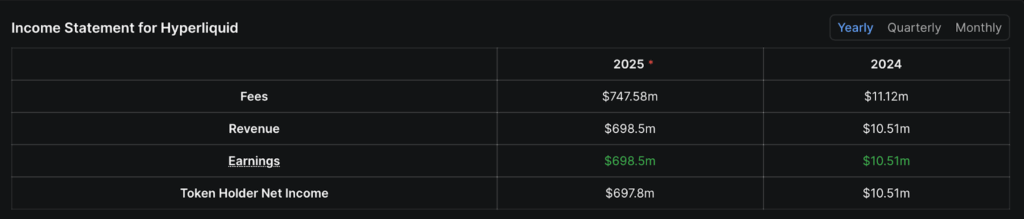
Hyperliquid annual income statement
Source: DeFi Llama
Architecture
The Hyperliquid DEX is powered by a dual-network design that merges HyperCore and HyperEVM into a unified Hyperliquid State. The HyperCore layer handles ultra-fast trading, processing up to 200,000 orders per second, and is safeguarded by the HyperBFT consensus mechanism.
Lighter: $1.5 Billion Valuation Before TGE
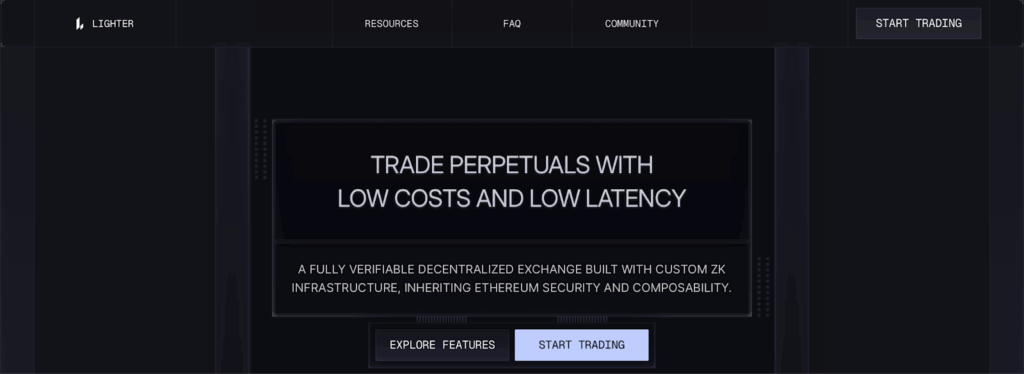
Image source: Lighter
Lighter is one of the Perp DEXs whose TGE is being eagerly awaited. The project raised $68 million in a recently concluded funding round at a valuation of $1.5 billion. This round was led by Peter Thiel’s Founders Fund, Haun Ventures and Ribbit Capital.
Perpetuals Trading
The main product of this Perp DEX is its trading environment; DeFi traders can experience a perpetual trading protocol that introduces some core aspects that are lacking in the traditional derivatives market. At the core, Lighter introduces a scalable, secure, transparent, non-custodial and verifiable order book within Ethereum’s ecosystem.
According to Coingecko, this Perp DEX currently supports 104 trading pairs, has $1.68 billion in open interest and a total value locked (TVL) of $1.15 billion.
Lighter Liquidity Pool (LLP)
Like its counterparts (Grvt and Hyperliquid), Lighter’s product portfolio also includes an LLP vault where users can earn a passive income from liquidity provision. The latest statistics indicate this vault yielded an APY of 45.84% as of 27th October. Notably, Lighter’s LLP has no lock-up period; however, there is an individual investment cap that is scalable with experience.
Architecture
Lighter is built as an Ethereum-anchored ZK roll-up. Lighter Core uses batched, zero-knowledge proofs for order-book matching and state transition integrity, enabling high-speed perpetual trading with full user custody. This Perp DEX already features multi-chain support for Ethereum, Base, Arbitrum and Avalanche.
Grvt: Bringing Privacy to the On-chain Perpetuals Landscape
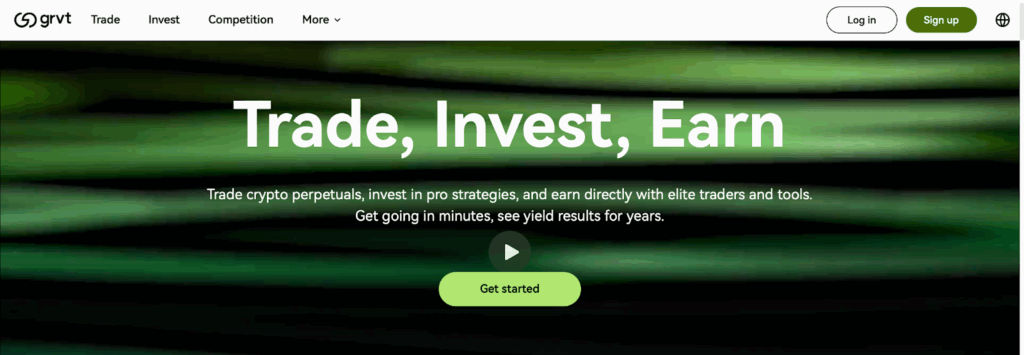
Image Source: Grvt
Grvt is positioned as a privacy-preserving Perp DEX that is powered by zero-knowledge (ZK) technology. The project recently closed a $19 million Series A funding round that was co-led by Grvt’s foundational technology partner ZKsync, Abu Dhabi-based investment firm Further Ventures, EigenCloud (formerly EigenLayer) and 500 Global.
Grvt’s core product suite consists of crypto perpetuals, invest strategies and a reward portal:
Crypto Perpetuals
Grvt’s crypto perpetuals trading suite currently supports 67 trading pairs. The platform allows users to trade perpetual contracts of major crypto trading pairs such as BTC/USDT and ETH/USDT, as well as lesser-known pairs like SUI/USDT and PUMP/USDT. Grvt offers up to 50x leverage on these pairs, with sub-millisecond settlement speeds and low transaction fees.
Grvt Strategies
Grvt Strategies enable users to allocate funds to trading strategies managed by professional entities, including institutional funds, market makers and elite traders:
- Investors deposit stablecoins (e.g, USDT) and receive on-chain tokens representing their ownership.
- Managers trade and execute strategies, but cannot withdraw investors’ capital.
- Performance, methods and allocation are all transparent and on-chain.
Grvt Liquidity Provider
Grvt also recently launched the GLP vault, a community-owned, delta-neutral market-making strategy that is designed to deliver stable and consistent returns for liquidity providers. GLP’s strategy has been battle-tested over 6 months in varied market conditions, recording an annualized performance of 48% APR and a Sharpe ratio of 7.6, which underscores its strong risk-adjusted performance.
Reward Portal
With its token generation event (TGE) yet to go live, Grvt is currently running a rewards system that allows users to earn points through trading activity, liquidity provision, referrals and investment. These points will later convert into allocations in the $Grvt token airdrop, expected in Q1 2026.
ZKsync Tech Stack – Atlas Upgrade
Grvt’s technical foundation leverages ZKsync Validium, a ZK Layer 2 framework designed to optimize performance and privacy. More notably, the latest ZKsync stack evolution, Atlas upgrade, positions Grvt as the de facto dApp to scale Ethereum’s liquidity and market layer in an incorruptible manner.
dYdX: The Blueprint for Modern Perp DEXs
Image Source: dYdX
dYdX is one of the earliest Perp DEXs: the project launched its initial V1 margin trading protocol back in 2019. Since then, it has evolved to become one of the leading Perp DEXs, raising a cumulative of $85 million to date from notable investors such as a16z crypto, Polychain Capital, Delphi Ventures and Hashkey Capital. This pioneer Perp DEX is now looking to expand its services into the U.S. by the end of 2025.
dYdX features several offerings, which include crypto perpetuals, margin trading, spot trading, lending and borrowing.
Crypto Trading (Perpetuals and Spot)
dYdX currently supports 220+ crypto markets. This is among the unique Perp DEXs that support spot trading as one of its features, alongside the core products, which are perpetual and margin trading. The lifetime volume of dYdX stands at $1.5 trillion, $200 million in open interest as of writing, and a total value locked (TVL) of $12 million in the MegaVault.
Cross-Platform Trading
Another unique offering is the flexibility to trade crypto perpetuals across several platforms. dYdX features a fully decentralized infrastructure designed to support API access, desktop and mobile versions of the DApp. It is already available on the Google Store and Apple Store.
Live Rewards Programs
dYdX also features live rewards programs in its product suite. For example, at the moment, there are two reward programs: one is a paid market research survey, while the other is a discovery program that is based on paid user interviews.
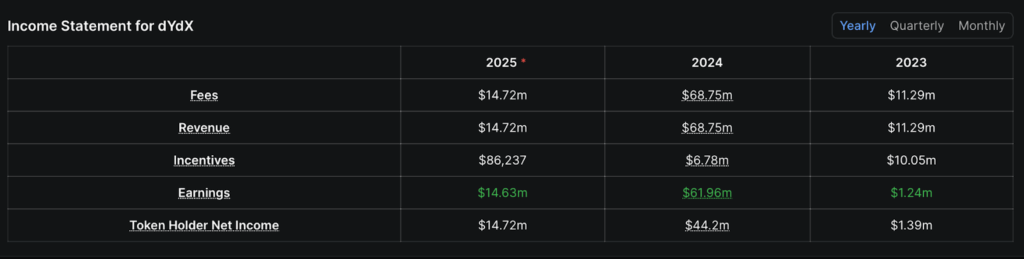
dYdX annual income statement
Source: DeFi Llama
Architecture
dYdX is designed to be a completely decentralized end-to-end Perp DEX. It runs on a p2p blockchain network using Cosmos SDK and CometBFT (formerly Tendermint). Notably, dYdX migrated from Ethereum L2 (StarkWare) to its own Cosmos SDK-based chain for sovereignty and decentralization.
GMX: The Liquidity Pool DEX
Image source: GMX
GMX is the only liquidity pool DEX in this deep dive. So far, GMX has raised a total of $10.5 million, with a notable $9.6 million grant from the Arbitrum Foundation back in 2023. The market cap of the $GMX token currently stands at $102.96 million, while the total value locked (TVL) in the protocol is at $450.27 million.
Spot and Perpetuals Trading
Being a liquidity pool DEX model, GMX operates as an Automated Market Maker (AMM). This means that the DEX leverages pooled assets to facilitate crypto perpetual trading. The beauty of this approach is that it provides an opportunity for DeFi users to earn yield for liquidity provision, while supporting traders to operate in capital-efficient markets. At the moment, GMX allows DeFi traders to access 70+ assets with a leverage of up to 100x.
Unique Value Proposition
GMX’s UVP is driven by the DEX’s multichain support: the project launched on Arbitrum, but has since expanded to Solana’s ecosystem as well. This Perp DEX also features network fee subsidies, cross-margin and cross-collateral support and scaling liquidity via net open interest.
Architecture
GMX’s V2 architecture uses automated GLV (Liquidity Vault) pools and market-specific GM pools to dynamically bootstrap long/short backing liquidity and capture trading, borrowing and liquidation fees for liquidity providers.
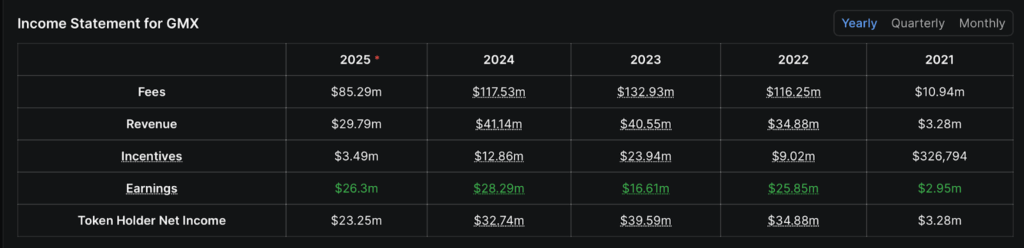
GMX annual income statement
Source: DeFi Llama
Strategic Differentiation and Positioning Overview
| Feature | Grvt | dYdX | Hyperliquid | GMX | Lighter |
| Core Architecture | zkSync L3 Validium | Cosmos SDK App Chain | Custom L1 | Arbitrum L2 | zk-rollup |
| Matching Model | Off-chain CLOB | On-chain CLOB | On-chain CLOB | AMM/LP | On-chain verified matching |
| TPS / Latency | 600k / <2ms | 200k / <1s | |||
| Privacy | Yes (Validium) | No | No | No | Partial |
| Max Leverage | 50x | 50x | 50x | 100x | – |
| Product Suite | Perps + Strategy Market | Perps | Perps + Copy Vaults | Perps + Spot | Perps |
Comparison of LP Vault Strategies
As market volatility increases and it becomes less predictable to allocate capital with conviction, most traders are better off with yield-generating strategies that combine stablecoin exposure with potential upside through LP vault participation.
| Platform | Description(Source of Yield) | Performance (APY) | Qualifying Restrictions | Lock Up | TGE-d? |
| Hyperliquid(HLP) | Portion of trading fees from market making and liquidations – Yield that investor earns pro rata of their share in the vault | ~10.1%(Source: hypurrscan.io) | None – anyone can invest | 4 days | Yes |
| Grvt(GLP) | Delta neutral, market-making strategy | ~48%(Backtested over 6 months) | Individual investment cap scales with lifetime trading volume | 2-7 days | No |
| Lighter(LLP) | Market making and liquidation fees | ~45.84% (as of 27 Oct) | Individual investment cap scales with lifetime trading volume | None | No |
| EdgeX(eLP) | Market making, liquidation fees, trading fees | ~57% (Annualized, based on September’s returns) | None, but eligible yield for amount deposited by an individual is capped at 20k | 2-7 days | No |
| Paradex(Gigavault) | Market making, trading fees | ~24.4% (as of 27 Oct) | None | 1 day | No |
| Variational(OLP) | Market making | Not open to the public yet | No | ||
| Extended | Market making, liquidation fees, trading fees | ~12% (as of 6 Oct) | Individual investment cap scales with points earned in previous epoch | 1 day | No |
| Pacifica | No LP Vault Strategy | No | |||
| Hibachi | No LP Vault Strategy | No | |||
Performance (APY):
In mid-October, the crypto market experienced a record $19 billion in liquidations; this event was a stress test for most liquidity strategies. During this period, Lighter’s LLP strategy posted a 5.35% drawdown, attributed to the loss of three transaction batches. Despite that setback, it still ranks third overall, maintaining a 45.84% APY.
EdgeX’s eLP leads the pack with a 57% annualized return, though this figure is based solely on September’s monthly performance. Meanwhile, Grvt’s newly launched GLP, which has undergone six months of backtesting, recorded a 48% APY, positioning it in second place.
Risk Profile:
From a risk-adjusted standpoint, Hyperliquid’s moderate 10% is most conservative, but more time-tested than the rest. Grvt’s GLP is also the only LP vault that explicitly declares a delta-neutral market-making strategy. This approach suggests an emphasis on hedged exposure and controlled volatility, which could appeal to investors seeking stable yield in a high-leverage environment.
Liquidity and Lockups:
In terms of capital mobility, Lighter’s LLP offers the most flexibility, enabling instant withdrawals. Paradex and Extended follow with 24-hour lockups, balancing accessibility with risk management. Grvt’s GLP, by contrast, features a 2–7 day withdrawal period, reflecting its structured, vault-based design.
Airdrop Farming Considerations:
For investors evaluating LP participation through the lens of airdrop farming, timing becomes a critical factor. Both Lighter and EdgeX are widely expected to conduct their TGE events in Q4 2025, leaving a limited window for prospective LP participants. Hyperliquid has already completed its TGE and entered price discovery for $HYPE. This narrows the field to Grvt, Paradex, and Extended, among which Grvt has publicly stated plans for a Q1 2026 TGE.
Conclusion
The perpetual DEX market represents a maturing front in the DeFi ecosystem. This nascent market will likely witness a continued interest as we head into 2026, given that there are multiple upcoming TGEs. With projects like Hyperliquid, Grvt and Lighter introducing differentiated approaches to privacy, scalability and capital efficiency, the momentum is set to attract new liquidity that has been sitting along the sidelines in anticipation of a more structured decentralized derivatives market.
You May Also Like

Born Again’ Season 3 Way Before Season 2

Fed forecasts only one rate cut in 2026, a more conservative outlook than expected