

RealFi Will Turn Cardano Into A $1 Billion DeFi Powerhouse By 2026: Hoskinson
Broadcasting on November 11 from “warm, sunny Colorado,” Cardano founder Charles Hoskinson said he expects RealFi to become the dominant liquidity engine across the Cardano–Midnight stack and push on-chain value to the billion-dollar mark within the next year. “RealFi will be the TVL monster for Cardano and Midnight alike. Billions and billions of dollars,” he said, adding a concrete target: “I want a TVL of over a billion dollars by the end of 2026.”
How Hoskinson Wants To Achieve A $1 Billion Cardano TVL
The pledge situates RealFi—Cardano’s long-trailed push into micro-lending and real-world credit rails—as the centerpiece of a broader liquidity plan that spans Bitcoin inflows, privacy-preserving DeFi on Midnight, and trustless cross-chain settlement.
Hoskinson described Midnight as a fourth-generation crypto platform designed for “rational privacy, selective disclosure, and cooperative economics,” positioning it as a neutral L2-to-everyone that routes identity, compliance and privacy logic off-chain while settling into whichever networks hold users and liquidity. “Midnight’s dream is to be a layer 2 to everyone. You can deploy into Ethereum, you can deploy into Solana, you can deploy into Cardano,” he said.
He tied that architecture directly back to ADA demand and stake-pool economics. “Midnight exists as a smart contract on Cardano […] If Midnight is heavily used, it creates ADA usage,” Hoskinson said. Fees may be abstracted, but “there has to be ADA at the end of the rainbow,” with Midnight’s staking paying the Knight token to SPOs on Cardano so “you make ADA and Knight.” He argued this design increases transaction load on Cardano, broadens listings for Cardano-native assets, and opens “new revenue streams for stake pool operators.”
On interoperability, Hoskinson said the final stage of the Midnight rollout includes a bidirectional recursive-SNARK bridge with Cardano that removes traditional bridge operators. “On the Cardano side, we added BLS support […] both sides will have trustless bridging capability.”
He paired that with performance claims—“5,000 TPS and sub-second block time” for the proof-aggregation role—and fast settlement once Ouroboros Peras lands, framing Midnight as a proof engine and coordination layer that can fold the state of connected chains and return constant-size proofs “validated on a cell phone.”
The liquidity plan extends to Bitcoin and RealFi. On Bitcoin DeFi, Hoskinson said the team has “been able to source more than 24,000 BTC” that could move, while acknowledging the gating items are yield products and finalizing the technology stack. His RealFi comments were unequivocal: the initiative is “going to be a huge [expletive] thing next year,” with smart contracts “being written right now,” and he reiterated the thesis that peer-to-peer micro-lending across Africa, South America and Southeast Asia can anchor on-chain credit flows. “Billions and billions of dollars,” he said.
Midnight’s go-to-market cadence is built around privacy-first DeFi and cross-chain composability. Hoskinson wants privacy-enabled stablecoins and DEXs on Midnight and was explicit about his distaste for centralized, asset-backed stables: “They can be frozen at any time […] That’s not a cryptocurrency.” He pointed to algorithmic, private designs as the preferred path and said oracles and bridges will arrive via decentralized integrations rather than bespoke native rewrites. “When chainlink? […] We can just use a trustless bridge and proofs and trusted execution environments to ferry the information over.”
He also highlighted early traction metrics and community programs designed to accelerate adoption. On Midnight’s scavenger hunt, he claimed “in 21 days, more compute has been expended […] than the first few years of Bitcoin,” with detailed numbers promised at the upcoming Midnight Summit near London. For ecosystem growth, he plans to recruit and pay 500 Midnight ambassadors in 2026, funneling part of their remuneration into Midnight DeFi and targeting “hundreds of thousands of monthly active users” and significant cross-chain transaction flow.
The AMA featured an extended critique of the Cardano Foundation’s governance and incentive structure, which he argued has impeded critical integrations such as stablecoins. “It’s the wrong structure, wrong governance, wrong leadership,” he said, calling for community-elected board oversight and published KPIs. He contrasted that with what he called “tough love” for a maturing protocol: “Cardano’s grown up. It needs to go to college […] You never abandon your children. You just fundamentally change your relationship.”
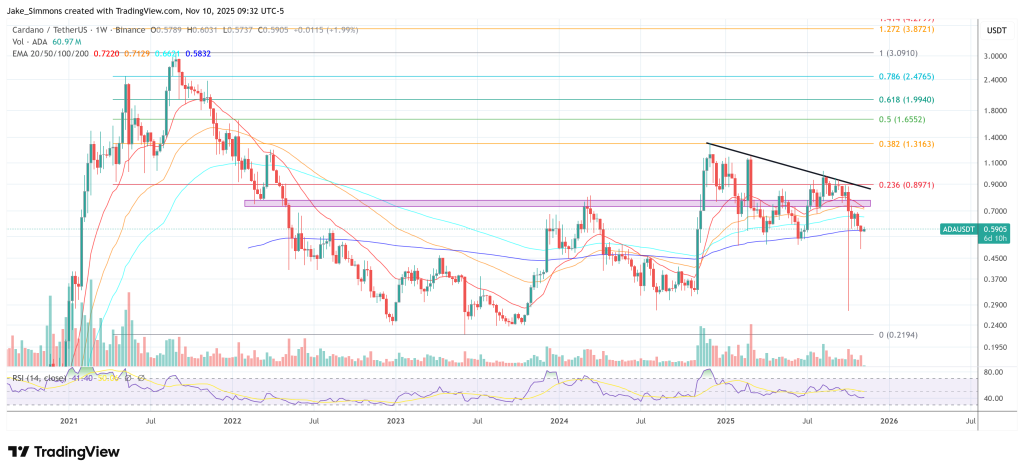
At press time, ADA traded at $0.59.
You May Also Like

Cashing In On University Patents Means Giving Up On Our Innovation Future

XRP Ledger Unlocks Permissioned Domains With 91% Validator Backing
