Quick Facts: ➡️ Bitcoin continued with its downtrend after it sank below $90K in the last 24 hours, leading to over $500M worth of positions liquidated. ➡️ It also saw a death cross, where the short-term MA went below the long-term one, which could signal further drops ahead. ➡️ Market volatility often highlights Bitcoin’s network […]Quick Facts: ➡️ Bitcoin continued with its downtrend after it sank below $90K in the last 24 hours, leading to over $500M worth of positions liquidated. ➡️ It also saw a death cross, where the short-term MA went below the long-term one, which could signal further drops ahead. ➡️ Market volatility often highlights Bitcoin’s network […]

Is Another Bitcoin Crash Coming? Why Network Health Is the Real Issue and How Bitcoin Hyper Can Help

2025/11/18 18:13
4 min read

Quick Facts:

  • ➡ Bitcoin continued with its downtrend after it sank below $90K in the last 24 hours, leading to over $500M worth of positions liquidated.
  • ➡ It also saw a death cross, where the short-term MA went below the long-term one, which could signal further drops ahead.
  • ➡ Market volatility often highlights Bitcoin’s network limitations, such as slow speeds and high fees during peak traffic.
  • ➡ Bitcoin Hyper offers a Layer-2 solution that brings Solana-like speed and smart contract functionality to the Bitcoin ecosystem.

Market volatility is stirring again, leaving many traders asking the same question: will Bitcoin ($BTC) crash again? While price action dominates headlines, a deeper issue often fuels market anxiety. Bitcoin’s own network limitations, like slow transaction speeds and high fees, can amplify panic.

In the last 24 hours, $BTC sank below $90K, wiping out $568.08M worth of $BTC positions, with $406.32M longs accounting for a bulk of the liquidations.
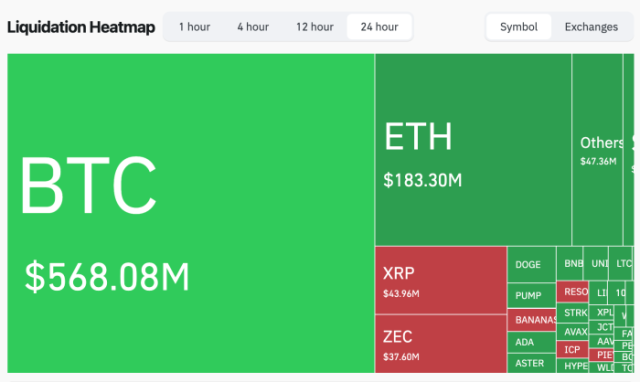
Bitcoin liquidations via Coinglass.

In addition, the coin drew a death cross, where its short-term moving average (MA) dropped below its long-term MA. This signals that a further slide could occur.

When the market moves quickly, the Bitcoin network often struggles to keep up. Transaction confirmation times can stretch from minutes into hours, while fees – or gas – can skyrocket. This congestion creates a bottleneck, trapping users who want to move assets to exchanges to sell or for cold storage for safety.

This isn’t just an inconvenience; it’s a critical flaw that can exacerbate a sell-off. If you can’t move your $BTC when you need to, you can’t react quickly to market changes.

This fundamental scalability problem has long been Bitcoin’s biggest challenge, preventing it from supporting a vibrant ecosystem of decentralized applications (dApps).

That reality is now changing. A new wave of innovation is focused on building Layer-2 solutions that inherit Bitcoin’s security while dramatically improving its performance. These protocols aim to solve the very issues that contribute to network stress during a potential Bitcoin crash.

Bitcoin Hyper ($HYPER) is a project leading this charge by bringing unprecedented speed and smart contract functionality to the original blockchain.

Bitcoin Hyper Unlocks a High-Speed Layer for $BTC

Bitcoin Hyper ($HYPER) is developing a modular architecture that finally solves Bitcoin’s core limitations. Once it launches, it will leverage Bitcoin Layer-1 for settlement, while a high-performance Layer-2 handles transaction execution. This design brings Solana-level speed directly to the Bitcoin ecosystem.

At its core is the integration of the Solana Virtual Machine (SVM), renowned for its parallel processing capabilities. This will allow Bitcoin Hyper to execute smart contracts quickly and cheaply, something impossible on Bitcoin’s base layer.

The market has taken notice of this breakthrough. Its ongoing presale has already attracted significant capital, raising an impressive $27.8M. On-chain data shows a whale buy worth over $500K, signaling that smart money sees its long-term potential.

💡 To get a full lowdown on the project, be sure to check out our detailed Bitcoin Hyper review.

Building a DeFi and dApp Ecosystem on Bitcoin

The implications of this technology extend far beyond faster payments. By enabling smart contracts, Bitcoin Hyper will open the door for a full suite of decentralized applications to be built on Bitcoin for the first time.

This includes DeFi protocols for lending and staking, dynamic NFT platforms, and even complex on-chain games. Developers can use familiar tools like Rust to build and deploy dApps quickly.

The project will also provide a Canonical Bridge for seamless $BTC transfers between layers, ensuring liquidity and user access remain simple and secure.

Bitcoin Hyper’s native token, $HYPER, will be central to this new economy, enabling governance participation and staking rewards for those who help secure the network. With immediate staking available after its TGE, the project is building a community-driven ecosystem from day one.

For now, you can buy $HYPER tokens via the Bitcoin Hyper presale page for $0.013295 each. You can also stake them after your purchase to earn 41% APY in staking rewards.

💰 Discover how to join the $HYPER presale in our guide to buying Bitcoin Hyper.

Meanwhile, our Bitcoin Hyper price prediction sees a potential high of $0.20 for the token by the end of 2026. Naturally, various factors will have to come together to make this happen, such as meeting the project’s roadmap and launching a Layer-2 that truly delivers on this promise.

But don’t delay because a new price increase is imminent. So, act quickly, as this could be your last chance to buy $HYPER at a steep discount.

🚀 Join the Bitcoin Hyper presale today.

Disclaimer: This article is for informational purposes only and does not constitute financial advice. Please conduct your own research before investing in any cryptocurrency.

Authored by Bogdan Patru, Bitcoinist – https://bitcoinist.com/bitcoin-crashes-below-90k-bitcoin-hyper-presale

Market Opportunity
RealLink Logo
RealLink Price(REAL)
$0.05243
$0.05243$0.05243
-3.35%
USD
RealLink (REAL) Live Price Chart
Disclaimer: The articles reposted on this site are sourced from public platforms and are provided for informational purposes only. They do not necessarily reflect the views of MEXC. All rights remain with the original authors. If you believe any content infringes on third-party rights, please contact [email protected] for removal. MEXC makes no guarantees regarding the accuracy, completeness, or timeliness of the content and is not responsible for any actions taken based on the information provided. The content does not constitute financial, legal, or other professional advice, nor should it be considered a recommendation or endorsement by MEXC.

You May Also Like

White House meeting could unfreeze the crypto CLARITY Act this week, but crypto rewards likely to be the price

White House meeting could unfreeze the crypto CLARITY Act this week, but crypto rewards likely to be the price

White House stablecoin meeting could unfreeze the CLARITY Act, but your USDC rewards may be the price The newly confirmed Feb. 10 White House meeting on stablecoin
Share
CryptoSlate2026/02/09 18:48
Coral Protocol launches Coral V1, introducing on-chain Solana payments for devs

Coral Protocol launches Coral V1, introducing on-chain Solana payments for devs

Coral Protocol has launched Coral V1, a new remote agent system that simplifies multi-agent software deployment. Developers building on the project now have production-ready agents that can be rented, customized, and combined with local solutions.  According to a press statement shared with Cryptopolitan on Friday, the platform introduces new capabilities to accelerate artificial intelligence (AI) […]
Share
Cryptopolitan2025/09/19 20:01
U.S. Senate panel to hold crypto tax policy hearing on October 1

U.S. Senate panel to hold crypto tax policy hearing on October 1

The Senate Banking Committee will hold a public hearing on October 1 to go after one of the most confusing messes in U.S. finance right now:- how crypto gets taxed. The committee confirmed the date in a notice first reported by Eleanor Terrett, and witnesses lined up include Jason Somensatto, Policy Director at Coin Center; Andrea S. Kramer, founding member of ASKramer Law; Lawrence Zlatkin, Vice President of Taxation at Coinbase; and Annette Nellen, Chair of the Digital Asset Taxation Working Group under the American Institute of Certified Public Accountants. This hearing is meant to address a problem that’s pissed off crypto users for years, which is why every small crypto transaction, even a few dollars, triggers a tax headache. The Senate is being pushed to finally look at de minimis exemptions, which would let people use crypto for daily stuff (like grabbing a coffee) without reporting every damn thing to the IRS. Trump administration backs small crypto tax relief Cryptopolitan reported back in July that White House Press Secretary Karoline Leavitt had said that the Trump administration still wants to push through the de minimis exemption in upcoming laws. “The president did signal his support for de minimis exemption for crypto and the administration continues to be in support of that,” Karoline said. She explained that right now, using crypto for basic purchases is too complicated because of tax rules, but a change could make everyday payments smoother. “We are definitely receptive to it to make crypto payments easier and more efficient for those who seek to use crypto as simple as buying a cup of coffee — of course, right now, that cannot happen, but with the de minimis exemption perhaps it could in the future.” Karoline also revealed that President Trump plans to host a signing ceremony for the GENIUS Act, a stablecoin-focused bill expected to pass soon. That bill is part of his administration’s broader goal to make the U.S. “the crypto capital of the world.” The Senate has already tried and failed to deal with this issue before. In 2020, two Democratic lawmakers proposed the Virtual Currency Tax Fairness Act, which aimed to ignore tax on crypto gains below $200. It didn’t even make it to a vote. A similar version in 2022 also died on the floor. Then came a broader bill in 2025 called the One Big Beautiful Bill Act, which covered everything from taxes to border control. Senator Cynthia Lummis, a Republican from Wyoming, tried to get a crypto exemption added in for gains under $300, but that proposal got scrapped before the final bill passed. President Trump signed it into law on July 4 without the crypto language attached. Right now, the IRS says every single crypto transaction must be reported, even if there’s no gain or the amount is tiny. If you spend $5 of bitcoin, that’s a taxable event. The idea behind the de minimis exemption is to cut through that nonsense and give users room to breathe. But it hasn’t been easy. Lawmakers face real obstacles. First, the federal government depends on tax income. If it suddenly lets millions of small crypto transactions go untaxed, that means less money coming in. And there’s no sign yet of how they’ll offset that shortfall. Even with strong voices like Cynthia and Jason in the room, the Senate still hasn’t landed on a solution. October 1 might give them a chance to do something useful. Or it might be another meeting where everyone talks and nothing happens. Get seen where it counts. Advertise in Cryptopolitan Research and reach crypto’s sharpest investors and builders.
Share
Coinstats2025/09/25 09:51