At TechSparks 2025, Rajesh Ramachandran, ABB's Global Chief Digital Officer, explains how the industrial giant is scaling autonomous operations across 15 industries while maintaining human supervision at the core of every AI-powered decision.At TechSparks 2025, Rajesh Ramachandran, ABB's Global Chief Digital Officer, explains how the industrial giant is scaling autonomous operations across 15 industries while maintaining human supervision at the core of every AI-powered decision.

ABB's Rajesh Ramachandran on why AI won't replace humans but will make them better at their jobs
4 min read

When three captains can oversee 6,000 marine vessels across the globe, or two operators can manage 3.8 million solar panels generating 2 billion watts of clean power, something fundamental has shifted in how industries operate. But, contrary to dystopian predictions about AI replacing workers, this transformation isn't about eliminating humans from the equation. It's about amplifying their expertise to unprecedented levels.

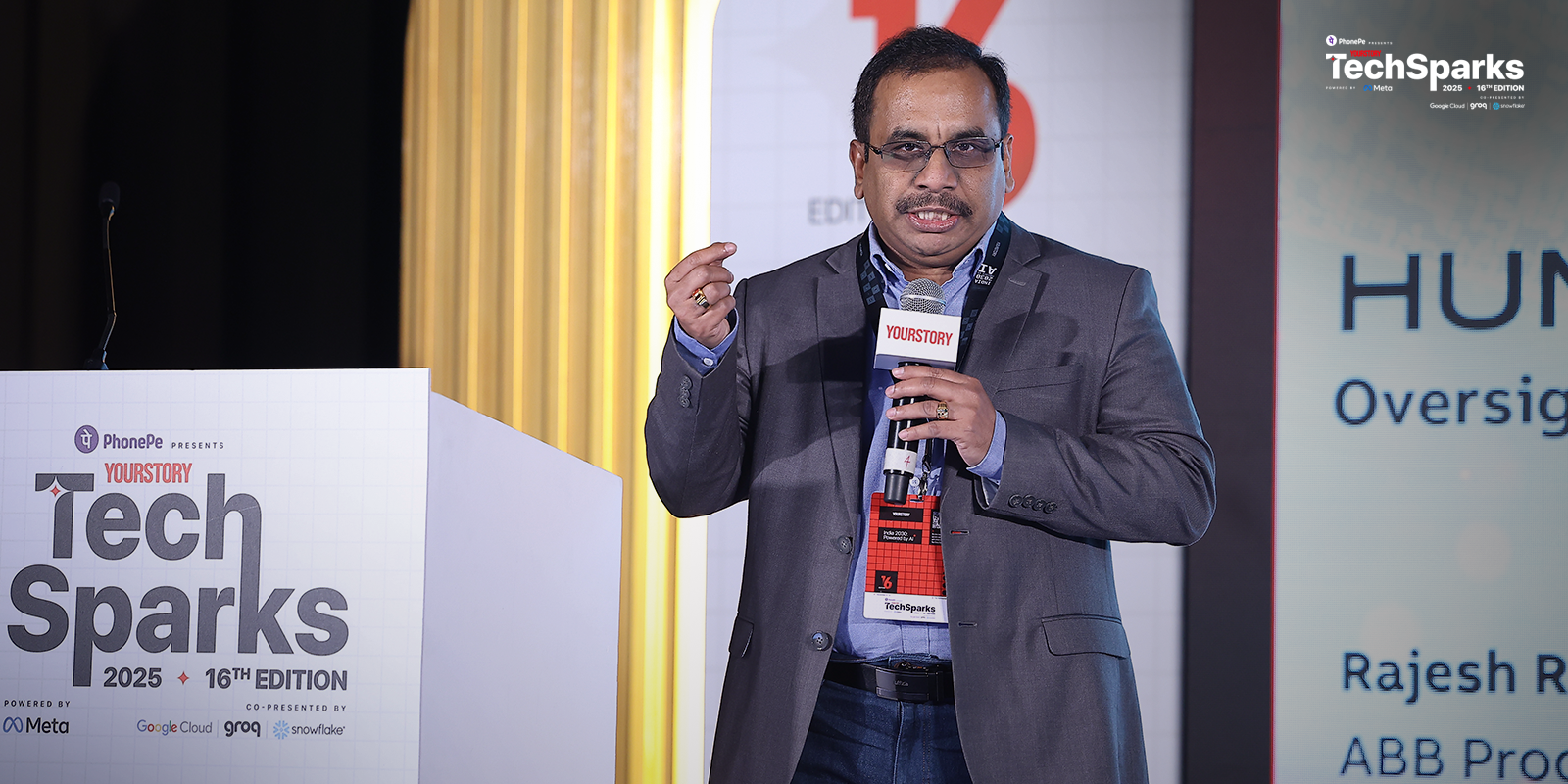
At YourStory's TechSparks 2025, Rajesh Ramachandran, Global Chief Digital Officer at ABB, delivered a keynote on ‘Human-Centered AI: Oversight without bottlenecks in the autonomous industry,’ outlining how the $40 billion industrial technology giant is navigating the complex transition from automation to autonomous operations while keeping humans firmly in the loop.

"If automation helps machines to get better, AI will make humans get better," Ramachandran told the audience. "It's not about replacing humans. Humans using AI will be replacing humans who are not using AI."

The anatomy of industrial AI

ABB's approach to autonomous operations rests on what Ramachandran calls "level four automation", a framework that maintains human supervision while allowing machines to execute tasks autonomously. This isn't a theoretical model. The company already operates a fleet operations center in Stockholm, Sweden, where a handful of experts provide insights for over 6,000 vessels, managing everything from voyage planning to fuel optimization and asset maintenance.

Similarly, ABB's control systems power the world's largest single-site solar plant in Abu Dhabi, where just two operators manage the entire facility using the company's Genix platform, which was developed in Bangalore. These aren't incremental improvements. They represent a

"We are responsible as one of the leaders to solve industrial problems, complex problems with AI," Ramachandran said. "We're fundamental reimagining of industrial operations.

not just doing pilots. This needs to be applied at scale for problems that need solving."

Beyond data crunching

What distinguishes ABB's industrial AI from consumer-facing applications is the integration of domain expertise with data science. Ramachandran explained that solving industrial problems requires combining first-principle models with data-driven approaches, which the company calls "ensemble learning".

Take precision cooling systems in data centers, which currently consume 10% of global electricity and are projected to reach 15% by 2030. ABB's solution doesn't rely solely on machine learning models crunching massive datasets. Instead, it combines thermodynamic and other physics-based models with data-driven approaches, requiring electrical engineers, chemical engineers, and data scientists to collaborate.

"It's just not about getting the data to solve problems," Ramachandran emphasized. "It's a combination of data and domain expertise."

This philosophy extends to ABB's Genix Copilot, an AI-powered platform that integrates analytical and generative AI. The copilot has transformed how field engineers work, providing 24/7 expertise through 25 different AI agents that analyze error codes and provide recommendations, reducing troubleshooting time by 80%.

The human element

Throughout his keynote, Ramachandran pushed back against the narrative that AI will eliminate programming jobs, citing Bill Gates' recent statement that programming is one profession that won't disappear due to AI. His own career trajectory supports this view. After 33 years across Siemens, Oracle, eBay, PayPal, and SAP, he joined ABB seven years ago, drawn by the opportunity to make a tangible societal impact through efficiency, reliability, and sustainability.

"When you connect technology with a purpose, then you make a really transformative impact," he said.

ABB's operations span 15 industries, from energy and manufacturing to transportation and space exploration. The company works on carbon footprint reduction through electrification, uses AI to monitor industrial emissions via satellite, and deploys drones for gas pipeline leakage detection using spectrographic and chromatographic technologies combined with cloud-based AI analysis.

In underground mines in South America, ABB manages operations remotely from 1,000 km away, controlling millions of signals and enabling autonomous operations across most of the value chain. What was once the domain of on-site operators has evolved into consultant roles where human expertise guides AI-powered decision-making systems.

The road ahead

With 40% of ABB's $36 billion revenue coming from services, the productivity gains from AI have massive implications. Ramachandran noted that the company has identified 200 use cases for AI applications, with 50 currently deployed at scale and 150 in development.

ABB is actively seeking partnerships with startups and technology providers. The company runs programs like Sinne Link, which funds emerging startups to tackle industrial challenges. Two weeks before TechSparks, ABB selected 10 startups through a challenge program to work on specific problems.

"The automation to autonomous journey is such a massive opportunity for industries, technology providers, and people who would like to define problem statements and build solutions," said Ramachandran, inviting collaboration across the ecosystem.

ABB's approach to AI offers a blueprint for how industries can embrace autonomy without losing sight of human judgment, accountability, and expertise. In this vision, the future isn't about choosing between humans and machines. It's about designing systems where both operate at their highest potential.

-
Disclaimer: The articles reposted on this site are sourced from public platforms and are provided for informational purposes only. They do not necessarily reflect the views of MEXC. All rights remain with the original authors. If you believe any content infringes on third-party rights, please contact [email protected] for removal. MEXC makes no guarantees regarding the accuracy, completeness, or timeliness of the content and is not responsible for any actions taken based on the information provided. The content does not constitute financial, legal, or other professional advice, nor should it be considered a recommendation or endorsement by MEXC.

You May Also Like

Cashing In On University Patents Means Giving Up On Our Innovation Future

Cashing In On University Patents Means Giving Up On Our Innovation Future

The post Cashing In On University Patents Means Giving Up On Our Innovation Future appeared on BitcoinEthereumNews.com. “It’s a raid on American innovation that would deliver pennies to the Treasury while kneecapping the very engine of our economic and medical progress,” writes Pipes. Getty Images Washington is addicted to taxing success. Now, Commerce Secretary Howard Lutnick is floating a plan to skim half the patent earnings from inventions developed at universities with federal funding. It’s being sold as a way to shore up programs like Social Security. In reality, it’s a raid on American innovation that would deliver pennies to the Treasury while kneecapping the very engine of our economic and medical progress. Yes, taxpayer dollars support early-stage research. But the real payoff comes later—in the jobs created, cures discovered, and industries launched when universities and private industry turn those discoveries into real products. By comparison, the sums at stake in patent licensing are trivial. Universities collectively earn only about $3.6 billion annually in patent income—less than the federal government spends on Social Security in a single day. Even confiscating half would barely register against a $6 trillion federal budget. And yet the damage from such a policy would be anything but trivial. The true return on taxpayer investment isn’t in licensing checks sent to Washington, but in the downstream economic activity that federally supported research unleashes. Thanks to the bipartisan Bayh-Dole Act of 1980, universities and private industry have powerful incentives to translate early-stage discoveries into real-world products. Before Bayh-Dole, the government hoarded patents from federally funded research, and fewer than 5% were ever licensed. Once universities could own and license their own inventions, innovation exploded. The result has been one of the best returns on investment in government history. Since 1996, university research has added nearly $2 trillion to U.S. industrial output, supported 6.5 million jobs, and launched more than 19,000 startups. Those companies pay…
Share
BitcoinEthereumNews2025/09/18 03:26
VectorUSA Achieves Fortinet’s Engage Preferred Services Partner Designation

VectorUSA Achieves Fortinet’s Engage Preferred Services Partner Designation

TORRANCE, Calif., Feb. 3, 2026 /PRNewswire/ — VectorUSA, a trusted technology solutions provider, specializes in delivering integrated IT, security, and infrastructure
Share
AI Journal2026/02/05 00:02
Top Solana Treasury Firm Forward Industries Unveils $4 Billion Capital Raise To Buy More SOL ⋆ ZyCrypto

Top Solana Treasury Firm Forward Industries Unveils $4 Billion Capital Raise To Buy More SOL ⋆ ZyCrypto

The post Top Solana Treasury Firm Forward Industries Unveils $4 Billion Capital Raise To Buy More SOL ⋆ ZyCrypto appeared on BitcoinEthereumNews.com. Advertisement &nbsp &nbsp Forward Industries, the largest publicly traded Solana treasury company, has filed a $4 billion at-the-market (ATM) equity offering program with the U.S. SEC  to raise more capital for additional SOL accumulation. Forward Strategies Doubles Down On Solana Strategy In a Wednesday press release, Forward Industries revealed that the 4 billion ATM equity offering program will allow the company to issue and sell common stock via Cantor Fitzgerald under a sales agreement dated Sept. 16, 2025. Forward said proceeds will go toward “general corporate purposes,” including the pursuit of its Solana balance sheet and purchases of income-generating assets. The sales of the shares are covered by an automatic shelf registration statement filed with the US Securities and Exchange Commission that is already effective – meaning the shares will be tradable once they’re sold. An automatic shelf registration allows certain publicly listed companies to raise capital with flexibility swiftly.  Kyle Samani, Forward’s chairman, astutely described the ATM offering as “a flexible and efficient mechanism” to raise and deploy capital for the company’s Solana strategy and bolster its balance sheet.  Advertisement &nbsp Though the maximum amount is listed as $4 billion, the firm indicated that sales may or may not occur depending on existing market conditions. “The ATM Program enhances our ability to continue scaling that position, strengthen our balance sheet, and pursue growth initiatives in alignment with our long-term vision,” Samani said. Forward Industries kicked off its Solana treasury strategy on Sept. 8. The Wednesday S-3 form follows Forward’s $1.65 billion private investment in public equity that closed last week, led by crypto heavyweights like Galaxy Digital, Jump Crypto, and Multicoin Capital. The company started deploying that capital this week, announcing it snatched up 6.8 million SOL for approximately $1.58 billion at an average price of $232…
Share
BitcoinEthereumNews2025/09/18 03:42